Why Did Hang Ease Go Out of Business? The Real Story Behind the Shark Tank Hanger’s Collapse

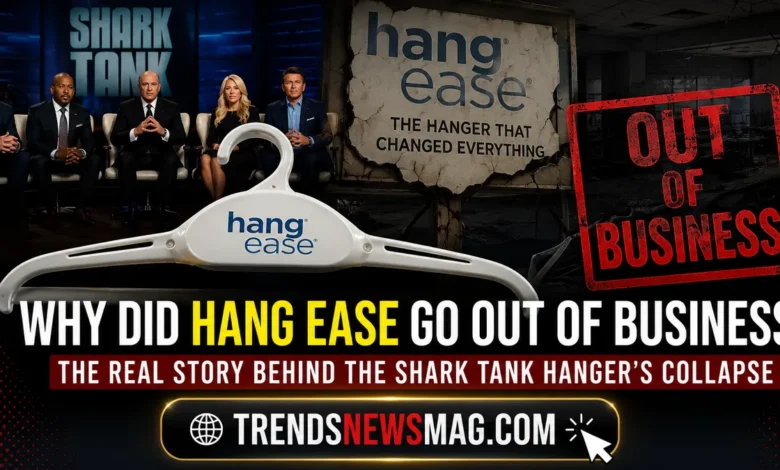
If you have spent any time watching reruns of Shark Tank, chances are you remember the young inventor who walked onto that stage with a hanger he designed back in the third grade. His name was Ryan Landis, and his product, Hang Ease, seemed destined for retail greatness. It had a working prototype, a patent, a spot on Walmart shelves, and a deal with two of the toughest investors on television, Mark Cuban and Lori Greiner. For a moment, it looked like the classic underdog story that Shark Tank fans love so much. Yet within a few years, the company had vanished almost completely. The website went dark, the social media accounts stopped posting, and the product disappeared from store shelves without so much as a press release.


So why did Hang Ease go out of business after such a strong start? The honest answer is not a single catastrophic mistake, but rather a slow accumulation of problems that, together, made survival nearly impossible. A patent that could not hold up under investor scrutiny, a Shark Tank deal that collapsed during due diligence, a founder who stepped away from the business for years to finish school, and a home organization market that grew more competitive and price-sensitive every year. Each of these factors on its own might have been survivable. Combined, they were fatal.
This article takes a deep, honest look at the entire Hang Ease story, from its humble beginnings as a school project to its national television debut and eventual quiet disappearance. We will explore exactly why did Hang Ease go out of business, what role the Shark Tank deal played in its downfall, how manufacturing and pricing challenges compounded the company’s struggles, and what happened to founder Ryan Landis after the business folded. Whether you are a longtime Shark Tank fan curious about the fate of one of its more memorable young entrepreneurs, or a business owner hoping to learn from another company’s mistakes, this is the complete picture of what really happened to Hang Ease.
The Origin Story of Hang Ease and Ryan Landis’s Invention
Every great business story starts somewhere, and for Hang Ease, that starting point was a third-grade classroom assignment. Around 2003, Ryan Landis was tasked by his teacher with identifying an everyday object in his home that could be redesigned or improved. Most kids in that situation come up with something forgettable. Ryan came up with something genuinely clever. He noticed that traditional rigid hangers were a constant source of frustration in his household. Shirts would snag on the hanger’s shoulders, collars would stretch out of shape, and sometimes the hanger itself would snap under the pressure of pulling a garment free.
His solution was elegantly simple. He designed a hanger with a hinge built into the middle of the frame. Instead of fighting against a rigid structure, the hanger would collapse inward when a shirt was pulled downward, allowing the garment to slide off smoothly without catching or stretching. It was the kind of idea that makes people slap their foreheads and say, “why didn’t I think of that?” That reaction is exactly why the invention eventually caught the attention of adults outside his immediate family. A parent connected to Ryan through school activities happened to run a business that supplied products to major retailers, and that parent recognized real commercial potential in what had started as a simple homework assignment.
What makes the Hang Ease origin story so compelling is the authenticity behind it. This was not a product dreamed up by a marketing team trying to identify a gap in the closet organization market. It was a genuine solution to a genuine problem, invented by someone who experienced that problem firsthand every single day. That authenticity carried the brand a long way in its early years, helping it secure retail placement and eventually a spot on national television. But as we will see throughout this article, a great origin story and a great product are not enough on their own to guarantee long-term business survival. Understanding why did Hang Ease go out of business requires looking past the charming beginning and into the operational and strategic decisions that followed.
The design itself was also protected early on, which gave the young founder and his family confidence that they had something defensible. A patent was filed to cover the collapsible hinge mechanism, and for a while, that patent served as the foundation of the entire business model. Investors and retail buyers alike were told that this was a proprietary design, something that could not simply be copied by a competitor overnight. As later events would prove, that assumption turned out to be far shakier than anyone initially realized, and it became one of the central reasons behind the company’s eventual collapse.
How Hang Ease Landed a Spot on Shark Tank
By the time Ryan Landis was a teenager, Hang Ease had already built a modest track record of retail success. The product had found its way onto shelves at Walmart and a handful of smaller retail chains, which is no small accomplishment for a product invented by a child. That kind of traction is exactly what television producers look for when scouting entrepreneurs for shows like Shark Tank. A young, articulate inventor with a working product, a patent, and real retail placement checks nearly every box that makes for compelling television.
Landis appeared on Shark Tank during Season 5, in an episode that would go on to become one of the more memorable young-entrepreneur segments in the show’s history. He pitched his collapsible hanger with confidence, explaining the third-grade origin of the idea and demonstrating how the hinge mechanism allowed clothing to slide off without damage. The panel of investors, often skeptical and blunt with adult entrepreneurs, softened considerably in the face of a well-prepared kid with a genuinely useful invention. That combination of charm and utility is a powerful one on Shark Tank, and it set the stage for what looked like a storybook outcome.
It’s worth pausing here to acknowledge just how difficult it is for any product, let alone one invented by a child, to make it as far as a national television pitch. Thousands of entrepreneurs apply to appear on Shark Tank every season, and only a small fraction ever get the opportunity to pitch on camera. The fact that Hang Ease made it that far speaks to the strength of the underlying idea and the genuine retail momentum the product had already built. But television exposure, however exciting, is only the beginning of the story, not the end of it. Understanding why did Hang Ease go out of business means recognizing that a great pitch and a memorable television moment do not automatically translate into a sustainable company.
The excitement of the episode also created expectations, both from viewers and from the Landis family, about what would come next. A successful pitch on Shark Tank often creates a temporary sales surge known informally as the “Shark Tank bump,” where viewers rush to purchase a product they just saw on television. Retailers and founders alike hope this initial wave of attention converts into lasting brand loyalty and repeat purchases. For Hang Ease, that bump did happen to some degree, but as later sections of this article will explain, converting a television moment into durable, long-term retail success proved to be a far bigger challenge than anyone anticipated.
Inside the Shark Tank Pitch: What Really Happened
When Ryan Landis stood before the panel of investors, he asked for financial backing in exchange for equity in his young company. What followed was a mix of genuine enthusiasm and pointed skepticism, which is fairly typical of how Shark Tank pitches unfold. Robert Herjavec was the first to pass on the deal, indicating that the product simply wasn’t a fit for his personal investment strategy. Kevin O’Leary followed shortly after, famously dismissing the hanger as “boring,” a comment that stung but did little to derail the momentum of the pitch. Barbara Corcoran also declined to participate, leaving two investors still in the running.
Mark Cuban and Lori Greiner both expressed genuine interest in the product and ultimately agreed to strike a deal with Landis. As one recap of the episode put it, Cuban and Greiner agreed to Landis’ deal, contingent on his patent being legitimate and covering, and that they have protection against competitors. That word “contingent” is doing an enormous amount of work in that sentence, and it foreshadows exactly why the Hang Ease story took the turn that it did. On television, the moment felt like an unambiguous win. Landis reportedly celebrated enthusiastically after the deal was struck, later saying he felt “really awesome” about working with two such high-profile investors on a product that had been part of his life since childhood.
What viewers at home did not fully appreciate in that moment was that a Shark Tank handshake deal is not the same thing as a finalized, funded business partnership. Every deal made on the show is followed by a due diligence period, during which the investors’ teams of lawyers and accountants dig into the company’s finances, legal protections, and operational realities. This is standard practice across the entire history of the show, and it is well documented that a meaningful percentage of on-air deals never actually close once due diligence begins. For Hang Ease, that due diligence period turned out to be where the real trouble started.
During the pitch itself, there was already a small but telling moment of friction. Lori Greiner mentioned that she had seen similar collapsible hangers on the market before, a comment that visibly surprised Landis in the moment. That single exchange, easy to overlook amid the excitement of a successful pitch, ended up being one of the earliest signs of a problem that would eventually unravel the entire deal. If a Shark with decades of product experience could immediately recall seeing comparable designs, it raised legitimate questions about how unique and defensible the Hang Ease patent truly was. Those questions did not go away once the cameras stopped rolling. If anything, they intensified.
Why the Shark Tank Deal Fell Apart
This is perhaps the single most important piece of the puzzle when trying to understand why did Hang Ease go out of business. The handshake agreement with Mark Cuban and Lori Greiner never actually closed. According to reporting that followed the episode’s airing, the deal collapsed sometime after the show aired, and Hang Ease’s website and social media presence went quiet not long afterward. This pattern, a promising on-air deal followed by silence, is unfortunately common among Shark Tank alumni, but it still represents a significant setback for any young company banking on that investment to fuel its growth.
The precise mechanics of why the deal fell through were never made fully public, which is also typical, since these negotiations are usually covered by confidentiality agreements. However, based on the concerns raised during the pitch itself, the strongest and most consistent explanation centers on the patent. Lori Greiner’s on-air comment about having seen similar hangers before was not just a passing remark; it pointed directly at the core vulnerability of the entire business. If the Hang Ease patent could not clearly and legally distinguish the product from existing designs already on the market, then the entire investment thesis behind the Cuban and Greiner deal became far riskier than it appeared during the excitement of the pitch itself.
Patent strength matters enormously to sophisticated investors, especially in a product category like hangers, where manufacturing is relatively simple and copying a design is not particularly difficult for a determined competitor. High-profile venture capitalists look for bulletproof legal moats that can protect an enterprise’s market valuation over multiple fiscal quarters. This protective strategy is visible across high-tech defense sectors, where companies scaling up industrial enterprise values—as tracked through the fluctuating momentum of Anduril stock indicators—rely heavily on proprietary tech barriers to secure their multi-million dollar venture backings. Mark Cuban and Lori Greiner are experienced enough to know that a weak patent means very little real protection against larger companies who could produce a similar product without technically infringing on the original design. If competitors could replicate the general concept, even without using the exact same hinge mechanism, the moat around the business would essentially disappear. That is a dealbreaker for investors who need some form of durable competitive advantage to justify putting serious money behind a small consumer products company.
There is also a broader lesson buried in this part of the Hang Ease story. Many young or first-time entrepreneurs assume that having “a patent” automatically means having strong legal protection. In reality, patents vary enormously in their scope and enforceability, which is why navigating the strict legal framework of the United States Patent and Trademark Office requires precise and defensible claims. A narrow patent that only covers a specific, easily redesigned mechanism offers far less protection than a broad patent covering the underlying functional concept. Whether the Hang Ease patent was too narrow, too easily challenged, or simply too similar to prior existing designs, the effect was the same: it was not strong enough to survive the scrutiny of due diligence, and the deal that once looked like the company’s ticket to national retail success quietly evaporated instead. When people ask why did Hang Ease go out of business, this collapsed deal and the lack of a secure contingent on his patent being legitimate agreement sit near the very top of the list of causes.
Why Did Hang Ease Go Out of Business? The Core Reasons Explained
At this point, it’s worth stepping back and laying out the full picture in one place, because the reasons behind the closure did not happen in isolation. They compounded on top of one another over time. Answering the question of why did Hang Ease go out of business requires looking at several overlapping factors rather than searching for one single smoking gun. There simply wasn’t one dramatic event that ended the company. Instead, there was a slow accumulation of pressures that made continued operation increasingly untenable.
The first major factor was the collapsed Shark Tank deal, discussed in detail above. Without the capital infusion and industry connections that Mark Cuban and Lori Greiner would have provided, Hang Ease lost access to resources that could have funded improved manufacturing, stronger marketing, and expanded retail distribution. Many small consumer products companies rely heavily on outside capital to scale beyond their initial, often modest, production runs. Losing that capital source at a critical early moment in the company’s development put Hang Ease at an immediate disadvantage compared to competitors with stronger financial backing.
The second major factor was a lengthy period of dormancy. Ryan Landis was still a young person when he appeared on the show, and like many entrepreneurs who invent something as children or teenagers, he eventually had to weigh the demands of running a manufacturing business against the demands of finishing his education. Reports indicate that the company went through roughly a seven-year period of inactivity, during which the brand’s retail relationships, marketing presence, and manufacturing partnerships largely fell apart. In a fast-moving consumer products market, seven years of silence is essentially a death sentence for brand awareness. Retail buyers move on to other suppliers, marketing momentum disappears entirely, and consumers simply forget the product exists.
The third factor was manufacturing cost and retail pricing. Even setting aside the collapsed investment deal and the years of dormancy, Hang Ease faced a fundamentally difficult economic reality. The collapsible hinge mechanism that made the product special also made it significantly more expensive to manufacture than a standard plastic hanger. That additional cost had to be passed along to consumers in the form of higher retail prices, and hangers are not typically viewed by shoppers as a category where they are willing to pay a significant premium. The fourth factor was competition. The home organization and closet accessory market includes massive, well-capitalized players such as Walmart’s private labels, Target, and IKEA, all of whom can produce similar or alternative products at a fraction of the cost. Together, these four forces created a business environment where survival became increasingly difficult, and eventually impossible. When a brand’s consumer outreach drops and retail distribution pauses, public consumer protection platforms and business registries begin flagging the company’s lack of operational updates. This drop in administrative status is common for stalling brands; in other industries, checking a company’s registration health on platforms like the MotoAssure BBB profile reveals how missing consumer complaints and unresolved profile records can signal to investors that an automotive or retail enterprise is quietly shutting down.
The Patent Problem That Sank Investor Confidence
It’s worth dedicating additional attention specifically to the patent issue, because it may be the single most instructive lesson buried within the entire Hang Ease story. When Ryan Landis first developed his hanger design, a patent was filed to protect the invention, and for years that patent formed the legal and financial backbone of the entire business. Retailers were told the product was proprietary. Investors were told the same thing. It was, in many ways, the company’s most valuable asset, more valuable even than the physical inventory sitting in warehouses.
The trouble is that a patent’s value is only as strong as its ability to actually stop competitors from doing something similar. During the Shark Tank pitch itself, Lori Greiner’s immediate recognition of similar hangers already on the market was a red flag that should not be underestimated. Greiner has built her career around evaluating consumer products, and her instinctive reaction suggested that the collapsible hanger concept, or something functionally close to it, was not nearly as novel or unprotected as the pitch had implied. Once due diligence began in earnest, that concern almost certainly escalated from a passing comment into a serious legal and financial red flag for the investing Sharks.
There’s an important distinction here between having a patent and having enforceable market exclusivity. A patent grants its holder specific legal rights, but only within the precise boundaries described in the patent’s claims. If a competitor can produce a functionally similar product using a slightly different mechanism, or if prior existing designs already covered similar functional territory, the patent’s real-world protective power shrinks dramatically. For a small company like Hang Ease, without deep pockets to fund expensive patent litigation against much larger competitors, a narrow or vulnerable patent essentially means the company has no meaningful way to prevent a big-box retailer from sourcing a similar collapsible hanger from an overseas manufacturer and selling it for a fraction of the price.
This is precisely the kind of risk that sophisticated investors like Mark Cuban and Lori Greiner are trained to identify before committing serious capital. It is entirely plausible, and consistent with everything publicly known about the situation, that the due diligence process surfaced exactly this concern, and that it became the primary reason the on-air handshake deal never converted into an actual signed and funded investment. When people search for why did Hang Ease go out of business, the patent weakness deserves to be treated as one of the foundational causes, because it directly triggered the loss of the company’s most promising funding opportunity.
Manufacturing Costs and Pricing Challenges

Even if the Shark Tank deal had gone through as originally announced, Hang Ease would still have faced a difficult structural challenge rooted in its manufacturing economics. Traditional plastic hangers are among the cheapest household products in existence, mass-produced by the billions using simple injection molding techniques that have been refined and optimized for decades. Producing a standard hanger costs manufacturers a matter of pennies, which is why consumers are accustomed to receiving them for free with clothing purchases or buying large packs for just a few dollars.
Hang Ease could not compete on that basis. Its collapsible hinge mechanism required additional components, more complex tooling, and more precise manufacturing tolerances to ensure the hinge would function reliably over repeated use without breaking. All of that added complexity translated directly into higher per-unit production costs. Some reporting suggests that Hang Ease hangers were priced somewhere between four and six times the cost of an ordinary hanger at retail, a gap that is genuinely difficult to overcome when consumers are shopping in a category they view as inherently low-value and utilitarian.
Consider the psychology of a typical shopper standing in a housewares aisle. Hangers are rarely an emotional or aspirational purchase. Shoppers are usually looking to solve a basic functional need as cheaply and quickly as possible, which is very different from, say, shopping for a kitchen gadget or a piece of furniture where consumers are more willing to pay a premium for perceived quality or innovation. For a premium-priced hanger to succeed, it typically needs to offer something transformative and immediately obvious in value, strong enough to overcome the instinct to grab the cheapest option on the shelf. Hang Ease’s core value proposition, preventing stretched collars and snagged fabric, was real and useful, but it may not have been dramatic enough in the eyes of the average shopper to justify paying several times more for a hanger.
There’s also the issue of profit margins once retail markups are factored in. Retailers typically apply significant markups to wholesale prices, meaning that even if Hang Ease’s own manufacturing margins were reasonable, the final shelf price seen by consumers could balloon to a point that discouraged purchases . For consumer brands, tracking high-volume transaction costs, digital retail point-of-sale systems, and wholesale processing metrics requires relying on specialized financial technology networks. Investors monitoring the financial health of these core commercial processors often evaluate shifts in Fiserv stock to gauge the broader health of retail consumer spending and merchant payment volumes. This kind of pricing squeeze is extremely common among small consumer products companies attempting to sell through major retail channels, and it represents yet another compounding pressure that helps explain why did Hang Ease go out of business, even setting aside the collapsed investment deal and the patent concerns discussed earlier.
The Seven-Year Dormancy That Killed Momentum
Timing matters enormously in retail and consumer products, and few factors damaged Hang Ease more severely than the extended period during which the business essentially went dormant. Ryan Landis was still young when he appeared on Shark Tank, and like many entrepreneurs who launch a business during their teenage years, he eventually had to make difficult choices about balancing school, personal development, and the demands of running a hardware manufacturing company. Reports describing his journey mention roughly a decade-long gap between his childhood invention and any meaningful renewed business activity, with a more specific seven-year period of complete business dormancy following the Shark Tank appearance itself.
In almost any industry, a multi-year gap in active operations is damaging. In consumer retail specifically, it can be catastrophic. Retail buyers at major chains like Walmart operate on tight planning cycles, constantly evaluating which products earn continued shelf space based on sales velocity, profitability, and consistency of supply. A supplier that goes quiet for an extended period, failing to restock inventory or communicate with buying teams, will almost certainly lose that shelf space to a competing product. Once lost, that shelf space is exceptionally difficult to win back, particularly for a small company without an established sales team or ongoing retail relationships to lean on.
Marketing momentum suffers just as badly during a period of dormancy. Whatever brand awareness Hang Ease built through its Shark Tank appearance and initial retail placement would have faded steadily with each passing year of inactivity. Consumers have short memories when it comes to niche household products, and without ongoing marketing investment, social media presence, or new product development, the Hang Ease name would have simply faded from public consciousness. By the time any renewed effort to revive the business might have been considered, the competitive landscape had shifted considerably, with new entrants and alternative solutions filling whatever gap in the market Hang Ease had once occupied.
This is a critical lesson for any founder who steps away from an early-stage business, whether due to school, health, family obligations, or any other legitimate life circumstance. Consumer products businesses, unlike some software or subscription-based companies, rarely have the luxury of pausing operations for years and then resuming as if nothing happened. Retail relationships, manufacturing partnerships, and consumer awareness all require continuous nurturing. When examining why did Hang Ease go out of business, this extended dormancy stands out as one of the most avoidable, yet most damaging, factors in the entire story.
Retail Competition and the Home Organization Market
Beyond the internal challenges facing Hang Ease specifically, it’s important to understand the broader competitive environment the company was operating within. The home organization and closet accessory market is enormous, and it includes some of the most powerful retail brands in the world. IKEA has built an entire global business around affordable, functional home goods, including a wide variety of hanger and closet storage solutions. Walmart and Target both maintain extensive private-label product lines covering nearly every household category imaginable, allowing them to offer functional alternatives at extremely competitive prices without relying on any single outside supplier.
For a small, independent brand like Hang Ease to compete against that level of retail infrastructure, it needed either a dramatically superior product, a significantly lower price point, or overwhelming brand loyalty strong enough to make consumers actively seek out the product by name. Unfortunately, the company’s economics worked against it on the pricing front, as discussed earlier, and the years of dormancy undermined any brand loyalty that might have developed. That left the product’s genuine functional advantages, the anti-stretch, anti-snag hinge design, as essentially the only differentiator remaining, and that alone proved insufficient to sustain long-term retail success against much larger and better-capitalized competitors.
Retail competition also extends beyond direct product competitors. Consumers facing closet organization frustrations have plenty of alternative solutions available to them beyond specialty hangers. Custom closet systems, stronger and more durable standard hangers, and various other organizational accessories all compete for the same consumer spending. As one industry analysis put it plainly, the home organization space is “one of the most saturated retail categories,” meaning that any single product, however clever, faces an uphill battle for sustained attention and shelf space.
There’s a broader trend worth noting here as well. Over the past decade, e-commerce and direct-to-consumer brands have reshaped how small companies compete in categories like this one. Businesses that once relied entirely on physical retail placement now have the option to build online sales channels, subscription models, or social-media-driven marketing campaigns to reach consumers directly, bypassing some of the gatekeeping power that major retailers hold. Whether Hang Ease could have used these tools to survive its retail struggles is impossible to know for certain, but the company’s prolonged dormancy meant it never had the opportunity to fully explore that path during the years when direct-to-consumer marketing was rapidly becoming a viable alternative for small consumer brands. This absence from the growing digital marketplace is another thread connecting directly back to the central question of why did Hang Ease go out of business.
A Timeline of Hang Ease’s Rise and Fall
Sometimes the clearest way to understand a complicated business story is to see it laid out chronologically. The table below summarizes the key milestones in the Hang Ease journey, from its origins as a school project through its eventual closure and the founder’s transition to a new career path.
| Year / Period | Key Event |
|---|---|
| Around 2003 | Ryan Landis invents the collapsible hanger concept as a third-grade school project |
| Mid-2000s to early 2010s | Hang Ease patent is filed; product gains placement in Walmart and smaller retail outlets |
| Season 5 (early 2010s) | Ryan Landis pitches Hang Ease on Shark Tank, securing a handshake deal with Mark Cuban and Lori Greiner |
| Shortly after airing | Due diligence reveals concerns about patent strength and product uniqueness; the on-air deal never officially closes |
| Following years | Website and social media accounts go inactive; the business enters an extended period of dormancy |
| Roughly seven-year gap | Little to no active operations; retail relationships and marketing presence largely dissolve |
| By late 2010s / early 2020s | Hang Ease is widely considered defunct, with no active product line or retail presence |
| 2022–2023 | Ryan Landis is confirmed to have moved on professionally, later earning an MBA from Rice University |
| 2026 (present) | Hang Ease remains out of business, though the founder’s story continues to be referenced as a well-known Shark Tank case study |
This timeline makes clear that the company’s decline was gradual rather than sudden. There was no single announcement of bankruptcy, no formal press release declaring closure. Instead, the brand simply faded from view over a period of years, which is a pattern seen fairly often among small consumer products companies that lose their primary source of capital and momentum early in their development.
What Happened to Ryan Landis After Hang Ease
While the business itself did not survive, the story of its founder took a genuinely positive turn, and it’s a part of the Hang Ease saga that deserves attention alongside the more difficult business lessons. Rather than viewing the company’s closure purely as a failure, it’s more accurate to describe it as a formative experience that helped shape Ryan Landis’s subsequent career path. Acquiring corporate acumen through high-stakes venture pitches open up extensive paths within massive global enterprises that value strategic risk management. Many corporate professionals utilize this exact blend of entrepreneurial history and advanced management degrees to climb corporate ladders, entering highly competitive corporate application pipelines such as Pfizer careers to manage major enterprise operations and supply infrastructures. According to available reporting, Landis went on to pursue higher education, eventually earning an MBA from Rice University around 2023.
That educational path led directly into a professional career in retail and merchandising, fields that align closely with the practical, hands-on lessons he learned while trying to get his own product onto store shelves years earlier. Reports indicate Landis has worked in high-level merchandising roles for major retail companies, including JCPenney and Neiman Marcus. There is a certain poetic symmetry to this outcome. The same retail industry that ultimately proved too competitive and too costly for his own small hanger business became the very industry where he built a successful professional career, this time working from within some of the largest retail organizations in the country rather than trying to break into their shelves as an outside supplier.
This trajectory offers an important and often overlooked perspective on business failure. It’s easy to focus exclusively on the financial and operational reasons why did Hang Ease go out of business, and those reasons are certainly worth understanding in detail. But it’s equally important to recognize that entrepreneurial ventures, even ones that ultimately close down, can generate immense value for their founders in the form of skills, industry knowledge, professional networks, and personal confidence. Landis didn’t walk away from his childhood invention as a failure; he walked away with firsthand experience navigating patents, retail negotiations, manufacturing logistics, and high-pressure investor pitches, experience that most business school graduates never get the chance to acquire before entering the workforce.
As one industry summary put it, Ryan continued his professional growth by pursuing an MBA from Rice University, proving that sometimes the most valuable outcome from entrepreneurship is the skills, experience, and confidence gained that enable success in related industries, even when the original venture doesn’t achieve its intended commercial goals. That perspective reframes the entire Hang Ease story in a more constructive light, without minimizing the very real business lessons embedded in its closure.
Lessons Entrepreneurs Can Learn From Hang Ease’s Closure
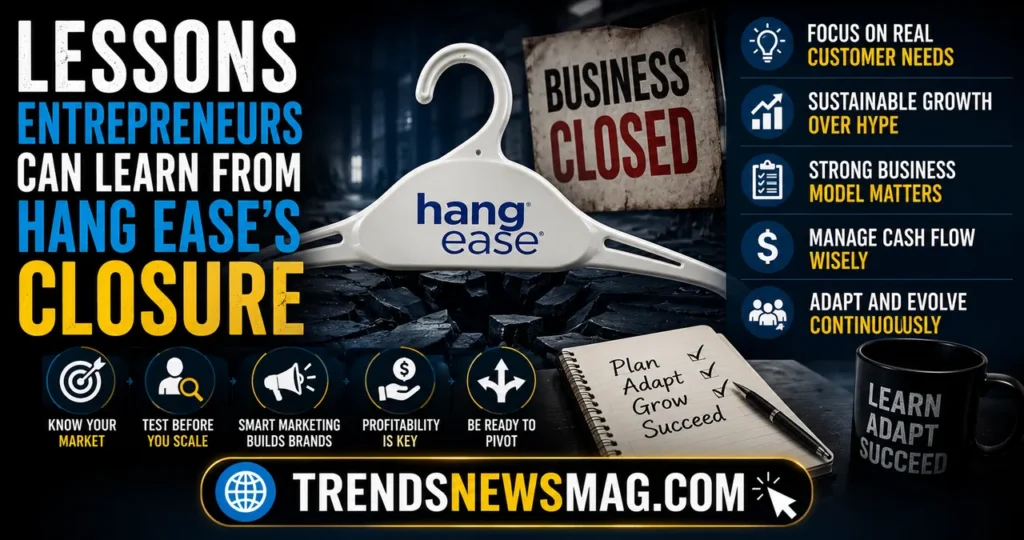
The Hang Ease story is frequently cited by business commentators and entrepreneurship educators as a valuable case study, precisely because it illustrates so many common pitfalls in a single, easy-to-follow narrative. Understanding why did Hang Ease go out of business offers practical, transferable lessons for anyone building a physical consumer products company, particularly those hoping to attract outside investment or secure major retail partnerships.
The first lesson centers on intellectual property protection. A patent is only as valuable as its ability to withstand scrutiny from sophisticated investors and to actually prevent competitors from copying the core innovation. Entrepreneurs should invest in thorough patent research and, where possible, seek broad protection covering the underlying functional concept rather than narrow protection covering only a specific mechanical implementation. As one analysis of the situation summarized it plainly, “a patent is only as strong as your ability to defend it in court against big rivals,” a lesson that applies far beyond the specific case of collapsible hangers.
The second lesson involves maintaining business momentum, even during periods of personal transition. Life circumstances, including education, family obligations, and health, will inevitably require founders to step back from their businesses at various points. But in consumer retail specifically, where relationships with buyers and consumer brand awareness require continuous reinforcement, an extended period of dormancy can be just as damaging as an outright business failure. Entrepreneurs facing a necessary pause should, whenever possible, consider bringing in partners, advisors, or even a temporary management team to keep essential operations running rather than allowing the business to go completely silent.
The third lesson relates to pricing strategy and manufacturing economics. Before scaling production or securing major retail placement, founders need a clear-eyed understanding of how their product’s cost structure compares to existing alternatives in the category, and whether their target consumers are genuinely willing to pay a premium for the added functionality being offered. A four-to-six-times price premium, as Hang Ease reportedly faced, requires an extraordinarily compelling value proposition to overcome typical consumer price sensitivity, particularly in a low-involvement category like household hangers.
The fourth and perhaps broadest lesson is that media exposure, however exciting and validating it feels in the moment, is not a substitute for a sound underlying business model. Appearing on a nationally televised show like Shark Tank generates enormous short-term attention, but that attention fades quickly if it isn’t backed by sustainable operations, strong unit economics, and durable competitive advantages. As one industry summary concluded, “the story also reflects how television exposure, while powerful, cannot guarantee sustainability. Success in the consumer market requires more than attention, it demands quality, consistency, and continuous evolution.” That single insight arguably captures the entire Hang Ease story in one sentence, and it remains just as relevant to today’s founders navigating viral social media moments as it was to a Shark Tank appearance from years earlier.
Conclusion
So, why did Hang Ease go out of business? After examining every piece of the story, from the third-grade classroom invention to the Shark Tank stage to the years of quiet dormancy that followed, the answer emerges as a combination of interconnected failures rather than any single fatal mistake. A patent that could not withstand investor due diligence led directly to the collapse of what should have been a transformative funding deal with Mark Cuban and Lori Greiner. That lost opportunity, combined with a lengthy period during which the founder stepped away entirely to focus on his education, allowed hard-won retail relationships and consumer brand awareness to erode almost completely. On top of that foundation of setbacks sat a genuinely difficult manufacturing and pricing challenge, one that made it extremely hard for a premium-priced hanger to compete against the mass-produced, ultra-cheap alternatives available at nearly every major retailer.
None of this diminishes the genuine cleverness of the original invention or the impressive achievement of a young inventor securing real retail placement and a nationally televised investment pitch. Hang Ease’s story is not really a story about a bad idea. It’s a story about how even a good idea, backed by real consumer demand and real retail traction, can still fail to become a sustainable business when patent protection is weak, capital access disappears, operational momentum stalls, and cost structures make competitive pricing nearly impossible. For entrepreneurs, students of business, and curious Shark Tank fans alike, understanding why did Hang Ease go out of business offers a genuinely valuable window into the gap that so often exists between a compelling pitch and a durable, long-term company. And for Ryan Landis himself, the closure of Hang Ease turned out to be far from the end of his story, serving instead as the foundation for a successful career built on the very retail lessons his childhood invention first taught him.
What was Hang Ease and who invented it?
Hang Ease was a collapsible clothes hanger built around a central hinge mechanism, invented by Ryan Landis as a third-grade school project around 2003. The design allowed the hanger to fold inward when a garment was pulled downward, letting clothes slide off smoothly without snagging or stretching fabric, a problem that traditional rigid hangers commonly caused. The invention later grew into a full consumer products business that achieved retail placement in Walmart and other stores before appearing on Shark Tank Season 5.
Did Hang Ease actually get a deal on Shark Tank?
Ryan Landis did secure a handshake agreement on the show with investors Mark Cuban and Lori Greiner, who both expressed genuine interest in the collapsible hanger concept. However, that on-air agreement was contingent on the company’s patent being verified as legitimate and defensible during the standard due diligence process that follows every Shark Tank deal. The deal ultimately never closed after the episode aired, which is one of the central reasons people continue to ask why did Hang Ease go out of business years after the episode originally aired.
Why did Hang Ease go out of business if the product worked well?
A functional, well-designed product is not enough on its own to guarantee business survival. Hang Ease faced a combination of challenges beyond the product itself, including a patent that couldn’t withstand investor scrutiny, the collapse of its primary Shark Tank funding opportunity, a multi-year period of business dormancy that damaged retail relationships and brand awareness, and manufacturing costs that made competitive retail pricing extremely difficult. When people ask why did Hang Ease go out of business, the answer is almost always this combination of financial, legal, and operational factors rather than any flaw in the core invention itself.
Is Hang Ease still available to buy anywhere today?
No, Hang Ease is not currently available through any major retailer or online marketplace. The company’s official website and social media accounts have been inactive for several years, and the product is no longer stocked at stores like Walmart or Target where it once had a retail presence. The business is widely considered defunct, with no active operations, product lines, or ongoing manufacturing.
What is Ryan Landis doing now after Hang Ease closed?
After stepping away from active operation of Hang Ease, Ryan Landis pursued higher education, eventually earning an MBA from Rice University. He has since built a professional career in retail merchandising, working with major companies including JCPenney and Neiman Marcus. His journey illustrates that the skills and experience gained through entrepreneurship, even when a specific venture like Hang Ease closes, can translate directly into meaningful long-term career success in related industries.
What can other entrepreneurs learn from the Hang Ease story?
The Hang Ease story offers several practical lessons for anyone building a physical consumer products company. These include the importance of securing broad, defensible patent protection rather than narrow claims that competitors can easily design around, the danger of allowing a business to go dormant for extended periods since retail relationships and consumer awareness require continuous reinforcement, and the necessity of carefully evaluating manufacturing costs against realistic consumer price sensitivity before scaling production. Ultimately, the central lesson behind why did Hang Ease go out of business is that a great product idea and even national television exposure are not substitutes for a sound, sustainable underlying business model.
Trending Today: [Mobile Homes For Sale Near Me]