SK Hynix Stock: A Complete 2026 Investor’s Guide to Price, Growth Drivers, and Long-Term Outlook

If you have followed global markets even loosely over the past year, you have almost certainly heard someone mention SK Hynix stock in the same breath as Nvidia, artificial intelligence, and the memory chip supercycle. What was once a relatively obscure South Korean semiconductor manufacturer known mainly to industry insiders has turned into one of the most talked-about names on global trading desks. The transformation has been so dramatic that even casual investors who have never opened a Korean brokerage account are now asking how to gain exposure to this company.


This surge did not happen by accident. SK Hynix sits at the center of a structural shift in computing, where memory chips are no longer just a commodity component but a critical bottleneck for artificial intelligence infrastructure. High-bandwidth memory, or HBM, has become the single most important product category in the semiconductor world, and SK Hynix has positioned itself as the dominant supplier to companies building the next generation of AI hardware. That positioning has translated into extraordinary financial results, a market valuation that recently crossed the trillion-dollar mark, and now a historic move onto the Nasdaq through an American Depositary Receipt listing.
In this guide, we will walk through everything a serious investor needs to understand about SK Hynix stock in 2026. We will look at the company’s business model, its recent price action, the forces driving its valuation, the risks that could derail the story, and how analysts on Wall Street and in Seoul are framing its future. Whether you are a beginner trying to understand why this stock keeps making headlines or a more experienced investor weighing whether to add exposure, this article is designed to give you a grounded, comprehensive picture.
Understanding SK Hynix and Its Place in the Global Chip Industry
SK Hynix traces its roots back to 1983, originally founded as Hyundai Electronics before a series of restructurings brought it under the SK Group umbrella in 2012. Today it operates as one of the “Big Three” memory manufacturers alongside Samsung Electronics and Micron Technology, and its products quietly power an enormous share of the world’s computing devices. The company manufactures dynamic random-access memory, commonly known as DRAM, along with NAND flash memory used in storage devices, and increasingly, the specialized high-bandwidth memory chips that have become essential for artificial intelligence workloads.
What makes SK Hynix stock particularly interesting is the breadth of its customer base. Major technology companies including Nvidia, Microsoft, Apple, Dell, and HP rely on SK Hynix memory in their products, ranging from smartphones and laptops to enterprise servers and networking equipment. This diversification across both consumer electronics and enterprise infrastructure gives the company multiple revenue streams, even as the market’s attention has narrowed almost entirely onto its AI-related business. Roughly 60% to 70% of SK Hynix’s revenue comes from DRAM, with the remaining 30% to 35% coming from NAND flash products, and the company holds the position of second-largest supplier globally in both categories. That second-place ranking in NAND is a relatively recent development, achieved after the company absorbed Intel’s NAND business in 2021, which pushed it from fourth place to second in that segment.
Governance and ownership also matter for anyone researching SK Hynix stock. SK Square, an investment holding company that was spun off from SK Telecom, is the largest shareholder of SK Hynix, currently holding about 20% of outstanding shares. This structure ties SK Hynix closely to the broader SK Group conglomerate, which has both advantages in terms of strategic support and complexities in terms of corporate governance that international investors sometimes find unfamiliar compared to standalone American tech companies.
The company is headquartered in Icheon, South Korea, with major manufacturing clusters also being built in Yongin and packaging facilities in Cheongju. These are not small projects. The scale of capital being deployed into new fabrication plants gives a sense of just how aggressively SK Hynix is trying to capture the current wave of demand, a point we will return to when discussing risks later in this article.
SK Hynix Stock Price Performance and the Historic 2026 Rally
There is no way to discuss SK Hynix stock honestly without acknowledging just how extraordinary its price action has been. As of early July 2026, shares on the Korea Exchange were trading in the range of roughly 2.3 million to 2.4 million Korean won, having pulled back somewhat from an all-time high above 2.9 million won reached earlier in the year. To put that move in context, the stock traded around 2.55 million won as of late June 2026, and had run more than tenfold off its prior cycle low, pushing the company’s market value past the $1 trillion mark.
Zooming out further, the numbers become almost hard to believe for a company that used to trade like a boring, cyclical hardware manufacturer. SK Hynix’s Korea-listed stock shot up 770% over the twelve months leading into July 2026, even after a 20% selloff from its June peak, a rally that actually outpaced Micron Technology’s own 700% surge over the same period. Separately, other reporting pegged the year-to-date gain at approximately 290% since the beginning of 2026, with the company’s market capitalization surpassing $1 trillion in May, making it the 15th company globally and the second in Asia to reach that milestone in the memory chip sector.
These figures tell you two things simultaneously. First, the market has fundamentally re-rated SK Hynix stock, moving it from a cyclical commodity chipmaker valuation toward something closer to an AI infrastructure company valuation. Second, that same re-rating has introduced enormous volatility. A stock that can rise sevenfold in a year can also give back a large chunk of those gains in a matter of days, and that is precisely what has happened on multiple occasions recently. In one particularly sharp move, the stock fell roughly 12% in a single session after reports surfaced that Nvidia might trim production of its upcoming Rubin AI chips and that SK Hynix itself was slowing the pace of its HBM4 capacity expansion. Just days before that, on the first two days of July, Samsung Electronics and SK Hynix shares both tumbled more than 9% as a broader chip stock rout spread from Wall Street into Asian markets.
Current market metrics reflect this volatility directly. According to trading data, SK Hynix carries a beta coefficient of 1.78 and shows roughly 8.94% volatility, alongside a market capitalization around 1,717.62 trillion won that had actually decreased by more than 12% over the prior week. A beta above 1.7 means the stock tends to swing considerably more than the broader market in both directions, which is an important consideration for anyone thinking about position sizing.
Why SK Hynix Stock Has Become an AI Infrastructure Bet
To understand why SK Hynix stock behaves more like a high-growth technology name than a traditional hardware manufacturer these days, you have to understand high-bandwidth memory. HBM chips are stacked memory modules that sit physically close to graphics processing units, allowing for dramatically faster data transfer speeds than conventional memory. This matters enormously for training and running large artificial intelligence models, where the bottleneck is often not raw computing power but how quickly data can move between memory and processor.
SK Hynix identified this opportunity early and invested heavily, and the payoff has been remarkable. The company commands a commanding share of this market, with figures cited variously between roughly 60% of the global HBM market according to Counterpoint research and 57% of global high-bandwidth memory revenue as of the fourth quarter of the prior year, according to Reuters, with Samsung and Micron splitting the remainder. Either way, SK Hynix is unambiguously the market leader in the single product category that AI hyperscalers care about most.
Its relationship with Nvidia deserves particular attention because it is central to the SK Hynix stock investment thesis. SK Hynix announced a multi-year technology partnership with Nvidia to develop next-generation memory chips for AI data centers, covering supply for Nvidia’s Vera Rubin AI supercomputers and Vera CPUs and other platforms, with Nvidia CEO Jensen Huang describing SK Hynix as Nvidia’s largest memory partner and noting that Nvidia already purchases billions of dollars worth of product from the company every year. When the world’s most valuable AI chip designer calls you its largest memory partner, that is about as strong a validation as a supplier can get, and it explains much of the enthusiasm behind SK Hynix stock over the past eighteen months.
The financial results back up the narrative. In the first quarter of 2026, SK Hynix reported revenue of roughly 52 trillion won, its first quarter ever above the 50 trillion won threshold, up sharply year over year, with an operating margin reported above 70%. For context, an operating margin above 70% is almost unheard of in hardware manufacturing, a business historically defined by thin margins and brutal price competition. Memory chips in particular have long been considered one of the most cyclical corners of technology, prone to boom and bust swings as manufacturers over-invest during good times and then face gluts when demand cools. SK Hynix pulling off 70% margins in a segment historically associated with commodity pricing is precisely why investors have begun treating SK Hynix stock less like a traditional cyclical hardware play and more like an AI infrastructure company deserving of a growth multiple.
Quarterly earnings have also been beating expectations by wide margins. Earnings for the most recent quarter came in at roughly 56,670 won per share against an estimate of 38,090 won, representing a 48.8% earnings surprise, with the next quarter’s earnings estimated at around 68,570 won per share. That kind of consistent, substantial beat pattern tends to keep momentum investors interested, even as it makes valuation harder to pin down using traditional metrics.
The Nasdaq ADR Listing: A Turning Point for SK Hynix Stock
Perhaps the single biggest recent development affecting SK Hynix stock is the company’s move to list American Depositary Receipts on the Nasdaq. This is arguably the most consequential corporate action in the company’s history from a capital markets perspective, and it deserves detailed explanation because many investors misunderstand what it actually involves.
Contrary to how it is sometimes described in headlines, this is not a traditional initial public offering. SK Hynix has been publicly traded in Korea for decades under the ticker 000660. What the company filed for is a secondary ADR listing, meaning a mechanism that allows American investors to buy dollar-denominated receipts representing underlying Korean shares, without SK Hynix creating an entirely new primary listing. Under the structure, ten ADRs represent one common share, with each ADR valued at around $165, allowing the company to raise up to $29.4 billion, or roughly 45.45 trillion won, without establishing a primary listing in the United States.
The scale of this offering is genuinely historic. At $29.4 billion, the SK Hynix listing would rank as the second-biggest US share sale in history, trailing only SpaceX, and would surpass both Saudi Aramco’s $29.4 billion float from 2019 and Alibaba’s $25 billion debut in 2014 on the all-time list. It is worth noting how quickly the target size grew. The company had earlier signaled a raise of no more than $14 billion when it filed confidentially back in March 2026, but the final target more than doubled as AI memory demand surged further.
Timing details matter for anyone tracking this closely. SK Hynix priced its ADR filing at 255,000 won per underlying share, or around $166, with trading tentatively set to begin on July 10, 2026, subject to change, while other reporting placed a subscription date of July 14, 2026, with the ADRs trading under the ticker symbol SKHY on the Nasdaq Global Select Market.
Why does this matter so much for the underlying investment case? Because SK Hynix stock has historically traded at a discount to its American peer Micron, despite comparable or even superior technology positioning in HBM. Analysts attribute this gap to structural factors rather than business quality. HSBC analysts noted that Micron has traded at an average 35% premium to SK Hynix over the past thirteen years, driven by better access to US investors, more shareholder-friendly policy, and higher beta supported by a smaller earnings base. The thesis behind the ADR listing is straightforward: by making shares directly accessible to American institutional investors, index funds, and retail traders who currently cannot easily buy Korean-listed equities, the valuation gap between SK Hynix and Micron could narrow meaningfully.
Analysts have already started adjusting price targets around this catalyst. HSBC applied a 20% premium to the chipmaker’s prior price-to-book ratio of 2.8x, arriving at 3.4x, and upgraded its price target from 2.9 million Korean won to 4 million won, representing a 38% uplift, reflecting more proactive shareholder-friendly initiatives and improved accessibility to global investors. Domestic Korean brokerages share a similar view. Mirae Asset Securities sees the ADR listing as a catalyst for a broader re-rating of Korean chip stocks, expecting passive fund inflows of around 7 trillion won, and raised its own target price for SK Hynix from 3.8 million won to 4.2 million won. There is also speculation that the listing could pave the way for index inclusion. Given the ADR listing, there were hopes for SK Hynix’s eventual inclusion in major benchmarks such as the Philadelphia Semiconductor Index, which would bring additional passive buying pressure from funds that track that index.
Of course, the proceeds from this offering are not simply going toward financial engineering. The company plans to use proceeds primarily to fund construction and equipment investment for Phase 1 of the Yongin Semiconductor Cluster fab in South Korea, along with the P&T7 advanced packaging facility in Cheongju, further enhancing production capacity and technological capabilities in high-end memory chips. The money will also go toward purchasing extreme ultraviolet lithography scanners from the Dutch toolmaker ASML, equipment that is essential and notoriously scarce for producing the most advanced memory chips. Importantly, this is not a survival-driven capital raise. SK Hynix held more than 35 trillion won in net cash at the end of the first quarter of 2026, meaning the fundraising is about accelerating growth rather than shoring up a weak balance sheet.
SK Hynix Stock Key Metrics Snapshot
For readers who want a quick reference point before diving deeper into valuation and risk, here is a snapshot of some of the headline figures circulating around SK Hynix stock as of early July 2026. These figures move quickly given the stock’s volatility, so treat them as a general reference rather than a live quote.
| Metric | Approximate Figure |
|---|---|
| Korea Exchange price range (early July 2026) | 2.3 million to 2.4 million KRW |
| 52-week trading range | 245,000 KRW to 2.99 million KRW |
| Market capitalization | Approximately 1,717 trillion KRW (over $1 trillion) |
| Beta coefficient | 1.78 |
| Dividend yield (TTM) | Around 0.12% to 0.14% |
| Global HBM market share | Roughly 57% to 60% |
| DRAM revenue share of business | 60% to 70% |
| NAND revenue share of business | 30% to 35% |
| Next earnings release | July 29, 2026 |
| Nasdaq ADR ticker | SKHY |
| ADR offering size | Up to $29.4 billion |
This table should not be treated as investment guidance in itself, but it does help frame just how large and fast-moving this company has become within the semiconductor sector.
Comparing SK Hynix Stock to Samsung and Micron
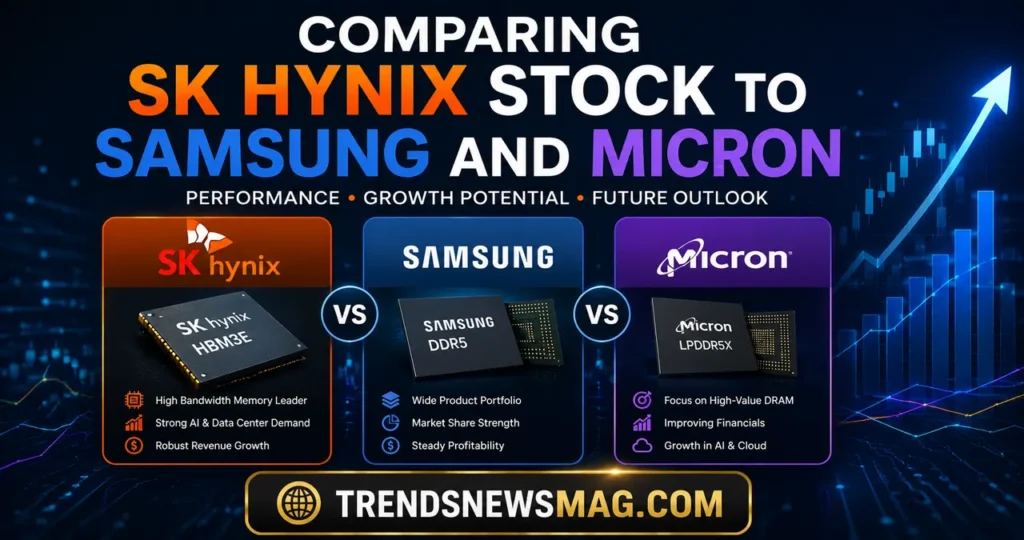
Any serious analysis of SK Hynix stock has to place it alongside its two closest rivals: Samsung Electronics and Micron Technology. All three companies compete in the same memory chip markets, and their fortunes tend to move together, though not always in perfect lockstep.
Samsung remains the largest memory manufacturer in the world by overall revenue and has historically held the top spot in DRAM market share, with SK Hynix in second place. However, in the specific and increasingly lucrative HBM segment, SK Hynix has actually taken the lead, moving to mass production of HBM4 chips ahead of its larger domestic rival. That technological edge is a big part of why SK Hynix stock has, at times, outperformed Samsung shares even though Samsung is the larger company overall. Notably, SK Hynix recently overtook Samsung Electronics to become South Korea’s most valuable listed firm, a symbolic milestone that would have seemed unthinkable just a few years ago.
Micron Technology, the lone major American player among the three, serves as the most direct valuation comparison for SK Hynix stock, particularly now that both companies will trade on US exchanges. As mentioned earlier, Micron has historically enjoyed a persistent valuation premium over SK Hynix, and its own stock performance in 2026 has been similarly explosive, rising roughly 700% over the trailing twelve months even as SK Hynix rose further still. When Micron reports strong quarterly results, it tends to lift sentiment across the entire memory sector, including SK Hynix stock, because investors treat the two companies’ order books as leading indicators for each other given how concentrated the AI memory customer base is around a handful of major buyers like Nvidia.
One useful way to think about the three companies is that Samsung offers the broadest diversification across memory, foundry, and consumer electronics; Micron offers the most direct US-market accessibility and historically higher relative valuation; and SK Hynix currently offers the strongest pure-play positioning in HBM specifically, which is the fastest-growing and highest-margin subsegment of the entire memory market. That HBM leadership is precisely why SK Hynix stock has captured such intense investor attention despite Samsung’s larger overall scale.
The Bull Case for SK Hynix Stock
The optimistic argument behind SK Hynix stock rests on a single word that keeps coming up in analyst commentary: scarcity. The core thesis is that demand for AI memory, and HBM in particular, will remain structurally undersupplied for years to come, not just quarters. Management has indicated that customer demand for the next several years already exceeds planned supply, and HBM4, which SK Hynix moved to mass production ahead of rivals, is being delivered to Nvidia under expanding long-term agreements through 2026.
If that scarcity narrative holds, several things support a continued positive outlook for SK Hynix stock. First, pricing power should remain elevated because buyers are forced to compete for constrained allocation rather than shopping around for the cheapest supplier, a dynamic that is highly unusual for what used to be considered a commodity product. Second, the ongoing shift in revenue mix toward HBM, which carries dramatically better margins than standard DRAM, should continue lifting overall profitability even if unit growth moderates. Third, the Nasdaq ADR listing itself functions as a potential re-rating catalyst independent of the underlying business performance, simply by widening the investor base that can access the shares.
There is also a broader macro angle supporting the bull case. Every major technology company racing to build out AI data center capacity, from hyperscalers to specialized AI infrastructure firms, needs enormous quantities of memory to pair with their computing chips. As long as capital expenditure on AI infrastructure keeps climbing, the derived demand for HBM should climb with it, and SK Hynix, as the acknowledged market share leader in that category, stands to capture an outsized portion of that spending.
Industry voices have echoed this optimism. As one semiconductor analyst put it regarding Micron’s recent results, which are widely seen as a read-through for the whole sector, “This is a very positive read-across for SK Hynix, who are exposed to the exact same market dynamics,” reflecting the view among semiconductor and infrastructure analysts that strong results from one memory maker tend to validate the demand backdrop for the others.
The Bear Case and Key Risks Facing SK Hynix Stock
No discussion of SK Hynix stock would be complete or honest without giving equal weight to the risks, and there are substantial ones. The most immediate risk is customer concentration. Because HBM revenue is disproportionately tied to a small number of massive buyers, largely Nvidia and a handful of other AI chip designers, any hint that one of those customers is trimming orders can send the stock reeling. We saw this play out directly when reports that Nvidia might cut Rubin production and that SK Hynix itself was slowing its HBM4 expansion knocked more than a tenth off the stock’s value within hours.
The deeper structural risk is the classic boom-and-bust pattern that has defined the memory industry for decades. Memory chips are cyclical for a very specific reason: when prices spike due to shortages, every manufacturer in the industry rushes to add capacity simultaneously, and that additional supply eventually overshoots demand, crashing prices. SK Hynix, Samsung, and Micron are all currently expanding HBM output at the same time, and if AI capital spending cools even modestly, or accelerator demand simply grows slower than the market currently expects, the same operating leverage that produced 70% margins on the way up could work violently in reverse on the way down. This is not a theoretical concern for SK Hynix stock; it is the exact mechanism that has caused every prior memory cycle to end badly for investors who bought near the peak.
There is also a valuation debate that sits at the heart of every SK Hynix stock discussion right now. A consensus average price target only slightly above the current trading price, paired with a Strong Buy rating from most sell-side analysts, tells you that while analysts genuinely like the business, they also believe a great deal of good news is already priced into the stock. The spread between the most bullish and most bearish analyst targets is unusually wide, which reflects genuine disagreement about how durable this cycle actually is rather than simple noise. Bear-case targets sit near 1 million won, roughly what the stock would be worth under mid-cycle rather than peak-cycle memory economics, and these are not tail-risk fantasies but plausible outcomes if the AI memory supercycle proves shorter-lived than the bulls expect.
Broader market sentiment concerns have also crept into the picture. Analysts at Capital Economics pointed out that the scale of recent volatility in Korean and global chip stocks has previously only occurred during genuine bear markets, such as the Asian financial crisis, the dot-com bust, and the Great Financial Crisis, calling the recent swings evidence of excessive froth that raises questions about the sustainability of the rally. Separately, analysts at Bank of America have warned more broadly that stocks are headed lower, pointing to speculation hitting extreme levels as high-multiple stocks gap up sharply, a pattern that has historically preceded valuation snapbacks.
There is also a political and regulatory dimension worth watching. A South Korean lawmaker recently referred to the KOSPI index publicly as a “casino” and called for strong measures, including delisting, against leveraged exchange-traded funds tracking Samsung Electronics and SK Hynix, which is a reminder that domestic political scrutiny of the sector’s rapid rise is intensifying alongside the price gains, and that regulatory intervention, however unlikely, is not entirely off the table.
Finally, currency and geopolitical risk deserve mention. SK Hynix is a Korean company whose primary listing is denominated in won, meaning international investors buying the Korean shares directly are also taking on currency exposure. The ADR structure mitigates but does not fully eliminate this, since the underlying value still tracks the Korean shares. Geopolitical tensions involving China, Taiwan, and semiconductor export controls have already shaped the broader industry once before and remain a background risk that could affect SK Hynix stock regardless of company-specific execution.
Financial Fundamentals and Valuation Metrics Behind SK Hynix Stock
Stepping back from the narrative and looking purely at the numbers, SK Hynix stock currently trades with fundamentals that reflect its unusual position straddling both a cyclical hardware business and a high-growth AI infrastructure story. The company’s EBITDA stands at roughly 91.67 trillion won, with a current EBITDA margin of 62.89%, figures that would be extraordinary for almost any hardware manufacturer in history. The trailing twelve-month earnings per share sits around 105,641 won, and depending on the data source, the stock’s price-to-earnings ratio has been cited in the high teens, reflecting a valuation that, despite the enormous price appreciation, is not obviously stretched relative to current earnings power, though it becomes far more debatable once you factor in the possibility of a cyclical downturn in memory pricing.
Dividend policy is a smaller part of the story but still relevant for income-focused investors considering SK Hynix stock. The company pays dividends quarterly, with the last dividend per share at 375 won and a trailing dividend yield around 0.12%, having been 0.46% in 2025 with a payout ratio of 4.84%, compared to 1.27% and 7.67% the year before. In plain terms, SK Hynix is not and has never really positioned itself as a dividend stock. Management has clearly chosen to reinvest the overwhelming majority of profits back into capacity expansion and technology development rather than returning cash to shareholders, which makes sense given the scale of capital required to keep pace with HBM demand, but it does mean investors buying SK Hynix stock should think of it primarily as a growth and capital appreciation play rather than an income vehicle.
Analyst price targets, while dispersed, give a sense of where the professional investment community currently sees fair value. The average twelve-month price target for SK Hynix stock stands around 3.17 million won, with a high estimate of 4.7 million won and a low estimate of 1.03 million won. That is an enormous range, spanning from a target roughly 30% above the recent trading price on the low end to nearly double the recent price on the high end, and it captures the genuine uncertainty professional analysts have about how this AI memory cycle ultimately resolves.
Wall Street and Analyst Sentiment on SK Hynix Stock
Broadly speaking, the sell-side community has remained firmly in the bullish camp on SK Hynix stock, even as individual price targets vary widely. Firms like HSBC and Mirae Asset Securities have both raised their targets specifically in response to the Nasdaq listing announcement, treating it as a structural catalyst rather than just a one-time capital event. The general framing from these analysts is that SK Hynix’s underlying business quality is not seriously in question; the debate is almost entirely about timing and cycle duration.
One senior industry figure summarized the situation well: “This is a very positive read-across for SK Hynix, who are exposed to the exact same market dynamics,” said Rolf Bulk, head of semiconductors and infrastructure at Futurum Group, commenting on how strong results from rival Micron tend to validate demand assumptions across the entire memory sector.
At the same time, more cautious voices in macro research have flagged the broader market conditions surrounding high-flying AI-adjacent names like SK Hynix stock. Economists tracking historical bear market indicators have pointed to the scale of recent volatility as a potential warning sign, even while acknowledging the company’s genuinely strong underlying earnings. This tension between company-specific fundamentals, which remain excellent, and macro-level valuation concerns, which are genuinely elevated, is probably the single most important thing for prospective investors to internalize about SK Hynix stock heading into the second half of 2026.
Retail investor sentiment, unsurprisingly, tends to skew more bullish and often anchors heavily on the headline record-earnings narrative without fully appreciating the cyclicality embedded in the business. As one analysis put it plainly, “most retail buyers anchor on the record-earnings headline and treat SK Hynix as a steady compounder. It is not.” The thing that experienced semiconductor investors actually watch closely is not the current quarter’s reported profit, but rather the forward order book and capacity announcements coming from all three major HBM producers simultaneously, since the historical pattern in this industry shows that the turning point almost always arrives via a supply-side signal, such as a rival ramping capacity aggressively or a major customer trimming its orders, landing exactly while the stock is still priced for continued upside.
Practical Considerations for Investors Weighing SK Hynix Stock
For investors trying to decide how, or whether, to approach SK Hynix stock, a few practical points are worth spelling out clearly. First, access matters. Until the Nasdaq ADR listing becomes fully established and liquid, most retail investors outside Korea have had to access this name either through international brokerage accounts capable of trading on the Korea Exchange, or through OTC-traded shares under tickers like HXSCL, which historically have suffered from thin liquidity and wide bid-ask spreads. The ADR listing under the ticker SKHY is specifically designed to solve this accessibility problem, and its success in doing so is itself one of the more interesting things to monitor going forward.
Second, position sizing deserves more attention than entry price when it comes to a stock this volatile. Given a beta near 1.78 and single-day moves of 8% to 12% occurring multiple times in recent months, treating SK Hynix stock like a typical large-cap holding in terms of allocation size could expose a portfolio to swings that feel disproportionate to the position’s intended weight. Sizing positions around the stock’s demonstrated volatility, rather than around a fixed conviction level, tends to be a more resilient approach for volatile, high-beta names generally.
Third, it helps to separate two distinct questions that are easy to conflate: is SK Hynix a good company, and is SK Hynix stock a good buy at the current price. The answer to the first question is, by almost any objective financial measure, clearly yes. Margins, market share, and technological leadership in HBM are all excellent and well documented. The answer to the second question depends entirely on an individual investor’s view of where the AI memory cycle currently sits, how long the current scarcity dynamic persists, and how much of that expected future strength is already reflected in a share price that has already risen several hundred percent.
Fourth, keep an eye on the earnings calendar and capacity announcements rather than just headline price moves. SK Hynix’s next earnings report is scheduled for July 29, 2026, and given how sensitive the stock has proven to be around commentary on HBM4 expansion plans, that report and any accompanying guidance on capacity could easily be a more important catalyst than the ADR listing itself in determining near-term direction.
It is also worth stating plainly that nothing in this article should be treated as personalized financial advice. Semiconductor stocks in general, and SK Hynix stock in particular given its current volatility profile, carry real risk of significant loss alongside the potential for significant gains, and anyone considering an investment should weigh their own financial situation, time horizon, and risk tolerance, ideally in consultation with a qualified financial professional, rather than relying solely on any single article or analyst note.
What the Nasdaq Listing Could Mean for the Stock’s Future Trajectory

Looking ahead, the success or failure of the Nasdaq ADR listing is likely to shape the narrative around SK Hynix stock for the remainder of 2026 and probably well into 2027. If the listing proceeds smoothly, attracts the kind of passive index-driven inflows that Mirae Asset and others have projected, and genuinely narrows the historical valuation gap with Micron, it would validate the core thesis that SK Hynix has simply been under-owned and under-covered by global investors relative to its actual business quality. In that scenario, continued strength in SK Hynix stock would likely be less about the memory cycle itself and more about a permanent re-rating driven by broader accessibility.
On the other hand, if the broader market backdrop deteriorates, whether due to a genuine slowdown in AI infrastructure spending, a supply glut emerging as all three major HBM producers ramp capacity simultaneously, or simply a broader risk-off shift in global equities of the kind that Bank of America and Capital Economics analysts have both flagged as a possibility, then SK Hynix stock could prove to be one of the more painful places to be caught overexposed, precisely because of how far and how fast it has already run. The stock’s own history offers a preview of both scenarios within just the past few weeks: sharp single-day rallies on positive HBM news and partnership announcements, followed by equally sharp single-day declines on any hint of demand softening.
What seems clear is that SK Hynix stock has permanently moved into a different category of investor attention than it occupied even two years ago. It is no longer viewed simply as a Korean memory manufacturer subject to the same boring commodity cycles that have defined the industry for decades. It is now widely treated as a bellwether for the health of the entire AI infrastructure buildout, which means its stock price will likely continue reacting not just to its own quarterly results but to news about Nvidia’s chip roadmap, hyperscaler capital expenditure plans, and the broader question of whether the artificial intelligence investment boom itself remains intact.
Conclusion
SK Hynix stock has completed one of the most remarkable transformations in recent corporate history, evolving from a cyclical, somewhat overlooked memory chip manufacturer into a trillion-dollar company sitting at the very center of the global artificial intelligence buildout. That transformation rests on a genuinely strong foundation: dominant market share in high-bandwidth memory, a deep and expanding partnership with Nvidia, extraordinary operating margins that would have seemed impossible for a memory maker just a few years ago, and now a historic Nasdaq ADR listing designed to close a long-standing valuation gap with American rival Micron.
At the same time, the risks facing SK Hynix stock are just as real as the opportunities. Memory remains a fundamentally cyclical industry, and the same scarcity dynamics currently driving record profits could reverse sharply if capacity expansion across the industry outpaces actual demand, or if AI infrastructure spending cools even modestly. The stock’s own recent trading history, with single-day swings of 8% to 12% occurring repeatedly, is a live demonstration of how quickly sentiment can shift around this name.
For investors trying to make sense of where SK Hynix stock fits into a broader portfolio, the most useful approach is probably to hold two ideas simultaneously without letting either one crowd out the other: the underlying business is currently excellent by almost any measure, and the stock’s valuation already reflects a great deal of optimism about how long that excellence will persist. Navigating that tension thoughtfully, rather than simply chasing the headline growth numbers or dismissing the story entirely due to volatility, is likely to serve investors better than taking an all-or-nothing view in either direction.
What is driving the recent surge in SK Hynix stock?
The primary driver has been explosive demand for high-bandwidth memory chips used in artificial intelligence servers, particularly through the company’s deepening partnership with Nvidia. SK Hynix holds a dominant share of the global HBM market and moved to mass production of its latest HBM4 chips ahead of competitors, which has translated into record revenue, operating margins above 70%, and a market valuation that recently surpassed $1 trillion. Additional momentum has come from the announcement of a historic Nasdaq ADR listing, which many analysts view as a catalyst for narrowing the stock’s longstanding valuation gap with American rival Micron Technology.
Is SK Hynix stock the same as buying shares directly on the Korea Exchange?
Not exactly. The company’s primary listing remains on the Korea Exchange under the ticker 000660, where it has traded for decades. The new Nasdaq offering is structured as an American Depositary Receipt listing, where multiple ADRs represent a fraction of one underlying Korean share, trading in US dollars under the ticker SKHY. This gives American investors more convenient dollar-denominated access to the same underlying economic exposure, including dividends and price appreciation, without SK Hynix creating an entirely separate primary listing in the United States.
What are the biggest risks to owning SK Hynix stock right now?
The most significant risks involve the cyclical nature of the memory chip industry itself. Because SK Hynix, Samsung, and Micron are all simultaneously expanding HBM production capacity, there is a real possibility that supply eventually outpaces demand, which could compress the extraordinary margins the company currently enjoys. Customer concentration is another concern, since a large portion of HBM revenue depends on a small number of major AI chip buyers, meaning any signal that a key customer like Nvidia is trimming orders can trigger sharp single-day declines in SK Hynix stock, as has already happened multiple times in recent months.
Does SK Hynix pay a meaningful dividend?
No, dividends are a minor part of the investment case for SK Hynix stock. The trailing twelve-month dividend yield sits below one percent, and the company’s payout ratio has historically been quite low, reflecting management’s clear preference to reinvest the large majority of profits into capacity expansion and advanced technology development rather than returning cash to shareholders. Investors drawn to SK Hynix stock are generally seeking growth and capital appreciation exposure to the AI memory theme rather than steady income.
How does SK Hynix stock compare to Micron and Samsung as an investment?
All three companies compete in the same memory markets and tend to move somewhat in tandem, but each offers a slightly different exposure. Samsung remains the largest and most diversified of the three, spanning memory, foundry, and consumer electronics, while Micron offers the most direct US-market accessibility and has historically traded at a valuation premium to SK Hynix. SK Hynix currently stands out for its clear leadership position specifically in high-bandwidth memory, the fastest-growing and highest-margin segment of the memory market, which is precisely why SK Hynix stock has attracted such outsized attention relative to the company’s historical profile.
Should beginners consider investing in SK Hynix stock?
Beginners considering SK Hynix stock should go in with clear eyes about its volatility, since the stock carries a beta well above the broader market and has experienced double-digit percentage swings within single trading sessions on multiple recent occasions. It is a name that requires comfort with cyclical technology sectors and a willingness to accept significant price swings in exchange for exposure to one of the clearest pure-play bets on continued AI infrastructure growth. As with any individual stock, especially one this volatile, it makes sense to consider position size carefully, understand the underlying business cycle risks, and, where appropriate, consult a qualified financial professional before making investment decisions.
Trending Today: [Wulf Stock Price]