Land for Sale Near Me: The Complete Buyer’s Guide to Finding, Evaluating, and Purchasing the Right Property in 2026


Searching for land for sale near me is one of those decisions that feels simple at first glance and grows more complicated the deeper you go. You type the phrase into a search bar, expecting a tidy list of parcels with prices attached, and instead you’re met with a sprawling mix of listings, auction sites, county records, and real estate agents all competing for your attention. That confusion is normal. Buying raw land, whether it’s a quarter-acre lot in a growing suburb or forty acres of rolling pasture out past the county line, is fundamentally different from buying a house. There’s no roof to inspect, no kitchen to admire, no walkthrough that tells you everything you need to know in thirty minutes. Instead, the value and usability of land depend on things most people never think to check until it’s too late: soil composition, easement rights, flood zones, mineral rights, road access, and a dozen other quiet variables that determine whether your dream property becomes a long-term asset or a frustrating money pit.


This guide exists to walk you through that entire process, from the first search to the closing table. Whether you’re hunting for a home site, an investment parcel, recreational acreage, or farmland, understanding how to properly evaluate land for sale near me will save you thousands of dollars and years of regret. We’ll cover market dynamics, financing quirks specific to raw land, due diligence checklists, negotiation tactics, and the practical realities of owning undeveloped property. By the end, you’ll have a framework that applies no matter where you’re searching or what kind of land you have in mind.
Why Location Still Rules Every Land Search
There’s an old saying in real estate that the three most important factors are location, location, and location. That principle applies just as forcefully to raw land as it does to finished homes, arguably more so, because land has fewer built-in features to compensate for a poor location. A house with a mediocre location can still offer comfortable living space, functioning utilities, and a roof over your head. A parcel of land in a poor location offers you dirt, and dirt alone rarely justifies its price tag.
When people search for land for sale near me, they’re usually driven by a specific set of motivations tied directly to proximity. Maybe they want to build a home close to aging parents, or they need land within a reasonable commute to their job, or they’re looking for recreational property they can actually visit on weekends without burning half a tank of gas just getting there. Distance matters in ways that aren’t always obvious until you own the property. A beautiful five-acre lot three hours away sounds romantic during the search phase, but after the novelty wears off, that same distance becomes the reason you visit twice a year instead of twice a month. Local land, even if it costs more per acre, tends to get used, developed, and enjoyed far more consistently than distant parcels bought on impulse.
There’s also a practical financial dimension to staying local. Land that sits within a familiar market gives you access to better information. You already understand the school districts, the flood history, the local economy, and the general trajectory of development in the area. You can drive by the property at different times of day, in different weather, to see how it actually behaves. Out-of-area land purchases require you to trust secondhand information from agents, satellite imagery, and public records, all of which can mislead you about the property’s true character. A parcel that looks flat and buildable on a topographic map might reveal itself, in person, to be a soggy low spot that floods every spring. Local knowledge closes that information gap, which is exactly why so many buyers instinctively gravitate toward land for sale near me rather than casting a wide net across unfamiliar regions.
Understanding What “Land for Sale Near Me” Actually Includes
The phrase land for sale near me covers a surprisingly broad category of properties, and lumping them all together is one of the most common mistakes new buyers make. Raw undeveloped acreage, subdivided residential lots, agricultural parcels, timberland, waterfront property, and commercial-zoned ground all fall under this umbrella, yet each comes with its own pricing logic, regulatory framework, and practical considerations. Before you start seriously evaluating listings, it helps to know which category you’re actually shopping in.
Residential lots, typically found in platted subdivisions or incorporated towns, tend to already have basic infrastructure nearby: roads, utility access, and sometimes even sewer connections. These lots are usually smaller, often under an acre, and priced at a premium because much of the development groundwork has already been done. When looking for raw acreage, it helps to understand what final structure you want to build on it. For buyers who want a detached feel but with minimal outdoor yard maintenance, searching for land to build patio homes for sale near me can be a smart alternative to buying massive rural plots that require extensive grading and infrastructure development. Agricultural land, by contrast, is priced based on soil quality, water rights, and productivity potential rather than proximity to city services. A hundred acres of Class II farmland in a strong agricultural region can be worth more per acre than a comparable-sized parcel of scrubby, rocky ground twenty miles away, even though both might appear on the same search for land for sale near me.
Recreational land, the kind bought for hunting, camping, or simply owning a private retreat, follows yet another pricing pattern. Buyers in this category often care less about soil quality or road frontage and more about wildlife presence, tree cover, water features, and seclusion. Timberland is valued using entirely different metrics tied to the age, species, and volume of standing timber, sometimes assessed through a formal timber cruise before a sale even closes. And then there’s land held purely for investment or future development, which is priced based on projected appreciation, proximity to expanding urban boundaries, and speculative zoning changes that may or may not materialize.
Understanding which of these categories fits your goals changes everything about how you search and what you should be willing to pay. A buyer looking for land for sale near me to build a retirement home has entirely different priorities than someone hunting for a speculative investment parcel on the edge of an expanding metro area. Clarifying your purpose before you start browsing listings prevents the common trap of falling in love with a property that technically doesn’t serve your actual needs.
How the Local Land Market Actually Works
Land markets behave differently from housing markets in ways that catch a lot of first-time buyers off guard. Housing markets are driven largely by comparable sales, since most homes within a neighborhood share similar square footage, construction quality, and amenities. Land markets, on the other hand, are far more fragmented. Two parcels sitting side by side can have wildly different values based on subtle differences in topography, access, or zoning designation, which makes pricing land for sale near me a genuinely tricky exercise even for experienced appraisers.
One of the biggest drivers of land value is scarcity relative to demand in a specific micro-market. In fast-growing suburban corridors, buildable land close to schools and employment centers can appreciate rapidly as developers compete for the last available parcels. In rural areas experiencing population decline, land prices can remain flat or even decline over long stretches, regardless of what national real estate trends suggest. This is why searching broadly for land for sale near me and comparing prices across regions rarely gives you an accurate read on fair value. What matters is understanding the specific dynamics of the market you’re actually buying into.
Seasonality also plays a bigger role in land sales than most people expect. Spring and early summer tend to bring more listings and more buyer activity, particularly for recreational and residential land, as people want to close deals in time to build or plant before winter. Late fall and winter often see reduced competition, which can work in a patient buyer’s favor, especially for agricultural or timber parcels where sellers are less motivated by a tight construction timeline. If you’re flexible on timing, searching for land for sale near me during the off-season can sometimes surface better deals from sellers eager to close before year-end.
Another quirk of land markets worth understanding is the wide variance in how listings get marketed. Unlike homes, which almost universally appear on the Multiple Listing Service, land parcels are frequently sold through a patchwork of channels: county auction sites, timber company listings, agricultural real estate brokerages, direct owner sales, and specialized land marketplaces that don’t always sync with mainstream home-search platforms. This fragmentation means that a truly thorough search for land for sale near me often requires checking multiple sources rather than relying on a single website, since no single platform captures the entire universe of available parcels in most regions.
Where to Actually Search for Available Parcels
Once you understand the market dynamics, the next practical step is knowing where to look. Mainstream real estate portals do list land, but they’re optimized for home searches and often bury land listings under filters that aren’t well suited to acreage, zoning, or land-specific features. Dedicated land marketplaces, by contrast, are built specifically around these variables and tend to surface more relevant results when you’re searching for land for sale near me.
County assessor and GIS (Geographic Information System) websites deserve far more attention than most buyers give them. These public tools let you view parcel boundaries, ownership records, tax history, and zoning designations directly, often for free. Many counties also maintain lists of tax-delinquent or foreclosure properties that never make it onto commercial listing sites, representing an entirely separate category of opportunity for buyers willing to do a bit of extra digging. Combining a GIS search with a traditional online search for land for sale near me gives you a much fuller picture of what’s actually available in your target area.
Local real estate agents who specialize in land, sometimes called land brokers or rural property specialists, remain one of the most valuable resources despite the rise of online search tools. These agents often know about parcels before they hit public listings, either because they represent sellers directly or because they maintain relationships with landowners considering a sale. A good land-focused agent brings knowledge of local zoning quirks, soil conditions, and infrastructure limitations that simply don’t show up in a basic online listing. If your search for land for sale near me is coming up thin through digital channels, a conversation with a local specialist can unlock inventory you’d never find otherwise.
Auctions represent another avenue worth exploring, particularly for buyers with some flexibility and a tolerance for competitive bidding. Land auctions, whether run by the county for tax-delinquent properties or by private auction houses handling estate sales, can produce excellent value, though they require faster decision-making and often demand cash or quick financing. Farm auctions in agricultural regions sometimes include land parcels alongside equipment, and these events can be a goldmine for buyers plugged into the local farming community. Even if you’re not ready to bid, attending a few auctions gives you a real-time education in how local land actually trades hands, which sharpens your instincts for evaluating any future listing you find while searching for land for sale near me.
The Due Diligence Checklist Every Buyer Needs
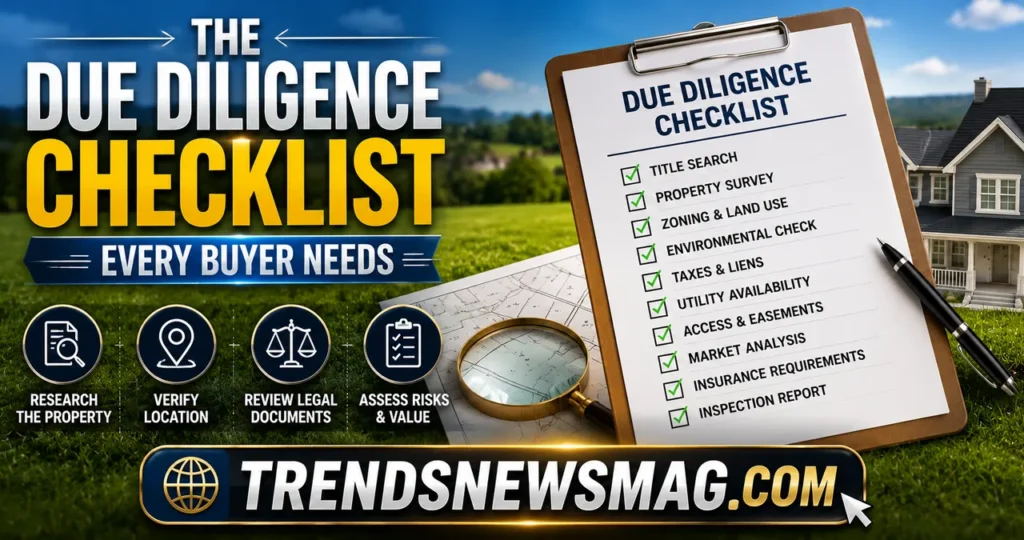
This is the section that separates confident, informed land buyers from the ones who end up with expensive regrets. Due diligence on raw land is more involved than most people expect, precisely because there’s no finished structure to hide behind or reveal problems through obvious visual inspection. Everything from the legal description to the soil profile requires active investigation.
Start with the title. A title search, ideally conducted through a title company or real estate attorney, reveals whether the seller actually has clear ownership rights, whether there are outstanding liens, and whether any easements or right-of-way agreements exist that could affect your use of the property. Easements are particularly important to understand because they can grant utility companies, neighboring landowners, or even the public certain rights to cross or use portions of your land, regardless of what you intend to build there. It’s not uncommon for buyers evaluating land for sale near me to discover, only after closing, that a significant portion of their new property is encumbered by a utility easement that limits where they can build.
Zoning and land use restrictions come next, and they deserve serious attention because they directly determine what you’re legally allowed to do with the property. Residential zoning might prohibit agricultural use or limit the number of structures you can build. Agricultural zoning might restrict subdivision or commercial activity. Some areas layer on additional restrictions through homeowners associations, conservation easements, or historic district designations that further limit your options. Before falling in love with any parcel appearing under a search for land for sale near me, call the local planning or zoning department directly and ask specific questions about your intended use. Verbal assurances from a seller or listing agent are not a substitute for written confirmation from the governing authority.
“People assume that if land is listed for sale, it must be ready to build on,” says one veteran land broker who has spent over two decades working rural transactions. “That’s almost never a safe assumption. I’ve seen buyers discover after closing that their beautiful ten acres has no legal access point, or that half of it sits in a floodplain that makes construction impossible without expensive mitigation.”
Environmental factors round out the core due diligence list. Flood zone status, determined through FEMA flood maps, affects both insurability and building feasibility. Wetlands designations can severely restrict development, sometimes requiring federal permits even for modest construction projects. Soil testing, particularly a percolation test for properties that will rely on a septic system rather than municipal sewer, tells you whether the ground can actually support a functioning wastewater system. Skipping any of these checks when evaluating land for sale near me is how buyers end up owning property they legally cannot build on, which turns what seemed like an affordable purchase into a stranded asset.
Access, Utilities, and Infrastructure Realities
Nothing torpedoes the value of an otherwise attractive parcel faster than poor access or missing utilities. It’s easy to get swept up in acreage and scenery while browsing listings for land for sale near me, but the unglamorous infrastructure questions ultimately determine whether a property is livable, buildable, and financeable at all.
Legal access means more than simply being able to drive up to a property. It means having a documented, legally recognized right to cross whatever land separates the parcel from a public road. Landlocked parcels, meaning those with no direct frontage on a public road and no recorded easement across neighboring property, are surprisingly common, especially in rural areas where large tracts have been subdivided over generations without formal access agreements being updated. A landlocked parcel can be nearly impossible to finance, insure, or eventually resell, so verifying legal access should happen early in your evaluation of any promising land for sale near me listing.
Utility access follows a similar logic. Electricity, water, and sewer or septic capability aren’t guaranteed just because a property sits within a reasonable distance of town. Extending power lines to a remote parcel can cost tens of thousands of dollars depending on distance from the nearest existing line, and rural water districts sometimes charge substantial tap fees or simply don’t service certain areas at all. Wells are a common alternative in rural settings, but well drilling costs vary enormously based on regional geology and water table depth, and there’s no guarantee a well will produce adequate water volume until it’s actually drilled. Buyers searching for land for sale near me with plans to build immediately should request specific utility information from the seller or local utility providers before making an offer, rather than assuming standard suburban infrastructure will simply be available.
Road conditions matter too, particularly for properties accessed via private or unmaintained roads. A dirt road that seems charming during a dry summer visit can become impassable during spring mud season or after heavy snowfall, which has real implications for year-round livability, emergency vehicle access, and even mail or package delivery. Once you purchase the land, the real work of clearing, grading, and site preparation begins. If you are planning to manage the excavation yourself or buy used heavy construction equipment online, checking verified industry feedback like Ironmartonline reviews is essential to avoid scams and ensure you are getting reliable machinery for your site development. Understanding who maintains the access road, whether it’s a public responsibility, a shared private agreement among neighboring landowners, or solely your own obligation once you take ownership, is a detail that’s easy to overlook but expensive to ignore. This is precisely the kind of nuance that makes local knowledge so valuable when hunting for land for sale near me, since out-of-town buyers relying purely on satellite imagery often miss these access realities entirely.
Financing Land: Why It’s Different From a Mortgage
If you’ve bought a home before, you might assume financing land works roughly the same way. It doesn’t, and this misunderstanding trips up more buyers than almost any other aspect of the process. Traditional mortgage lenders view raw land as a fundamentally riskier asset than a home with an existing structure, primarily because undeveloped land is harder to appraise, harder to resell quickly, and generates no income or utility on its own while sitting vacant. Securing a loan for raw land is notoriously difficult compared to a standard home mortgage. Major banking institutions are constantly adjusting their risk management and operational overhead—as seen during major structural shifts like the recent Wells Fargo layoffs—which directly impacts how tightly they underwrite speculative land loans.
Land loans typically require larger down payments than conventional home mortgages, often somewhere between twenty and fifty percent depending on the lender, the type of land, and whether it’s raw or improved with utilities already in place. Loan terms also tend to be shorter, frequently ranging from five to fifteen years rather than the standard thirty-year mortgage most home buyers are familiar with, which means higher monthly payments relative to the loan amount. Interest rates on land loans usually run higher than comparable home mortgage rates as well, reflecting the increased risk lenders associate with undeveloped property.
The type of lender matters significantly here. Many buyers searching for land for sale near me find that local community banks and credit unions are more willing to finance rural or undeveloped parcels than large national banks, largely because local lenders understand the regional land market and can more confidently assess property value. Agricultural land purchases can sometimes be financed through specialized lenders like farm credit associations, which understand agricultural income potential and offer terms specifically structured around farming operations. Seller financing represents another path worth exploring, particularly for smaller parcels or in areas where traditional lending options are limited; some landowners are willing to carry the note themselves, spreading payments out over time in exchange for interest income, which can simplify the purchase process considerably.
| Financing Option | Typical Down Payment | Typical Term | Best Suited For |
|---|---|---|---|
| Raw Land Loan (Bank/Credit Union) | 30–50% | 5–15 years | Undeveloped acreage with no immediate build plans |
| Improved Lot Loan | 15–25% | 15–20 years | Lots with utilities already connected |
| Construction-to-Permanent Loan | 10–20% | Converts to 30-year mortgage | Buyers planning to build immediately |
| Seller Financing | Negotiable, often 10–30% | Negotiable, often 3–10 years | Smaller parcels, motivated sellers |
| Farm Credit / Agricultural Loan | 20–35% | Up to 30 years | Working farmland with income potential |
| USDA Rural Development Loan | As low as 0% for qualified buyers | Up to 38 years | Low-income rural buyers building primary residence |
Buyers who plan to build relatively soon after purchase often benefit from construction-to-permanent loans, which combine the land purchase and building costs into a single financing package that eventually converts into a standard mortgage once construction is complete. This structure can reduce overall closing costs and simplify what would otherwise be two separate loan processes. For buyers browsing land for sale near me with a near-term construction timeline, discussing this option with a lender before making an offer can clarify what down payment and budget range actually makes sense.
Evaluating Price: What Actually Drives Land Value
Pricing land accurately is part art, part science, and it trips up even experienced buyers because the usual comparable-sales approach used in home valuation doesn’t translate cleanly to acreage. Two parcels of similar size in the same general area can carry dramatically different price tags depending on factors that aren’t always visible on a listing page.
Size alone doesn’t determine value the way people often assume. Price per acre typically decreases as total acreage increases, meaning a two-acre parcel might sell for a higher per-acre price than a two-hundred-acre parcel in the same region, simply because smaller lots suited for a single home site attract a different, often more competitive, buyer pool than large agricultural or investment tracts. When comparing listings for land for sale near me, it’s more useful to calculate price per acre across similar-sized parcels than to compare total price across dramatically different acreages.
Topography and usable acreage matter enormously as well. A hundred-acre parcel might sound impressive, but if forty of those acres are steep hillside, wetland, or otherwise unbuildable, the effective usable land might be closer to sixty acres, and pricing should reflect that reality. Savvy buyers request topographic maps or walk the entire property, not just the portion visible from the road, before finalizing their sense of what a parcel is actually worth. This kind of careful evaluation is exactly what separates buyers who end up satisfied with their purchase from those who feel misled after the fact when searching for land for sale near me.
Proximity to infrastructure, as discussed earlier, directly impacts price too. Land with existing road frontage, nearby utility connections, and established access tends to command a premium over otherwise comparable parcels lacking those features, because the buyer avoids the additional cost and hassle of bringing that infrastructure in themselves. Views, water features, and mature tree cover can add value for recreational or residential buyers, while agricultural buyers care far more about soil classification, drainage, and historical crop yields than aesthetic appeal.
“Land doesn’t have a Zillow Zestimate that means much of anything,” notes a rural appraiser who works primarily with agricultural and recreational properties. “You really have to understand the specific drivers of value in that micro-market, because a beautiful view might mean nothing to a farmer buying for crop production, while it means everything to someone buying a weekend retreat.”
Comparable sales still matter, but they need to be genuinely comparable in terms of size, zoning, topography, and access, not just geographically close. Working with a local appraiser or land-specialist agent who understands these nuances can prevent both overpaying and, just as importantly, underestimating a property’s true value when you’re negotiating a purchase discovered through a search for land for sale near me.
Negotiation Strategies That Actually Work for Land Deals
Negotiating for raw land follows different rhythms than negotiating for a house, largely because land often sits on the market longer and attracts a smaller, more specialized pool of buyers. This dynamic can work heavily in your favor if you understand how to use it.
Time on market is one of the most useful pieces of information you can gather before making an offer. Land listings that have languished for six months or longer often signal a seller who’s become more flexible on price, particularly if they’re carrying property taxes and maintenance costs on a parcel that isn’t generating any income. Asking your agent, or checking public listing history yourself, how long a specific piece of land for sale near me has been on the market gives you real leverage in structuring your initial offer.
Understanding seller motivation matters just as much as market data. Landowners sell for wildly different reasons: an inherited parcel someone has no use for, a farmer looking to consolidate acreage elsewhere, a developer who overextended and needs cash quickly, or an estate settlement with multiple heirs eager to divide proceeds and move on. A motivated seller in a hurry to close will often accept a lower offer or more flexible terms than a seller who’s simply testing the market with no real urgency to sell. If you can identify why a particular piece of land for sale near me is actually on the market, you can tailor your negotiation approach accordingly, sometimes offering a faster closing timeline in exchange for a price concession, which benefits sellers eager to move on.
Contingencies deserve careful thought during negotiation as well. Building appropriate contingencies into your offer, such as a satisfactory perc test, confirmed legal access, or acceptable zoning verification, protects you without necessarily weakening your negotiating position, since reasonable sellers understand that thorough buyers make for smoother closings. However, stacking too many contingencies onto an offer can make it less attractive compared to a competing cash buyer with fewer conditions attached, so it’s worth prioritizing the contingencies that genuinely protect you against deal-breaking issues rather than including every possible protection out of habit.
Price isn’t the only negotiable term either. Seller financing terms, closing timeline, who pays for the survey or title search, and even whether the seller will subdivide a larger parcel to sell you only the portion you actually want are all points of potential negotiation. Buyers who approach land for sale near me listings with creativity, rather than fixating purely on the asking price, often end up with deal structures that work better for their specific financial situation than a straightforward price reduction would have provided.
Rural, Suburban, and Urban-Edge Land: Weighing Your Options
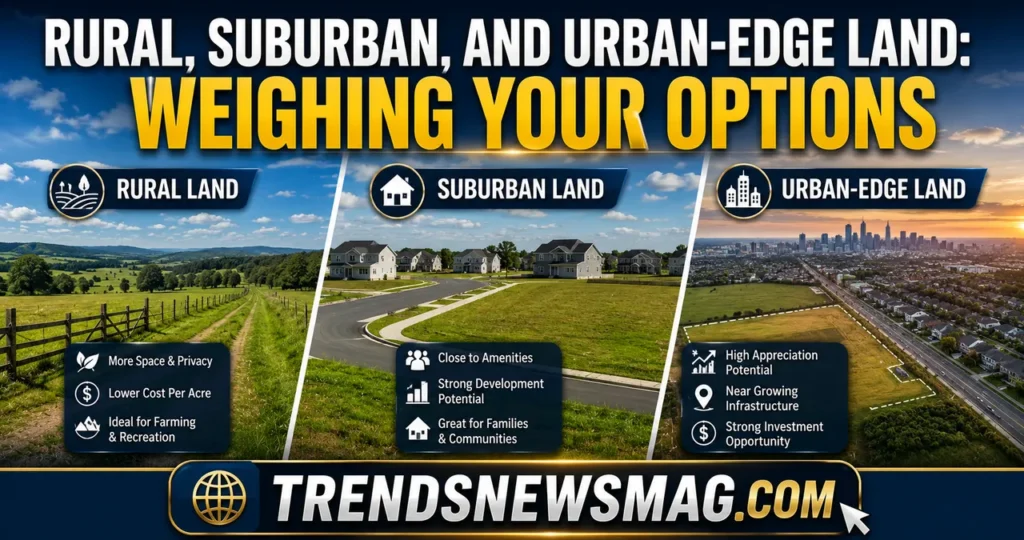
Not all “near me” searches point toward the same kind of land, and understanding the tradeoffs between rural, suburban, and urban-edge parcels helps clarify what you’re actually looking for before you start seriously evaluating listings.
Rural land generally offers the most acreage for your money, along with privacy, quiet, and often fewer restrictions on land use. The tradeoffs include longer commutes to employment centers, limited access to municipal utilities, and in some cases slower long-term appreciation compared to land closer to expanding population centers. For buyers whose priority is space, self-sufficiency, or a genuine escape from urban density, rural land for sale near me often represents the best value, provided you’re realistic about the infrastructure investment required to make the property fully livable.
Suburban land occupies a middle ground that appeals to a large share of buyers precisely because it balances space with convenience. Lots in growing suburban areas tend to already have, or be close to, established utilities, paved roads, and reasonable commute times to urban job centers. This convenience comes at a price premium compared to rural acreage, and lot sizes are typically smaller, but the tradeoff often makes sense for buyers building a primary residence who still want reasonable proximity to schools, healthcare, and daily conveniences. When people search specifically for land for sale near me with the intent to build a family home relatively soon, suburban parcels frequently emerge as the practical sweet spot.
Urban-edge land, meaning parcels sitting just outside expanding city boundaries, represents the highest-risk, highest-reward category. These properties can appreciate dramatically if development pressure pushes the urban boundary outward and the land eventually gets rezoned for higher-density residential or commercial use. However, this appreciation is speculative and can take years or even decades to materialize, and there’s always a chance that development patterns shift in a different direction, leaving the land essentially stuck at rural-level values despite its proximity to a growing city. Investors specifically targeting this category of land for sale near me need patience, a genuine understanding of local growth patterns and municipal planning documents, and a financial cushion that allows them to hold the property through an uncertain timeline without needing to sell under pressure.
Practical Considerations for Building on Newly Purchased Land
Buyers planning to build immediately or in the near future face a distinct set of considerations that differ from those buying land purely as an investment or long-term hold. Understanding these practical realities before purchasing helps prevent the frustrating scenario of owning land you technically can’t build on the way you’d planned.
Building permits and setback requirements vary significantly by jurisdiction, and they directly affect where on your property you’re actually allowed to place a structure. Setback requirements, which dictate minimum distances from property lines, roads, and water features, can dramatically shrink your effective buildable area, especially on smaller or irregularly shaped parcels. Before finalizing a purchase of land for sale near me with construction plans in mind, requesting a copy of local setback and building code requirements lets you confirm that your intended structure will actually fit within the legally buildable envelope of the property.
Site preparation costs are another factor buyers frequently underestimate. Clearing trees, grading uneven terrain, and preparing a stable building pad all add real expense before construction on the actual home even begins. Properties with significant slope, dense tree cover, or rocky soil can require substantially more site work than a flat, cleared lot, even if the raw land purchase price was lower. Factoring these anticipated costs into your overall budget, rather than focusing purely on the acquisition price of land for sale near me, gives you a far more accurate picture of your total investment before you commit to a specific parcel.
Timeline expectations matter too, particularly for buyers coordinating land purchase with a construction loan or seller financing arrangement. Permitting processes, utility installation, and well or septic system approval can all introduce delays that push a building timeline out by months beyond initial expectations. Building in reasonable buffer time, and discussing realistic timelines with local contractors and permitting offices before finalizing a purchase, prevents the frustration of an extended gap between closing on land for sale near me and actually breaking ground on construction.
Land as a Long-Term Investment
Beyond personal use, land continues to attract buyers purely for its investment potential, and understanding this angle adds useful context even for buyers primarily focused on eventual personal use. Land, unlike stocks or many other investment vehicles, is a finite physical asset that historically tends to hold value reasonably well over long time horizons, though appreciation rates vary enormously based on location and market conditions.
Agricultural land has historically delivered steady, if unspectacular, returns driven by rental income potential and gradual appreciation tied to commodity prices and farming productivity. Investors drawn to this category often lease the land back to local farmers, generating modest ongoing income while waiting for long-term appreciation, a strategy that works particularly well for buyers who found productive farmland through a search for land for sale near me in an established agricultural region.
Land banking, meaning purchasing undeveloped land in the path of anticipated growth and holding it until development pressure drives values upward, represents a higher-risk, potentially higher-reward strategy favored by more sophisticated investors. This approach requires genuine research into municipal growth plans, infrastructure investment patterns, and demographic trends, rather than simple guesswork, since holding costs including property taxes accumulate over the entire holding period regardless of whether appreciation ultimately materializes on schedule.
Recreational land has seen notable demand growth in recent years, driven partly by a broader cultural shift toward outdoor activities and remote work flexibility that allows people to spend more time at rural retreats. This demand shift has pushed prices upward in many desirable recreational regions, making land purchased even a few years ago look like a comparatively excellent value in hindsight. Buyers currently searching for land for sale near me for recreational purposes should recognize that this category has become increasingly competitive, which means acting decisively on well-priced, well-located parcels rather than waiting indefinitely for a better deal that may not materialize as this trend continues.
Common Mistakes Buyers Make and How to Avoid Them
Even careful buyers stumble into predictable pitfalls when purchasing land, and reviewing these common mistakes provides one final layer of protection before you finalize any purchase.
Skipping a physical site visit, or visiting only briefly during ideal weather conditions, ranks among the most common and costly mistakes. Satellite imagery and listing photos simply cannot convey drainage patterns, road noise, neighboring property conditions, or the true texture of the land the way an in-person visit can. Walking the entire perimeter, not just the area near the road, and visiting during different weather conditions if possible, gives you a far more honest sense of what you’re actually buying. This is particularly important for buyers evaluating land for sale near me who assume proximity means they already know the area well enough to skip a thorough walkthrough.
Underestimating total costs beyond the purchase price causes financial strain for many first-time land buyers. Property taxes, even on undeveloped land, accumulate every year regardless of whether you’re actively using the property. Insurance, ongoing maintenance like brush clearing or fence repair, and the infrastructure costs discussed earlier all add up to a meaningful ongoing financial commitment that extends well beyond the initial purchase price. Building a realistic total cost picture before committing to any land for sale near me prevents the unpleasant surprise of an ownership experience that costs significantly more than anticipated.
Ignoring future development plans in the surrounding area is another oversight with real consequences. Checking local planning department records for proposed highway expansions, new commercial developments, or rezoning applications near your target property can reveal changes that might significantly affect your quiet rural retreat or quality of life within just a few years. A parcel that seems perfectly secluded today might sit directly in the path of a planned highway bypass or commercial development within five years, and this kind of information is almost always available through public planning records if you take the time to look.
Finally, rushing the closing process without adequate professional guidance causes more problems than almost any other mistake on this list. Land transactions involve genuinely complex legal and practical considerations that benefit enormously from professional involvement: a real estate attorney familiar with land transactions, a title company experienced with rural or agricultural parcels, and where appropriate, a surveyor to confirm exact boundaries. The modest additional cost of proper professional guidance is almost always worth it relative to the risk of discovering a costly problem after closing, when your options for recourse become far more limited and expensive to pursue.
Conclusion
Finding the right land for sale near me ultimately comes down to patience, thorough research, and a willingness to look past the surface appeal of acreage and scenery toward the practical realities that determine whether a property will actually serve your goals. Location remains the foundation of every smart land purchase, but location alone isn’t enough; understanding zoning, access, utilities, soil conditions, and financing structures separates confident, well-informed buyers from those who end up disappointed after closing.
The process rewards buyers who slow down and ask the right questions rather than those who rush toward the first attractive listing they find. Verify legal access before falling in love with a view. Confirm zoning compatibility before assuming a property can accommodate your plans. Understand the true cost of bringing utilities to a remote parcel before comparing raw land prices against developed lots. And recognize that financing land requires a different approach than financing a home, with larger down payments and shorter terms that need to be factored into your budget from the very beginning.
Whether you’re drawn to rural acreage for its space and privacy, suburban lots for their balance of convenience and opportunity, or urban-edge parcels for their long-term investment potential, the fundamentals of careful due diligence remain constant. Take the time to walk the property, verify the paperwork, understand the local market, and work with professionals who genuinely know the region. Land bought thoughtfully tends to reward its owner for decades; land bought hastily tends to generate regret almost immediately. With the framework laid out in this guide, you’re now equipped to search for land for sale near me with far greater confidence and clarity than when you started.
What should I check first before making an offer on land for sale near me?
Before making any offer, confirm legal access to a public road, verify the zoning designation matches your intended use, and check whether the property falls within a flood zone or contains protected wetlands. These three factors alone can eliminate a surprising number of otherwise attractive listings and will save you significant time and potential legal complications down the road. It’s also worth requesting the seller’s disclosure documents and any available survey information, since these documents often reveal easements, boundary disputes, or other encumbrances that aren’t visible during a casual property walkthrough.
How much more expensive is financing land compared to financing a house?
Land loans generally require larger down payments, often between twenty and fifty percent depending on the lender and property type, compared to conventional home mortgages that can go as low as three to five percent down for qualified buyers. Interest rates on land loans also tend to run higher, and loan terms are typically shorter, often five to fifteen years rather than the standard thirty-year mortgage. This means your monthly payment relative to the loan amount will generally be higher for land than for an equivalent-value home purchase, so budgeting accordingly before you start seriously searching for land for sale near me is essential to avoid financing surprises later in the process.
Is it worth buying land now and building later, or should I wait until I’m ready to build immediately?
This depends heavily on your local market conditions and personal financial situation. Buying land for sale near me now, even without immediate building plans, can make sense in markets where land values are appreciating steadily, since securing a good parcel before prices climb further often outweighs the carrying costs of property taxes and maintenance during the waiting period. However, buyers should factor in ongoing costs like property taxes, potential HOA fees, and basic maintenance obligations during the holding period, and should also confirm that zoning and building codes aren’t likely to change unfavorably before they’re ready to build, since regulations can shift over time in ways that affect what you’re ultimately allowed to construct.
How do I know if a piece of land has legal access, and why does it matter so much?
Legal access means the property has a documented, recorded right to reach a public road, either through direct road frontage or through a formal easement across neighboring property. You can verify this through a title search, county records, or by working with a real estate attorney who specializes in land transactions. This matters enormously because landlocked parcels, those without confirmed legal access, are extremely difficult to finance, insure, build on, or eventually resell, regardless of how attractive the land itself might appear. Many buyers searching for land for sale near me skip this verification step and only discover access problems after closing, at which point resolving the issue can be expensive, time-consuming, or in some cases impossible if neighboring landowners refuse to grant an easement.
What’s the difference between buying land through an agent versus buying directly from the owner?
Working with a real estate agent, particularly one who specializes in land transactions, provides access to professional market knowledge, help navigating due diligence, and representation during negotiations, though this typically comes with a commission cost usually paid by the seller. Buying directly from an owner, sometimes called a For Sale By Owner transaction, can occasionally result in a lower purchase price since the seller avoids paying agent commissions, but it places more responsibility on the buyer to independently verify title, zoning, access, and other critical due diligence items without professional guidance. For buyers newer to land purchasing, working with an experienced agent when searching for land for sale near me often provides valuable protection worth the associated cost, while more experienced buyers comfortable managing their own due diligence process may find direct owner purchases offer meaningful savings.
How long does it typically take to close on a land purchase compared to buying a house?
Land transactions can actually move faster than home purchases in some cases, particularly when there’s no mortgage contingency or home inspection process to navigate, with some cash transactions closing in as little as two to three weeks. However, land deals involving more complex due diligence, such as perc testing, survey work, or zoning verification, can take significantly longer, sometimes stretching to sixty or ninety days depending on how quickly various inspections and approvals can be scheduled and completed. Financed land purchases generally take longer than cash transactions since land loans often involve more thorough underwriting than conventional home mortgages. Buyers searching for land for sale near me should discuss realistic timeline expectations with their lender and agent early in the process, particularly if they’re coordinating the purchase with other time-sensitive plans like a construction start date or a lease expiration on current housing.
Trending Today: [Condos for Sale Near Me]