Wulf Stock Price Today: A Complete Guide To TeraWulf’s Valuation, Momentum, And What Comes Next


If you’ve typed “wulf stock price” into a search bar recently, you’re not alone. TeraWulf has gone from a niche bitcoin miner that most investors couldn’t place to one of the more talked-about names tied to the artificial intelligence infrastructure boom, and the chart tells that story better than any headline could. Shares that traded in the single digits not that long ago have swung into the twenties, dragging along a wave of new attention from retail traders, institutional analysts, and curious onlookers who want to understand what actually happened.


This guide walks through the wulf stock price from every angle that matters. We’ll cover where the stock sits today, how it got here, what the underlying business actually does now versus what it used to do, how analysts are pricing the future, and what risks could derail the story. Along the way, we’ll compare TeraWulf to its closest peers, unpack the numbers behind the hype, and give you a framework for thinking about volatility so you’re not caught off guard the next time the ticker moves ten percent in a single session. None of this is a recommendation to buy or sell anything. Stocks like this one carry real risk, and you should treat every number here as a starting point for your own research rather than a final answer.
What Is TeraWulf And Why The Wulf Stock Price Keeps Making Headlines
TeraWulf Inc. trades on the Nasdaq under the ticker WULF, and the company’s own description of itself has changed meaningfully over the past couple of years. TeraWulf, together with its subsidiaries, owns and develops digital infrastructure in the United States, and it also develops and operates bitcoin mining facilities for both bitcoin mining and high-performance computing workloads, leaning on clean, cost-effective, and reliable energy. That phrase, “high-performance computing,” is doing a lot of work in that sentence, and it’s the reason the WULF stock price is behaving so differently this year compared to the company’s early years as a pure-play crypto miner.
The company itself is young. It was founded by Paul B. Prager and Nazar M. Khan on February 8, 2021, and it’s headquartered in Easton, Maryland. For its first few years, TeraWulf ran the standard bitcoin-mining playbook: build data centers powered by low-carbon energy sources, plug in mining rigs, and generate bitcoin that could be sold or held on the balance sheet. That business model is straightforward but brutally cyclical. When bitcoin prices rise, mining revenue rises with it. When bitcoin prices fall, or when mining difficulty increases faster than hash rate additions, margins get squeezed fast. It’s a business built on a commodity that swings wildly, and for years that volatility was baked directly into the wulf stock price.
What changed is that TeraWulf, like several of its mining peers, realized its physical infrastructure — the power contracts, the substations, the cooling systems, the land — was valuable for a second purpose entirely: hosting the compute-intensive workloads behind the artificial intelligence boom. Training and running large AI models requires enormous amounts of electricity and specialized data center space, and that happens to be almost exactly what bitcoin miners had already built. So TeraWulf began repositioning itself as a high-performance computing host, leasing capacity to AI and cloud customers instead of only running its own mining operations. That pivot is the single biggest reason the wulf stock price has captured so much attention this year, and it’s a theme we’ll come back to repeatedly throughout this guide because it touches nearly every part of the investment case.
Where The Wulf Stock Price Stands Right Now
As of the most recent trading session, TeraWulf shares are valued at $24.68, with the stock trading between an intraday low of $21.89 and a high of $27.55. That’s a wide range for a single session, and it’s worth sitting with for a second, because it tells you something important about this stock before we even get to the fundamentals: it moves. A lot. The company’s market cap currently stands at roughly $10.49 billion, with a price-to-earnings ratio of -8.43, reflecting the fact that TeraWulf is not yet profitable on a net income basis.
Zoom out to the 52-week window and the picture becomes even more dramatic. Over the past year, TeraWulf stock has traded between a low of $4.52 and a high of $29.84. Think about what that actually means in practical terms. Someone who bought near the bottom of that range and held through the peak would have seen their position multiply by more than six times. Someone who bought near the top and watched the stock retest lower levels would have felt a very different kind of ride. That’s the nature of a stock going through a business-model transformation while riding two of the most talked-about themes in markets right now: bitcoin and artificial intelligence infrastructure.
Trading volume adds another layer to this. Recent daily volume has run around 4.29 million shares against a daily average closer to 30.9 million. When volume runs meaningfully below its average, it can suggest a pause after a big move, though volume patterns should always be read alongside price action and news flow rather than in isolation. One analyst covering the space summed up the mindset that seasoned traders bring to a stock like this: as one veteran trader put it, the discipline is to “trade the price action, not the hype,” a reminder that’s especially relevant when a stock’s story is moving faster than its financial statements.
From Bitcoin Miner To AI Infrastructure: The Story Behind The Wulf Stock Price Surge
To really understand the wulf stock price, you have to understand the pivot at the center of this company’s recent history, because it’s not a minor tweak to the business — it’s a full repositioning of what TeraWulf is trying to be. For years, bitcoin miners were valued almost entirely on hash rate, electricity costs, and bitcoin price sensitivity. Investors modeled these companies the way you’d model a commodity producer: revenue goes up when the commodity’s price goes up, and margins compress when input costs (mainly power) rise faster than output value.
The AI infrastructure buildout flipped that script for companies willing and able to make the leap. Instead of running their own mining rigs around the clock hoping bitcoin cooperates, miners with the right land, power contracts, and grid connections could instead sign long-term leases with AI companies and cloud providers who desperately need data center capacity and, more specifically, need it fast. These leases tend to be structured very differently from mining revenue. They’re often multi-year, sometimes running into decades, with contracted payments that don’t swing with bitcoin’s price. That’s a fundamentally more predictable revenue stream, and predictable revenue tends to earn a different kind of valuation multiple from the market.
TeraWulf leaned into this shift aggressively. The company’s flagship Lake Mariner campus became a proving ground for this new model. During the first quarter of 2026, TeraWulf advanced Lake Mariner as one of North America’s largest HPC campuses, with 60 megawatts of critical IT capacity operational and generating revenue for a customer known as Core42 as of March 31, 2026. That’s not a hypothetical pilot program — that’s real, contracted, revenue-generating infrastructure already up and running. The company was also nearing completion on additional capacity known as CB-3, with further phases called CB-4 and CB-5 scheduled for delivery and rent commencement later in 2026.
The pivot didn’t stop there. In late May 2026, TeraWulf expanded its footprint further by acquiring a large-scale site in Kentucky, and just recently, the company announced a lease agreement with Anthropic alongside a deal involving its Abernathy joint venture and a company called Fluidstack, signaling that the largest AI labs in the world are now directly renting TeraWulf’s infrastructure. Every one of these announcements has moved the wulf stock price in real time, because each one represents a concrete, dollar-denominated validation of the pivot away from pure bitcoin mining and toward AI hosting. That’s the core narrative driving this stock, and it’s why the wulf stock price has become such a popular search term among both crypto-focused investors and a completely new audience of AI infrastructure watchers who might never have looked at a bitcoin miner otherwise.
Breaking Down TeraWulf’s Financials Behind The Wulf Stock Price
Narrative moves stocks in the short term, but numbers eventually catch up with the story, so let’s look at what TeraWulf’s actual financial results show. The company generated first quarter 2026 revenue of $34.0 million, including $21.0 million specifically from HPC lease revenue. That split matters enormously. It tells you that HPC leasing already accounts for well over half of total revenue, meaning the pivot isn’t just a slide-deck story for investor presentations — it’s showing up directly in the top line.
Balance sheet strength is another piece of this puzzle that doesn’t always get enough attention amid the excitement over price targets and AI partnerships. TeraWulf reported maintaining a strong liquidity position, with approximately $3.1 billion of cash and restricted cash as of the end of the first quarter. That’s a substantial war chest for a company of this size, and it matters because building out data center capacity at the scale TeraWulf is targeting requires enormous upfront capital: land, transformers, cooling infrastructure, grid interconnection fees, and construction costs that can run into the hundreds of millions of dollars per site. Having billions in liquidity gives the company room to keep building without immediately needing to tap capital markets under unfavorable terms, though it’s worth noting that TeraWulf has still gone back to equity markets during this buildout phase, including a stock offering earlier in the year.
That said, profitability remains a work in progress, and this is one of the more important nuances for anyone trying to make sense of the wulf stock price relative to traditional valuation metrics. The negative price-to-earnings ratio of -8.43 reflects ongoing net losses, and looking back over the trailing year, revenue came in around $168.5 million with a net loss of roughly $126.6 million in the fourth quarter of 2025 alone. Heavy losses alongside heavy revenue growth is a familiar pattern for infrastructure-heavy businesses in a rapid buildout phase — think of it less like a mature company missing targets and more like a construction company still in the middle of pouring concrete for buildings that haven’t started collecting full rent yet. The risk, of course, is execution: if leasing revenue doesn’t scale fast enough to outpace the capital being deployed, the losses could persist longer than the market is currently pricing in.
Here’s a simplified snapshot of where things stood at last check, useful as a quick reference point rather than a moving target you should expect to stay fixed for long given how fast this stock moves:
| Metric | Recent Figure |
|---|---|
| Wulf stock price (last trade) | $24.68 |
| 52-week range | $4.52 – $29.84 |
| Market capitalization | ~$10.49 billion |
| P/E ratio | -8.43 (not yet profitable) |
| Q1 2026 total revenue | $34.0 million |
| Q1 2026 HPC lease revenue | $21.0 million |
| Cash and restricted cash (Q1 2026) | ~$3.1 billion |
| Average analyst rating | Strong Buy |
Analyst Price Targets And What They Mean For The Wulf Stock Price
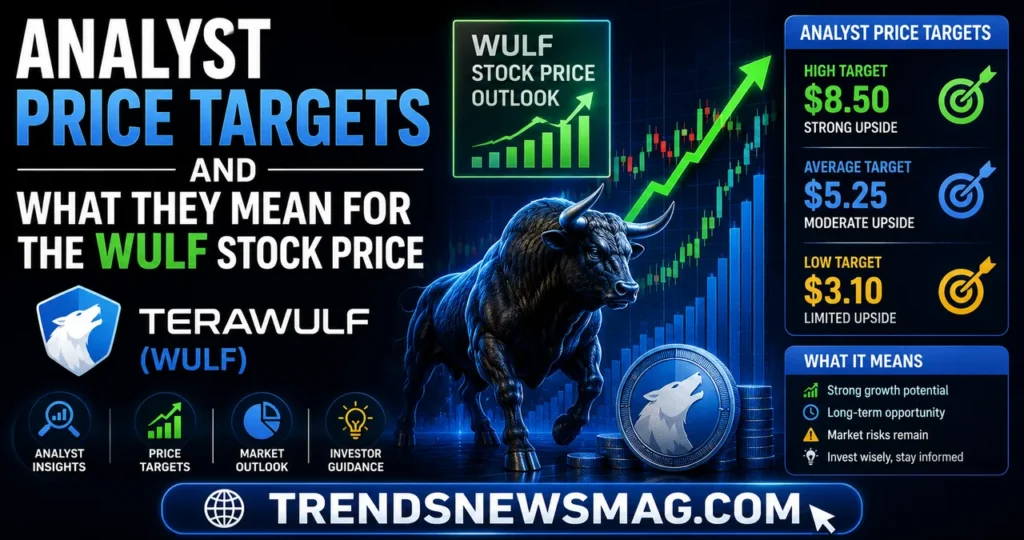
Wall Street coverage of TeraWulf has grown substantially as the AI infrastructure story has taken hold, and the range of price targets tells its own story about how differently analysts are weighing the risks and rewards here. According to a group of 15 analysts, the average rating for WULF stock currently sits at “Strong Buy,” with a 12-month price target of $36.34, representing an increase of over 71 percent from recent trading levels. That’s a bullish consensus by almost any measure, but it’s worth digging into the individual calls rather than just accepting the average, because the spread between the most conservative and most aggressive targets is enormous.
On the more conservative end, Keefe Bruyette issued a $25 price target, which at the time was barely above where the stock was trading, essentially signaling a “fairly valued, proceed with caution” stance. Northland set its target at $30, tied specifically to the company’s 480 megawatt Kentucky site, showing that some analysts are pricing in continued expansion of physical capacity as the primary driver of future value. Then you get into the more aggressive calls. Citi initiated coverage with a Buy rating and a $36 price target, pointing to TeraWulf’s expansion into high-performance compute for data centers and accelerating demand in that space. BofA’s Michael Funk also initiated coverage with a Buy rating and a $34 target, framing TeraWulf as a company transitioning away from volatile legacy bitcoin mining toward digital infrastructure with more durable revenue.
The most bullish call on the Street currently belongs to Bernstein. Bernstein’s Gautam Chhugani initiated coverage with an Outperform rating and a $46 price target, citing an active, multi-gigawatt power development pipeline and strong order momentum. That target implies nearly a doubling from recent trading levels, and it’s grounded in the idea that power availability — not chips, not customer demand — is the actual bottleneck constraining AI infrastructure growth right now, and that TeraWulf’s existing power contracts and grid connections put it in a scarce and valuable position. Morgan Stanley has echoed similarly bullish sentiment, raising its target to $41.50 and maintaining an Overweight rating, explicitly citing expanded power volumes in Maryland and Kentucky alongside the company’s shift toward AI and HPC hosting.
What should you actually take away from this spread of targets when thinking about the wulf stock price? The honest answer is that a $25 target and a $46 target aren’t really disagreeing about facts so much as they’re disagreeing about how much weight to put on execution risk versus opportunity size. Every analyst here agrees the pivot toward AI hosting is real and already showing up in revenue. Where they diverge is on how much of TeraWulf’s massive potential power pipeline will actually convert into signed, contracted, revenue-generating leases versus how much remains speculative. That’s a genuinely difficult thing to forecast, which is exactly why the range of targets is so wide.
Key Catalysts Moving The Wulf Stock Price
If you’ve watched the wulf stock price move sharply on any given day this year, there’s a good chance one of a handful of recurring catalyst types was behind it. The first and most obvious category is customer announcements. Every time TeraWulf signs, expands, or confirms a lease agreement with a major AI or cloud customer, the market treats it as concrete evidence that the pivot away from pure bitcoin mining is working. The recent announcement involving a lease with Anthropic at what TeraWulf calls its Justified Data Campus, paired with the sale of a majority interest in its Abernathy joint venture to Fluidstack, is a good recent example. Deals like this do two things simultaneously: they add contracted revenue, and they validate that top-tier AI labs are willing to build directly on TeraWulf’s infrastructure rather than exclusively with the largest hyperscale cloud providers.
The second catalyst category is capacity expansion. When TeraWulf announces new land, new power capacity, or new construction milestones — like the acquisition of the 1+ gigawatt Eastern Kentucky HPC campus in late May 2026 — the market often reacts favorably because it signals the company has room to keep signing leases well into the future. Power is the scarce resource in this industry right now, more so than land or even construction labor in many cases, so any deal that secures meaningful new power capacity tends to move the wulf stock price because it expands the addressable opportunity.
The third catalyst category is analyst and institutional sentiment, which we covered above but deserves a mention here too because of how directly it interacts with price action. When a major bank raises or initiates coverage with an aggressive price target, it often triggers buying from investors who use analyst sentiment as a screening tool, and that can create momentum on top of momentum. The fourth and final major catalyst type worth watching is earnings releases and guidance updates. Quarterly results give the market a chance to check the narrative against actual numbers, and any gap between expectation and reality — in either direction — tends to produce outsized moves given how much of the current valuation rests on future growth rather than current profitability.
Risks That Could Weigh On The Wulf Stock Price
No serious discussion of the wulf stock price would be complete without spending real time on the risks, because this is not a low-volatility, defensive stock by any stretch of the imagination. The most obvious risk is execution. TeraWulf has an ambitious pipeline of power and data center capacity it intends to build out, but announcing capacity and actually energizing it on schedule, on budget, and with the right customer already lined up to lease it are three very different things. Construction delays, supply chain bottlenecks for critical equipment like transformers and cooling systems, and permitting slowdowns at the local or state level can all push completion dates back, and every delay pushes back the point at which that capacity starts generating rent.
Financing risk is closely related. Building gigawatt-scale data center capacity is capital-intensive, and TeraWulf has already gone back to equity markets multiple times to fund its buildout, including a notable stock offering earlier in the year. Repeated equity issuance dilutes existing shareholders, and if the company needs to raise capital again on less favorable terms — say, during a period when the wulf stock price has pulled back — that dilution could weigh more heavily on per-share value than investors currently expect. The balance sheet’s roughly $3.1 billion in liquidity provides a real buffer here, but a buildout of this scale can consume capital quickly, and heavy debt alongside continued capital spending is a combination worth watching closely rather than glossing over.
Then there’s the legacy bitcoin mining exposure that still sits within the business. Even as TeraWulf pivots toward HPC leasing, it hasn’t fully exited bitcoin mining, and that segment remains sensitive to bitcoin’s price and to network-wide mining difficulty. For many bitcoin miners, production costs have at times exceeded what the coin could be sold for, forcing operators to power down machines and sell holdings just to raise cash — a dynamic that can still affect TeraWulf’s mixed-model results even as HPC becomes the larger share of revenue. Competitive risk deserves mention too. TeraWulf faces real competition and execution risk amid a stock price surge of roughly 500% over the past year, and that kind of run tends to attract well-funded competitors racing to secure the same scarce power capacity, which could compress margins or pricing power on future leases if supply of hosting capacity starts to outpace demand.
Finally, there’s straightforward valuation risk. A stock trading at a market capitalization north of $10 billion while still posting net losses is, by definition, priced heavily on future expectations. If AI infrastructure demand growth slows, if a major customer pulls back on committed leasing plans, or if broader market sentiment toward speculative growth stocks sours (something that tends to happen quickly during periods of rising interest rates or risk-off sentiment), the wulf stock price could see a sharp repricing even if the underlying business hasn’t fundamentally changed. Insider selling activity is worth watching as one data point among many here too — CEO Paul Prager disclosed a sale of 216,700 shares worth about $4.49 million, though he still retains roughly 40.1 million shares, mostly held indirectly — which most analysts read as routine liquidity rather than a signal of declining conviction, but it’s the kind of filing serious investors track regardless.
How The Wulf Stock Price Compares To Other Bitcoin Miners And AI Data Center Stocks
TeraWulf doesn’t operate in isolation, and understanding the wulf stock price in the context of its closest peers helps clarify what’s unique about this particular story versus what’s part of a broader sector-wide trend. The company is regularly grouped alongside names like Cipher Digital, CleanSpark, Hut 8, MARA Holdings, Riot Platforms, HIVE Digital Technologies, and Core Scientific — a peer group that spans companies at very different stages of the same bitcoin-mining-to-AI-hosting transition.
Some of these peers have moved further along the HPC pivot than others, and some have barely started. What’s notable about TeraWulf specifically is how quickly the market has rewarded its pivot with a premium valuation relative to companies still generating the bulk of their revenue from mining alone. That premium isn’t guaranteed to hold. If a competitor announces a larger or more prestigious AI hosting deal — say, a direct agreement with one of the largest cloud hyperscalers at a scale that dwarfs TeraWulf’s current contracts — capital could rotate toward that name instead, pressuring the wulf stock price even without any negative news specific to TeraWulf itself. This is a genuinely competitive, rapidly evolving space, and relative positioning among peers matters just as much as each company’s standalone fundamentals.
It’s also worth distinguishing TeraWulf from pure-play AI data center REITs and hyperscale-adjacent names that never touched bitcoin mining at all. Those companies typically carry more stable, predictable earnings profiles because they’ve been running long-term lease books for years, but they also don’t carry the same explosive upside if a scarce-power narrative plays out the way bulls expect for TeraWulf. In other words, TeraWulf sits in an interesting middle ground: more volatile and speculative than a mature data center REIT, but with a clearer, more established base of existing infrastructure than a brand-new AI hosting startup trying to build from scratch. That middle-ground positioning is a big part of why the wulf stock price has attracted such a broad mix of investors, from crypto-native traders who followed the company from its mining days to growth investors who discovered it purely through the AI infrastructure angle.
Volatility And Beta: What Traders Should Know About Wulf Stock Price Swings
If there’s one thing every prospective investor should internalize before trading this name, it’s that TeraWulf is genuinely volatile, and the numbers back that up in ways that go beyond just “the chart looks jumpy.” The stock carries a notably elevated beta figure, reflecting outsized price swings relative to the broader market, and that volatility shows up in very practical, day-to-day ways: options market activity around WULF has repeatedly shown mixed to bearish positioning even during periods when the underlying share price was rising, a sign that professional traders are actively hedging or betting against continuation even amid bullish headline momentum.
This kind of two-sided positioning is worth understanding rather than fearing. A stock can have a strongly bullish analyst consensus and a rapidly growing business while still seeing traders bet against short-term continuation, because those two things are answering different questions. Analysts with 12-month price targets are making a call about where the stock should be in a year based on fundamentals. Options traders positioning for the next few weeks are often making a much narrower bet about near-term momentum, technical levels, or event-driven volatility around an earnings date. Conflating the two — assuming bearish options activity somehow contradicts a bullish long-term thesis — is a common mistake. One trading educator’s advice on names like this captures the right mindset well: “Preparation is half the trade. By the time the bell rings, my decisions are nearly made,” a reminder that reacting to headlines in real time is a much weaker approach than having a plan for how you’ll respond to a range of scenarios before they happen.
Practically speaking, this means position sizing matters enormously with a stock like TeraWulf. A move that would be considered a major event for a mega-cap, low-beta stock — a five or ten percent single-day swing — is closer to routine behavior here. If you’re going to hold this name, whether as a short-term trade or a longer-term position, it’s worth deciding in advance how much of a drawdown you’re comfortable absorbing and at what point you’d reconsider the thesis entirely, rather than making that decision emotionally in the middle of a sharp move.
Long-Term Outlook For The Wulf Stock Price

Stepping back from the day-to-day noise, the long-term case for TeraWulf rests on a fairly simple thesis: if the company can continue converting its power capacity and land holdings into signed, long-duration HPC leases at a pace that outstrips its capital spending, the wulf stock price has room to re-rate higher as the market shifts from valuing TeraWulf like a volatile commodity miner to valuing it like a contracted infrastructure operator. That shift in how a stock gets valued — sometimes called a multiple re-rating — can be a powerful driver of share price appreciation independent of even huge swings in revenue, because investors are often willing to pay meaningfully more for each dollar of predictable, contracted revenue than they are for each dollar of commodity-linked mining revenue.
The bear case is essentially the mirror image. If leasing revenue growth stalls, if construction timelines slip repeatedly, or if competition for the same scarce power capacity compresses the economics of future leases, the market could revert to valuing TeraWulf closer to its mining-era multiples, which would imply a meaningfully lower wulf stock price than where the more bullish analyst targets currently sit. The truth, as is often the case with fast-moving growth stories, probably lives somewhere between the most bullish and most bearish scenarios, and which direction it leans will likely become clearer over the next several quarters as more of the company’s development pipeline either converts into signed leases or doesn’t.
What makes this particular stock harder to model than a typical company is the sheer pace of change. A company that took years to build out its mining infrastructure has, in a relatively short window, signed major leasing agreements with some of the most prominent names in AI, expanded into new geographic markets, and fundamentally repositioned how Wall Street thinks about its business. That kind of rapid transformation makes historical financial patterns a less reliable guide than usual, which is exactly why so many analysts are relying on forward-looking power capacity and signed-lease data rather than trailing revenue multiples when setting their targets.
Practical Tips For Tracking And Evaluating The Wulf Stock Price
If you’re planning to follow the wulf stock price closely going forward, a few habits will serve you better than simply checking the ticker once a day and reacting to whatever number you see. First, pay closer attention to lease announcements and capacity milestones than to daily price swings. Because so much of this stock’s valuation rests on the pace of the HPC pivot, a new signed lease or a completed construction phase tells you more about the underlying business trajectory than a single day’s trading range ever will.
Second, read analyst price target changes for the reasoning behind them, not just the number itself. A $46 target built on power pipeline assumptions and a $25 target built on near-term execution caution are telling you two very different stories about the same stock, and understanding why analysts disagree is far more useful than simply averaging their targets together. Third, keep an eye on the balance sheet alongside the growth headlines. Cash position, debt levels, and any new equity or debt issuances matter enormously for a company still spending heavily to build out infrastructure, and dilution risk is easy to overlook when the narrative is exciting.
Fourth, separate short-term options and trading sentiment from long-term fundamental sentiment, since the two often diverge and both are legitimate but answer different questions. And finally, remember that this remains, at its core, a company still transitioning between two very different business models simultaneously — bitcoin mining and AI infrastructure hosting — which means both bitcoin-specific news and AI infrastructure-specific news can move the wulf stock price, sometimes on the same day, sometimes in opposite directions. Staying aware of both categories of news, rather than assuming this is purely a crypto stock or purely an AI stock, will give you a more complete picture than most casual observers have.
Conclusion
The wulf stock price tells the story of a company in the middle of one of the more compelling transformations happening in markets right now: a bitcoin miner repositioning itself as core infrastructure for the artificial intelligence buildout, using power contracts and data center assets it already owned rather than starting from scratch. That transformation has driven the stock from single digits to the high twenties over the past year, backed by real, contracted HPC leasing revenue, a substantial cash position, and a growing list of high-profile AI customers signing on to use TeraWulf’s capacity.
At the same time, this is not a settled, low-risk story. Profitability remains elusive on a net income basis, the company continues to raise capital to fund an ambitious buildout, legacy bitcoin mining exposure still ties part of the business to a volatile commodity, and analyst price targets span a wide enough range to remind you that even well-informed professionals disagree meaningfully about how this plays out. Whether you’re a longer-term investor weighing the AI infrastructure thesis or a shorter-term trader navigating day-to-day swings, the wulf stock price deserves the kind of careful, ongoing attention this guide has tried to model rather than a one-time glance at a headline number. Keep watching the lease announcements, keep an eye on the balance sheet, and treat every price target as a hypothesis to test against incoming news rather than a guarantee of where this stock is headed.
What is driving the wulf stock price higher this year?
The primary driver has been TeraWulf’s pivot from a pure bitcoin mining business toward hosting high-performance computing and AI workloads, using the same power infrastructure and land it originally built for mining. Concrete lease agreements with AI and cloud customers, expanding power capacity through new site acquisitions, and a wave of bullish analyst coverage have all combined to push the wulf stock price up sharply over the past year, though the stock remains highly volatile and sensitive to both bitcoin-market news and AI infrastructure developments.
Is TeraWulf still a bitcoin mining company?
Yes, TeraWulf still operates bitcoin mining infrastructure, but that side of the business has become a smaller piece of the overall picture as HPC leasing revenue has grown. The company is actively repurposing portions of its legacy mining footprint to support higher-value HPC workloads, which means investors need to weigh both bitcoin-related risk and AI infrastructure opportunity when evaluating the wulf stock price rather than treating it as a single-theme stock.
Why do analyst price targets for WULF vary so widely?
Analysts disagree primarily on how much of TeraWulf’s future power and data center pipeline will actually convert into signed, revenue-generating leases versus remaining speculative capacity. More conservative analysts weight execution risk and near-term valuation more heavily, while more bullish analysts emphasize the scarcity of available power capacity industry-wide and TeraWulf’s early positioning to capture AI hosting demand, which produces a wide spread between targets even though all the analysts are looking at largely the same underlying facts.
How volatile is TeraWulf stock compared to other companies?
TeraWulf carries a notably high beta and has a 52-week trading range stretching from roughly $4.52 to $29.84, which is an unusually wide band even by growth-stock standards. This volatility stems from its dual exposure to bitcoin price swings and rapidly evolving AI infrastructure sentiment, so anyone tracking the wulf stock price should expect larger day-to-day and week-to-week swings than they would see in a typical established company outside the crypto or high-growth technology sectors.
Should I buy TeraWulf stock based on its current price target?
That’s a decision that depends on your own risk tolerance, time horizon, and portfolio goals, and it isn’t something a general guide can answer for you. What’s clear is that the wulf stock price reflects a company still transitioning business models, still posting net losses, and still relying on continued capital raises to fund its buildout, even as it shows genuine, contracted revenue growth from AI hosting customers. Rather than relying solely on an analyst’s price target, it’s worth digging into the underlying lease agreements, balance sheet trends, and construction timelines yourself, or speaking with a licensed financial advisor who can weigh this stock against your specific financial situation.
Where can I find the most current wulf stock price?
Real-time and delayed quotes for WULF are available through major financial platforms including brokerage apps, financial news sites, and stock market data providers that track Nasdaq-listed securities. Because this stock moves quickly and can shift meaningfully within a single trading session, checking a live quote source directly before making any decision is far more reliable than relying on a price mentioned in an article, since the wulf stock price can change significantly even within the span of a few hours.
Trending Today: [SK Hynix Stock]