Spire Recovery Solutions: What Every Consumer and Creditor Needs to Know Before Picking Up the Phone

Getting a phone call from an unfamiliar number, only to discover it’s a debt collector, is one of those moments that can turn an ordinary afternoon upside down. If the name on the other end of that call was Spire Recovery Solutions, you’re not alone in wondering exactly who they are, why they have your information, and what your next move should be. This isn’t a fly-by-night operation dialing random numbers hoping to scare someone into paying. Spire Recovery Solutions is a licensed, third-party debt collection agency that works with creditors across the country to recover unpaid balances on credit cards, medical bills, personal loans, and other forms of consumer debt.


What makes this topic worth exploring in depth isn’t just curiosity. It’s leverage. The more you understand about how a collection agency like Spire Recovery Solutions actually operates, the better positioned you are to handle any communication from them calmly, confidently, and within the boundaries of the law. Whether you’re a consumer trying to figure out if a debt is legitimate, a business owner considering hiring a collections partner, or someone who simply wants to separate fact from rumor, this guide walks through everything that matters. We’ll look at the company’s background, how it fits into the broader receivables management industry, what rights protect you during any interaction, and what steps actually move the needle toward resolution. Along the way, we’ll compare Spire Recovery Solutions to other agencies in the space and answer the most common questions people ask when this name shows up on their caller ID.
What Is Spire Recovery Solutions and Why Are They Contacting You
Spire Recovery Solutions is a nationally licensed debt collection agency based in Lockport, New York, that provides accounts receivable management services to creditors nationwide. In plain terms, that means businesses, hospitals, lenders, and financial institutions hire the company to reach out to people who owe money and try to arrange repayment. Spire Recovery Solutions doesn’t originate loans or extend credit itself. Instead, it acts as a third-party intermediary, stepping in after an original creditor has been unable to collect a balance directly and has either sold the debt or assigned it to the agency for collection.
If Spire Recovery Solutions has contacted you, it almost always means an account somewhere along the line, whether a credit card, a medical bill, a personal loan, or another form of consumer credit, has become past due and has been placed with the agency for recovery. That doesn’t automatically mean the debt is accurate or that you owe the exact amount being claimed. Records get transferred between creditors, balances can include fees you weren’t expecting, and sometimes accounts are flagged in error. This is precisely why understanding your rights matters just as much as understanding who’s calling. The company operates within the framework of the Fair Debt Collection Practices Act, commonly known as the FDCPA, along with newer regulations like Regulation F, which govern how often collectors can contact you and what information they must disclose.
It’s also worth noting that many consumers report being contacted under the abbreviation “SRS” rather than the full company name. Some complaints filed with consumer protection organizations mention representatives identifying themselves only by those initials during phone calls, which can add to the confusion when someone is trying to verify who is actually reaching out to them. If you ever receive a call and the caller only gives an abbreviation, it’s entirely reasonable, and recommended, to ask directly for the full company name, a callback number, and written documentation before discussing any account details.
The History and Background of Spire Recovery Solutions
Spire Recovery Solutions was founded in 2014 by Jacob Torriere and Joseph Torriere, both U.S. military veterans who transitioned into the receivables management industry after their service. That founding story matters to some consumers and business partners because it shapes how the company positions itself publicly, emphasizing discipline, structure, and a values-driven approach to an industry that often struggles with a poor public image. The company’s headquarters sits at 57 Canal Street, Suite 302, in Lockport, New York, a small city near Buffalo that has become something of a regional hub for receivables management firms.
Since its founding, Spire Recovery Solutions has grown from a small regional operation into a nationally licensed agency capable of collecting on behalf of creditors across all fifty states. That expansion required the company to obtain licensing in numerous jurisdictions, each with its own set of collection laws, bonding requirements, and compliance standards. Growing a debt collection business at that scale isn’t simply a matter of hiring more phone representatives. It requires building compliance infrastructure, investing in secure technology platforms, and establishing relationships with creditors who need assurance that their accounts will be handled professionally and lawfully.
Over the past decade, the company has also built out a public-facing presence that goes beyond typical collections marketing. It maintains an active LinkedIn profile highlighting community outreach initiatives, financial literacy campaigns, and charitable partnerships, including support for organizations like the Community Foundation of the Texas Hill Country. Whether or not that outreach changes how an individual consumer experiences a collection call, it does reflect a broader industry trend where collection agencies are trying to reposition themselves as partners in financial recovery rather than purely adversarial actors. As one longtime consumer credit counselor put it during an industry panel discussion, “The agencies that survive long term are the ones that realize a paid account and a respected consumer aren’t mutually exclusive goals.”
How Spire Recovery Solutions Operates in the Debt Collection Industry
To understand how Spire Recovery Solutions functions, it helps to understand the broader mechanics of the debt collection industry itself. When a consumer falls behind on payments, the original creditor, say a credit card issuer or a hospital billing department, typically attempts to collect the debt internally for a period of months. If those internal efforts fail, the creditor has two general options: sell the debt outright to a debt buyer, or place the account with a collection agency like Spire Recovery Solutions on a contingency basis, meaning the agency only gets paid a percentage of whatever it successfully recovers.
Spire Recovery Solutions primarily operates as this second type of partner, working accounts on behalf of the original creditor rather than owning the debt itself in most cases. This distinction matters because it affects who ultimately has authority to negotiate, settle, or forgive a balance. When you’re dealing with a collection agency working on contingency, that agency often has some flexibility to negotiate payment plans or reduced settlements, but final approval on larger concessions may still route back to the original creditor. Understanding this dynamic can help you set realistic expectations when negotiating.
The company also emphasizes a technology-driven approach to receivables management, including a secure online consumer portal where account holders can supposedly verify debt details, make payments, and manage communication preferences without needing to speak with a representative directly. This kind of self-service infrastructure has become increasingly common across the collections industry, partly in response to consumer demand for more control over these interactions and partly because digital engagement tends to reduce operating costs for the agency. If Spire Recovery Solutions has reached out to you, using their official portal, accessed only through verified contact information rather than a link received in an unsolicited text message, can be a safer way to review your account than engaging over the phone with an unfamiliar caller.
Types of Debt Spire Recovery Solutions Collects
Spire Recovery Solutions handles a fairly broad range of unsecured consumer debt, and understanding which category your account falls into can shape how you approach resolution. The company’s own materials indicate it works across credit card balances, medical bills, personal loans, and various forms of commercial debt on behalf of creditor clients. Each of these debt types comes with slightly different considerations when it comes to negotiation, documentation, and legal protections.
Credit card debt tends to be the most straightforward category from a documentation standpoint, since issuers generally maintain detailed statement histories that make verifying the original balance relatively simple. Medical debt, on the other hand, often involves a more complicated paper trail, since it may pass through a hospital’s internal billing department, then to a third-party biller, and only later to a collection agency like Spire Recovery Solutions. Errors are more common in this category, particularly around insurance adjustments that weren’t properly applied before the account was sent to collections. If you’re contacted about a medical bill, it’s worth checking with your insurance provider to confirm the balance reflects any coverage or negotiated rates you were entitled to.
Personal loans and other forms of installment debt bring their own nuances, especially when it comes to calculating remaining interest or fees that may have accrued after the account went delinquent. Because Spire Recovery Solutions collects across all these categories, the agency’s representatives are generally trained to handle a wide variety of account types, but that doesn’t mean every representative has deep expertise in the specific nuances of, say, medical billing versus credit card interest calculations. This is one more reason why requesting written validation of any debt before making a payment is such a consistently recommended first step, regardless of which category your account falls under.
Your Rights When Dealing With Spire Recovery Solutions
Federal law provides significant protections for anyone contacted by a debt collector, and these protections apply fully whether you’re dealing with Spire Recovery Solutions or any other licensed agency. The Fair Debt Collection Practices Act prohibits collectors from using abusive, deceptive, or unfair practices when attempting to collect a debt. That includes restrictions on when they can call you, how many times they can contact you in a given period, and what they’re allowed to say during those conversations. To understand how broader banking industry shifts affect consumer accounts, you can check our analysis on the Wells Fargo Layoffs. Newer rules under Regulation F, which took effect in recent years, added even more specificity, including limits on the number of phone calls a collector can place regarding a particular debt within a seven-day window.
One of the most important rights consumers have is the ability to request debt validation. Within thirty days of the initial contact from Spire Recovery Solutions, you have the legal right to send a written request asking the company to prove that you actually owe the debt, that they have the legal authority to collect it, and that the amount being claimed is accurate. Once that request is submitted, the law requires the collector to pause active collection efforts, including calls and credit reporting, until they provide that documentation. This single step resolves a surprising number of disputes, either because the paperwork confirms the debt is legitimate and gives the consumer clarity, or because the agency cannot produce adequate documentation and the collection effort stalls out entirely.
You also have the right to request that Spire Recovery Solutions stop contacting you altogether, sometimes called a cease-and-desist request. Submitting this in writing generally obligates the collector to stop calling, though it’s important to understand that this doesn’t erase the underlying debt or prevent the creditor from pursuing other legal remedies, such as filing a lawsuit. As one consumer rights attorney explained during a recent webinar on collections practices, “Silencing the phone doesn’t silence the debt. It just changes the channel through which that debt gets addressed, and consumers need to plan accordingly.” Additionally, consumers have protections against harassment, including repeated or continuous calls intended to annoy or abuse, calls to your workplace after you’ve indicated your employer doesn’t allow such calls, and disclosure of your debt to third parties like family members, roommates, or coworkers.
Compliance, Licensing, and Data Security at Spire Recovery Solutions
Because Spire Recovery Solutions operates as a nationally licensed collection agency, it is required to maintain proper licensing in each state where it conducts business, along with bonding requirements that protect consumers in the event of misconduct. The company has publicly stated that it maintains full compliance with the FDCPA and Regulation F, and it employs a Chief Compliance Officer along with a dedicated Director of Compliance, roles that reflect the increasingly regulated nature of the receivables management industry. These positions typically oversee training programs for collection representatives, monitor call quality, and ensure that communications with consumers stay within legal boundaries.
Beyond legal compliance, data security has become an increasingly prominent concern for any company handling sensitive financial information, and Spire Recovery Solutions has highlighted its SOC 2 compliance as part of its operational standards. SOC 2, for those unfamiliar with the term, is an independent auditing standard developed to evaluate how well an organization manages customer data based on criteria like security, availability, processing integrity, confidentiality, and privacy. Achieving and maintaining this certification requires ongoing audits, meaning it’s not simply a box checked once and forgotten. For consumers, this kind of certification offers at least some reassurance that personal and financial information shared through the company’s systems, including its online consumer portal, is subject to independent scrutiny rather than resting solely on internal assurances.
That said, compliance certifications and regulatory licensing don’t guarantee a flawless track record on every single call or account. Large-scale collection operations process thousands of accounts, and even well-run agencies occasionally generate consumer complaints related to call frequency, documentation delays, or miscommunication between representatives and account holders. What compliance infrastructure does provide is a mechanism for accountability. If you ever believe Spire Recovery Solutions has violated your rights during a collection attempt, the existence of formal compliance officers and documented policies means there’s an internal channel, along with external regulators like the Consumer Financial Protection Bureau and your state attorney general’s office, where those concerns can be formally raised and investigated.
Common Complaints About Spire Recovery Solutions and How to Handle Them
Like virtually every debt collection agency operating at a national scale, Spire Recovery Solutions has accumulated a number of consumer complaints over the years, filed through outlets like the Better Business Bureau. Reviewing these complaints offers useful insight into recurring friction points, even though it’s worth remembering that complaints represent a small fraction of total interactions and don’t necessarily reflect the experience of every consumer the company contacts. Common themes in these complaints include calls placed from numbers that appear spoofed or unfamiliar, representatives contacting multiple family members or workplaces while searching for a specific individual, and frustration when calls continue despite a consumer requesting they stop.
If you find yourself experiencing repeated or unwanted contact from Spire Recovery Solutions, documentation becomes your best tool. Keep a written log of every call, including the date, time, phone number used, and a brief summary of what was discussed. This record becomes invaluable if you later need to file a formal complaint or demonstrate a pattern of behavior that violates FDCPA call frequency limits. It’s also worth confirming early on whether the account being discussed is actually associated with you, since some complaints stem from cases of mistaken identity, particularly when a consumer shares a name with someone else who does owe the debt in question.
When a complaint does need to be filed, consumers have several avenues available. The Better Business Bureau allows for direct complaints against the business, which typically prompts a formal response from the company. The Consumer Financial Protection Bureau offers a more formal federal complaint process that can trigger regulatory review. State attorneys general also maintain consumer protection divisions that handle debt collection complaints, and many states have their own collection agency licensing boards that can investigate specific allegations. A consumer advocate who regularly reviews collection complaints noted, “Most agencies respond quickly once a complaint is filed through an official channel, because ignoring it creates far more liability than addressing it directly.” Filing through these formal channels tends to produce faster, more accountable responses than simply hoping repeated calls will stop on their own.
How to Verify a Debt With Spire Recovery Solutions
Verifying a debt is arguably the single most important step anyone should take before making any payment to a collection agency, and this holds true whether the agency contacting you is Spire Recovery Solutions or any other company in the industry. Debt validation isn’t just a courtesy the collector might offer, it’s a legally protected right under the FDCPA. Once you submit a written validation request within thirty days of initial contact, the company is required to halt active collection efforts until they provide adequate proof of the debt.
A proper validation request should ask for specific documentation, including the name of the original creditor, the original account number, an itemized breakdown of the current balance including any fees or interest added, and proof that Spire Recovery Solutions has the legal authority to collect on this particular account. Sending this request via certified mail with a return receipt creates a documented paper trail proving both that you sent the request and when the company received it. Some consumers choose to use the company’s stated verification options, including calling directly or logging into the secure online portal referenced on the company’s website, though written requests generally offer stronger legal protection and a clearer record than a phone conversation.
It’s also worth understanding what happens on both sides of this process. If Spire Recovery Solutions can produce adequate documentation, that doesn’t necessarily mean you have to pay the full amount immediately or agree to whatever terms are initially proposed. Verified debts can still be negotiated, disputed on specific line items, or resolved through structured payment plans. On the other hand, if the company cannot produce sufficient documentation within a reasonable timeframe, continuing collection efforts, including reporting the account to credit bureaus, would violate federal law. This is why validation isn’t simply a delay tactic, it’s a genuine fork in the road that determines how the rest of the process should unfold.
Spire Recovery Solutions vs Other Debt Collection Agencies
When consumers research a company like Spire Recovery Solutions, it often helps to see how it compares against other agencies operating in similar spaces. While every collection agency has its own internal culture, complaint history, and operational focus, there are useful benchmarks that apply across the industry. The table below outlines general comparison points that consumers commonly evaluate when trying to understand where an agency like Spire Recovery Solutions fits within the broader landscape.
| Comparison Factor | Spire Recovery Solutions | Typical Small Regional Agency | Large National Debt Buyer |
|---|---|---|---|
| Licensing Scope | Nationally licensed across most states | Often limited to a handful of states | Nationally licensed, high volume |
| Debt Types Handled | Credit cards, medical, personal loans, commercial | Usually specialized in one category | Broad, often purchased debt portfolios |
| Ownership of Debt | Primarily works on behalf of creditors | Varies by agency | Often owns purchased debt outright |
| Consumer Portal | Yes, online self-service options available | Rarely available | Common at larger scale |
| Compliance Certifications | SOC 2, FDCPA and Regulation F compliant | Varies widely | Varies, larger firms often certified |
| BBB Rating Reported | A+ rating reported historically | Inconsistent across agencies | Varies significantly |
This kind of comparison isn’t meant to declare one type of agency universally better than another, since outcomes depend heavily on the specific account, the consumer’s circumstances, and how the interaction is handled on both sides. What it does illustrate is that Spire Recovery Solutions occupies a middle ground in terms of scale, operating with national licensing and formal compliance infrastructure similar to larger debt buyers, while still functioning primarily as a contingency-based collector working accounts on behalf of original creditors rather than owning large purchased debt portfolios outright.
Understanding where an agency sits on this spectrum can shape your negotiation strategy. Agencies that own debt outright sometimes have more flexibility to accept steep settlements because any recovery beyond their original purchase price represents pure profit. Agencies like Spire Recovery Solutions, working primarily on a contingency basis for creditors, may have somewhat less unilateral authority to offer dramatic reductions without creditor approval, though this varies significantly by account and by the specific arrangement in place between the agency and the original creditor.
Practical Steps to Resolve an Account With Spire Recovery Solutions
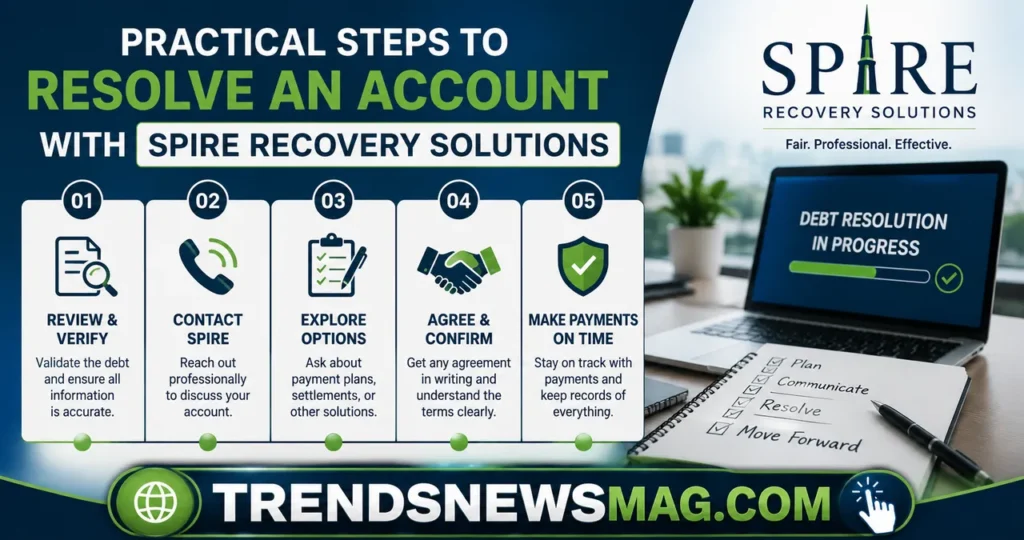
If you’ve confirmed that a debt with Spire Recovery Solutions is legitimate and you’re ready to move toward resolution, there are several practical paths available depending on your financial situation. The first option many consumers consider is a lump-sum settlement, where you negotiate to pay a reduced percentage of the total balance in exchange for the account being marked as settled or resolved. Collection agencies often have some flexibility here, particularly on older accounts, since recovering a partial payment is frequently preferable to recovering nothing at all if the account continues aging without resolution.
For consumers who can’t manage a lump-sum payment, structured payment plans represent another common path. These plans break the total balance into manageable monthly installments, and Spire Recovery Solutions, like most agencies, generally prefers this option over letting an account sit unpaid indefinitely. Before agreeing to any payment plan, it’s worth requesting written confirmation of the agreed terms, including the total amount, the payment schedule, and explicit language about how the account will be reported once payments are completed. Verbal agreements alone leave too much room for misunderstanding or disputes down the line.
It’s also worth exploring whether professional assistance makes sense for your specific situation. Nonprofit credit counseling agencies can help negotiate on your behalf and sometimes secure better terms than an individual consumer might achieve alone, particularly for those juggling multiple collection accounts simultaneously. In cases involving larger balances, disputed amounts, or situations where a lawsuit has already been filed, consulting a consumer protection attorney becomes increasingly worthwhile. Many attorneys in this space offer free initial consultations, and some cases involving clear FDCPA violations can even result in the attorney’s fees being covered by the collector rather than the consumer, since the law includes fee-shifting provisions designed to encourage enforcement of consumer protections. Whichever path you choose, getting every agreement with Spire Recovery Solutions in writing before sending any payment remains one of the most consistently important pieces of advice across the entire debt resolution process.
Working With or Against Spire Recovery Solutions: Career and Consumer Perspectives
It’s worth pausing to look at Spire Recovery Solutions from more than one angle, because the company exists at an interesting intersection between employer, creditor partner, and consumer touchpoint. On the employment side, the company has built out a career pipeline within the receivables management industry, offering training programs designed to bring new representatives up to speed on compliance requirements, negotiation techniques, and communication standards. Employee reviews on platforms like Indeed paint a mixed but fairly typical picture for the collections industry, with some employees describing meaningful growth opportunities, promotions, and a supportive team culture, while others describe the emotional weight of spending each workday speaking with people experiencing financial hardship, along with periodic frustrations around management communication and workplace support.
This dual reality isn’t unique to Spire Recovery Solutions, it reflects a broader tension present throughout the debt collection industry. Representatives are simultaneously expected to meet recovery performance targets while maintaining the kind of respectful, compliant communication that regulations require and that ethical business practice demands. Companies that manage this balance well tend to see lower turnover and fewer compliance complaints, since well-trained representatives who understand both the legal boundaries and the human element of these conversations tend to produce better outcomes for everyone involved, including the creditor clients who hired the agency in the first place.
From the creditor side, businesses considering a partnership with Spire Recovery Solutions typically evaluate the agency based on recovery rates, compliance track record, and how the agency’s communication style might reflect on the creditor’s own brand reputation, since consumers often associate a rude or aggressive collection experience with the original business even when a third-party agency handled the actual contact. Creditors increasingly prioritize agencies that emphasize transparency and consumer respect, not purely out of altruism, but because overly aggressive collection tactics can generate legal liability, regulatory scrutiny, and reputational damage that outweighs any short-term recovery gains. This shift in industry priorities helps explain why companies like Spire Recovery Solutions have leaned into messaging around ethical, consumer-first collection practices as a competitive differentiator rather than treating compliance as a mere legal formality.
Conclusion
Dealing with any debt collection agency can feel intimidating, but understanding exactly who Spire Recovery Solutions is and how the company operates transforms an anxious, uncertain situation into something far more manageable. This is a nationally licensed, veteran-founded debt collection agency based in Lockport, New York, working on behalf of creditors to recover unpaid balances across credit cards, medical bills, personal loans, and commercial debt. The company operates under federal regulations like the FDCPA and Regulation F, maintains SOC 2 data security compliance, and has built formal compliance infrastructure that gives consumers real avenues for accountability when something goes wrong.
At the same time, being informed doesn’t mean assuming every interaction will be flawless. Complaints about call frequency and communication practices exist, as they do for nearly every large-scale collection operation, which is exactly why knowing your rights matters so much. Requesting written debt validation, documenting every interaction, understanding your options for settlement or payment plans, and knowing when to bring in professional help are the tools that put you back in control of the conversation. Whether you ultimately negotiate a settlement, set up a payment plan, dispute inaccurate information, or determine the debt isn’t actually yours, approaching any contact from Spire Recovery Solutions with knowledge rather than panic is the single most effective strategy available to you. The debt itself might feel overwhelming in the moment, but the process for addressing it is far more structured, and far more within your control, than it might initially seem.
Related Corporate Insights: Track modern market shifts and structural evaluations through our analysis of Anduril Stock.
FAQs
What should I do if Spire Recovery Solutions calls me about a debt I don’t recognize?
Start by staying calm and avoiding the temptation to confirm personal information or agree to payment on the spot, since scammers sometimes impersonate legitimate agencies. Ask the representative to send written validation of the debt, including the original creditor’s name, the account number, and an itemized balance. You have thirty days from initial contact to formally request this documentation in writing, and Spire Recovery Solutions is legally required to pause collection efforts until they provide it. If the debt turns out to be unfamiliar even after receiving documentation, you can dispute it in writing and request further proof before making any payment.
Is Spire Recovery Solutions a legitimate company or a scam?
Spire Recovery Solutions is a legitimate, nationally licensed debt collection agency, not a scam operation. The company has been in business since 2014, maintains an A+ rating with the Better Business Bureau historically, and operates in compliance with federal debt collection laws including the FDCPA and Regulation F. That said, legitimacy as a company doesn’t mean every single call you receive claiming to be from them is guaranteed authentic, since scammers occasionally impersonate real collection agencies. Always verify any claim independently by contacting the company directly through official channels rather than a number provided in a suspicious call or text message.
How can I stop Spire Recovery Solutions from calling me?
You have the legal right to request that Spire Recovery Solutions stop contacting you, commonly known as a cease-and-desist request, and submitting this request in writing creates the strongest documentation. Once received, the company is generally required to stop calling, though it’s important to understand this doesn’t eliminate the underlying debt or prevent the original creditor from pursuing other collection avenues, including potential legal action. If calls continue after a documented cease-and-desist request, that continued contact may constitute a violation worth reporting to the Consumer Financial Protection Bureau or a consumer protection attorney.
Will Spire Recovery Solutions sue me if I don’t pay?
It’s possible, though not guaranteed, since the decision to pursue a lawsuit typically depends on the size of the debt, the strength of documentation, and the original creditor’s overall strategy for that account. If you receive notice of a lawsuit connected to a debt held by Spire Recovery Solutions, it’s important not to ignore it, since failing to respond can result in a default judgment against you, which carries far more serious consequences than the original debt alone, including potential wage garnishment depending on your state’s laws. Consulting a consumer protection attorney as soon as you receive any legal notice gives you the best chance of understanding your options and responding appropriately within required deadlines.
Can I negotiate a lower payment with Spire Recovery Solutions?
In many cases, yes. Collection agencies working on a contingency basis often have some flexibility to accept a reduced lump-sum settlement or arrange a structured payment plan, particularly for older accounts where partial recovery is preferable to continued nonpayment. Before agreeing to any negotiated terms with Spire Recovery Solutions, request written confirmation of the agreement, including the total settlement amount, payment schedule, and clear language regarding how the account will ultimately be reported to credit bureaus once resolved. Getting these terms in writing before sending payment protects you if any disagreement arises later about what was actually agreed upon.
Trending Today: [Sierra Trading Post]