Account Manager Job Description: The Complete Guide to Roles, Skills, and Career Growth in 2026

Every growing business eventually reaches a point where keeping clients happy becomes just as important as winning new ones. That’s usually when companies start searching for the right account manager job description to attract someone who can bridge the gap between sales, service, and long-term client success. It sounds simple on paper, but anyone who’s actually worked in this role knows there’s a lot happening beneath the surface. An account manager isn’t just a glorified customer service rep, nor are they purely a salesperson chasing renewals. They sit somewhere in between, wearing multiple hats depending on the day, the client, and the situation at hand.


If you’re a hiring manager trying to write a job posting that actually attracts qualified candidates, or a job seeker trying to understand what this career path really involves, you’re in the right place. This guide breaks down everything from core responsibilities to required skills, salary expectations, career trajectories, and the subtle differences between account managers and similar roles that often get confused with one another.
What Does an Account Manager Actually Do?
At its core, an account manager job description centers on one primary mission: maintaining and growing relationships with existing clients. Unlike sales representatives who focus heavily on acquiring new business, account managers inherit relationships after the initial sale and are responsible for nurturing them over months or even years. This means they become the face of the company for that particular client, the person who picks up the phone when something goes wrong, and the strategist who identifies opportunities for the client to expand their spending.
Think about it this way: if a company sells software subscriptions, the sales team closes the deal, but it’s the account manager who ensures the client actually gets value from that software, renews their contract next year, and maybe even upgrades to a premium tier. This distinction matters enormously because it shapes how account managers are evaluated. Their success isn’t measured by how many deals they close from scratch, but by retention rates, upsell revenue, and overall client satisfaction scores. A seasoned account manager once put it well when she said, “My job isn’t to sell something new every quarter. My job is to make sure the client never wants to leave in the first place.”
Day-to-day tasks vary depending on the industry, but common threads run through almost every account manager job description you’ll come across. These professionals typically conduct regular check-in calls with clients, prepare performance reports, troubleshoot issues before they escalate, coordinate with internal teams like product development or customer support, and negotiate contract renewals. In agency settings, account managers might also manage creative briefs, oversee project timelines, and act as a liaison between the client and internal creative teams. The role demands equal parts diplomacy, organization, and commercial awareness.
Core Responsibilities Found in Most Account Manager Job Descriptions
When you dig into dozens of job postings across different sectors, certain responsibilities appear again and again, forming the backbone of nearly every account manager job description out there. Relationship management sits at the very top of that list. This isn’t just about being friendly on calls; it involves deeply understanding a client’s business goals, industry challenges, and internal politics well enough to anticipate needs before the client even voices them.
Contract renewal and retention management represent another pillar of the role. Account managers are typically tasked with tracking contract expiration dates, initiating renewal conversations well in advance, and negotiating terms that satisfy both the client and the company’s revenue targets. This requires a delicate balance because pushing too hard on pricing can damage trust, while being too passive can leave money on the table or, worse, result in a client walking away entirely.
Cross-functional collaboration is equally critical. Account managers rarely operate in isolation. They work closely with sales teams during the handoff period when a new client signs on, coordinate with customer support when technical issues arise, and partner with product or marketing teams to relay client feedback that might influence future offerings. This internal networking aspect of the job often surprises newcomers who assume the role is purely client-facing. In reality, a significant portion of an account manager’s week involves internal meetings, status updates, and advocating for client needs within the organization.
Reporting and performance tracking round out the core duties. Most account managers are expected to maintain detailed records of client interactions, track key performance indicators like customer satisfaction scores or net revenue retention, and present quarterly business reviews that demonstrate value delivered. These reviews often become the foundation for renewal and upsell conversations, so the ability to translate data into a compelling narrative becomes a genuinely valuable skill.
Essential Skills Every Account Manager Needs
Reading through countless job postings reveals a consistent pattern in the skills section of any well-crafted account manager job description. Communication skills top the list every single time, and for good reason. Account managers spend their days translating technical jargon into language clients understand, delivering difficult news diplomatically, and persuading stakeholders to see things from a particular perspective. In fact, establishing this level of professional credibility is the backbone of long-term retention, echoing the same principles of transparency and trust highlighted by regulatory consumer watchdogs like the Better Business Bureau when evaluating business-to-client operations. Written communication matters just as much as verbal skills since much of the job involves emails, proposals, and written reports that need to be clear, professional, and free of ambiguity.
Emotional intelligence deserves far more attention than it typically receives in job descriptions, even though it’s arguably one of the most important traits for success in this field. Reading a client’s tone during a call, sensing frustration before it boils over, and knowing when to push versus when to listen requires a level of emotional awareness that can’t be taught through a training manual alone. One account director explained it this way: “You can teach someone the product inside and out, but you can’t easily teach someone how to read a room. That instinct either develops over time or it doesn’t.”
Organizational and time management abilities also feature prominently because account managers often juggle multiple client portfolios simultaneously. Depending on the industry and company size, a single account manager might handle anywhere from five to fifty accounts, each with different needs, timelines, and priorities. Without strong organizational systems, it becomes incredibly easy for details to slip through the cracks, and in this business, small oversights can quickly snowball into lost trust or lost revenue.
Negotiation skills round out the essential skill set. Whether discussing contract terms, addressing pricing concerns, or managing scope creep on a project, account managers need to advocate for their company’s interests while maintaining a client-first mindset. This dual loyalty, being both a company representative and a client advocate, creates a unique tension that experienced account managers learn to navigate with practiced ease.
Below is a table summarizing the key skills typically listed in account manager job description postings, along with why each one matters in practice.
| Skill | Why It Matters | How It’s Applied Daily |
|---|---|---|
| Communication | Builds trust and clarity with clients | Client calls, emails, presentations |
| Emotional Intelligence | Helps navigate tense or sensitive situations | Reading client mood, de-escalating conflict |
| Organization | Manages multiple accounts without errors | Tracking deadlines, renewals, deliverables |
| Negotiation | Balances company profit with client satisfaction | Contract renewals, pricing discussions |
| Data Analysis | Supports evidence-based recommendations | Performance reports, quarterly reviews |
| CRM Proficiency | Keeps client records organized and accessible | Logging interactions, tracking pipeline |
| Problem-Solving | Resolves issues before they escalate | Troubleshooting service or product concerns |
Educational Background and Qualifications
Most companies drafting an account manager job description will list a bachelor’s degree as a preferred or required qualification, though the specific field of study tends to be fairly flexible. Business administration, marketing, communications, and even psychology are common academic backgrounds among successful account managers. What matters more than the specific degree, though, is the candidate’s demonstrated ability to build relationships and manage competing priorities under pressure.
Interestingly, many companies have started relaxing formal education requirements in favor of relevant experience, particularly for candidates who’ve worked in customer-facing roles like sales development, customer support, or hospitality. For instance, managing high-volume customer interactions in entry-level corporate positions or retail roles—similar to what candidates experience when navigating Dunkin Donuts jobs—frequently provides practical exposure to the exact conflict-resolution skills needed for account management. These backgrounds often provide practical exposure to the exact skills needed for account management, sometimes more effectively than a traditional business degree could. A hiring manager at a mid-sized tech company mentioned during a recent industry panel, “I’d rather hire someone who spent two years handling difficult customers at a call center than someone with a business degree who’s never had to calm down an angry client on the phone.”
Certifications can also strengthen a candidate’s profile, even if they aren’t strictly required. Programs focused on customer relationship management, sales methodology, or project management provide structured frameworks that can accelerate a new account manager’s learning curve. Some professionals pursue certifications in specific CRM platforms like Salesforce, which can make them more attractive candidates since technical proficiency with these tools is increasingly non-negotiable in modern sales and service organizations.
Industry-specific knowledge often carries more weight than general qualifications, particularly in specialized fields like healthcare technology, financial services, or manufacturing. A company selling complex enterprise software, for instance, will likely prioritize candidates who understand the technical landscape well enough to have credible conversations with IT decision-makers. This is why you’ll often see an account manager job description that specifies “SaaS experience preferred” or “familiarity with supply chain logistics required” rather than generic qualifications alone.
Account Manager vs. Sales Representative vs. Customer Success Manager
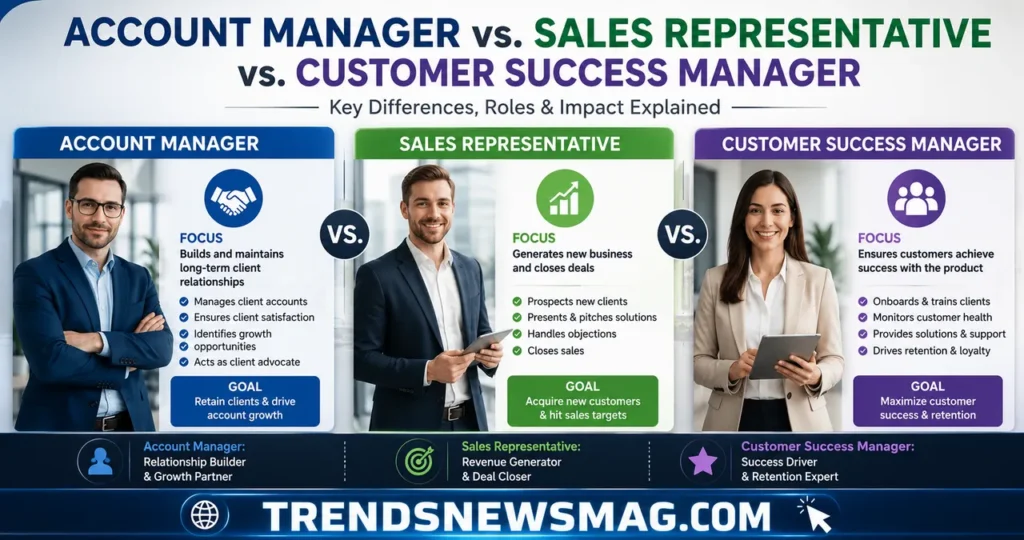
Confusion often arises because these three roles overlap in certain areas, and job titles vary wildly across industries. Understanding the distinctions helps both employers write more accurate job postings and helps candidates target roles that actually match their strengths and career goals.
Sales representatives focus primarily on new business acquisition. Their compensation structures typically emphasize commission tied to closing deals, and their success metrics revolve around conversion rates, deal size, and sales cycle length. Once a deal closes, sales reps in many organizations hand off the client relationship entirely, moving on to pursue the next prospect. Account managers, by contrast, inherit that relationship post-sale and focus on retention, expansion, and long-term value rather than initial acquisition.
Customer success managers occupy a role that’s increasingly similar to account management, particularly in the software and technology sectors, but there are subtle differences worth noting. Customer success managers typically focus more heavily on product adoption, ensuring clients actually use the features they’re paying for, and reducing churn through proactive engagement. Account managers, meanwhile, often carry more direct revenue responsibility, including upselling, cross-selling, and contract renewal negotiations. In smaller companies, these roles frequently merge into a single position, but larger organizations tend to separate them to allow for more specialized focus.
The lines blur even further when you consider that many companies use these titles interchangeably despite different underlying responsibilities. This is exactly why job seekers should read the actual responsibilities section of any account manager job description carefully rather than assuming the title alone tells the full story. Two companies might use identical job titles while describing completely different day-to-day realities, one leaning heavily toward relationship management and retention, the other functioning almost like a hybrid sales role with quota-driven expectations.
Industry Variations in Account Manager Roles
The specifics of an account manager job description shift considerably depending on the industry, and understanding these variations helps set realistic expectations for both employers and candidates. In advertising and marketing agencies, account managers often function as project coordinators as much as relationship managers. They oversee creative campaigns, manage client feedback loops, ensure deliverables meet deadlines, and act as the primary point of contact throughout a campaign’s lifecycle. This version of the role demands strong project management skills alongside traditional relationship-building abilities.
In the technology and SaaS sector, account managers frequently carry substantial revenue targets tied to renewals and expansion revenue, sometimes referred to as net revenue retention. These professionals need enough technical fluency to discuss product features, integrations, and use cases credibly, even if they aren’t expected to troubleshoot technical issues themselves. The stakes tend to be higher here because software contracts often represent significant annual recurring revenue, and losing even a handful of key accounts can meaningfully impact a company’s growth trajectory.
Financial services and insurance industries present yet another variation, where account managers often need specialized licensing or certifications depending on regulatory requirements. These roles frequently involve managing complex, high-value relationships with corporate clients, requiring a deep understanding of financial products, risk management, and regulatory compliance. The sales cycles tend to be longer, the relationships more formal, and the trust-building process considerably more gradual compared to faster-moving industries like technology or retail.
Manufacturing and distribution companies often structure account manager roles around large-scale supply agreements, where the job involves coordinating logistics, managing inventory expectations, and serving as the communication hub between the client’s procurement team and the company’s operations department. These roles tend to be less about persuasive selling and more about operational reliability, ensuring that promises made during the sales process are consistently fulfilled over time.
Salary Expectations and Career Progression
Compensation for account managers varies significantly based on industry, geographic location, company size, and the specific revenue responsibilities attached to the role. Entry-level positions, often labeled as junior account managers or account coordinators, typically offer base salaries that reflect the learning curve involved, with total compensation packages sometimes including modest performance bonuses tied to client retention metrics. As professionals gain experience and demonstrate their ability to manage larger, more complex accounts, compensation tends to scale considerably, particularly in industries like technology and financial services where account values run into the hundreds of thousands or even millions of dollars annually.
Senior account managers and account directors often earn substantially more, with compensation structures that frequently include base salary plus commission or bonus components tied directly to renewal rates, upsell revenue, and overall portfolio growth. This performance-based element means that top-performing account managers in lucrative industries can earn compensation packages that rival or exceed those of traditional sales representatives, particularly when managing high-value enterprise accounts.
Career progression from an account manager role typically follows a few distinct paths. Many professionals move into senior account management or account director positions, taking on larger client portfolios and mentoring junior team members. Others pivot toward sales leadership roles, leveraging their deep understanding of client relationships and revenue generation to manage broader sales teams. Some account managers transition into customer success leadership, particularly in technology companies where these functions increasingly overlap. There’s also a notable path toward general management or business development roles, since the combination of relationship management, negotiation, and strategic thinking developed in account management translates well to broader business leadership positions.
A veteran account manager who eventually became a VP of client services reflected on this trajectory: “Account management taught me more about running a business than any MBA program could have. You learn how revenue actually works, how relationships translate into dollars, and how to read what a client isn’t saying out loud.” This sentiment echoes across the industry, where many executives point back to their early account management experience as foundational to their broader business acumen.
How to Write an Effective Account Manager Job Description
For hiring managers and recruiters, crafting a compelling account manager job description requires striking a balance between specificity and appeal. Overly generic postings filled with corporate jargon tend to attract a flood of unqualified applicants, while overly narrow requirements might discourage strong candidates who could excel in the role despite not checking every single box. The most effective postings clearly articulate the actual day-to-day responsibilities rather than relying on vague phrases like “manage client relationships” without further elaboration.
Specificity around metrics and expectations helps set the right tone from the very beginning. Rather than simply stating that the role involves “meeting sales targets,” effective job descriptions specify actual expectations, such as maintaining a certain retention rate, managing a portfolio of a specific size, or achieving particular upsell revenue targets within the first year. This transparency helps candidates self-select appropriately, reducing turnover that often results from mismatched expectations discovered only after hiring.
Including information about company culture, team structure, and growth opportunities also strengthens a job posting considerably. Candidates evaluating account manager roles are often comparing multiple opportunities simultaneously, and details about mentorship programs, career advancement paths, or the specific tools and technologies used can meaningfully influence their decision-making process. A posting that simply lists responsibilities without conveying any sense of the actual working environment misses an opportunity to differentiate itself in a competitive hiring market.
Finally, being upfront about required versus preferred qualifications helps attract a broader, more diverse pool of qualified candidates. Research consistently shows that candidates, particularly those from underrepresented backgrounds, are less likely to apply for roles where they don’t meet every single listed requirement, even when those requirements are merely preferred rather than mandatory. Clearly distinguishing between must-have qualifications and nice-to-have bonuses can significantly expand the applicant pool without sacrificing candidate quality.
Common Challenges Account Managers Face
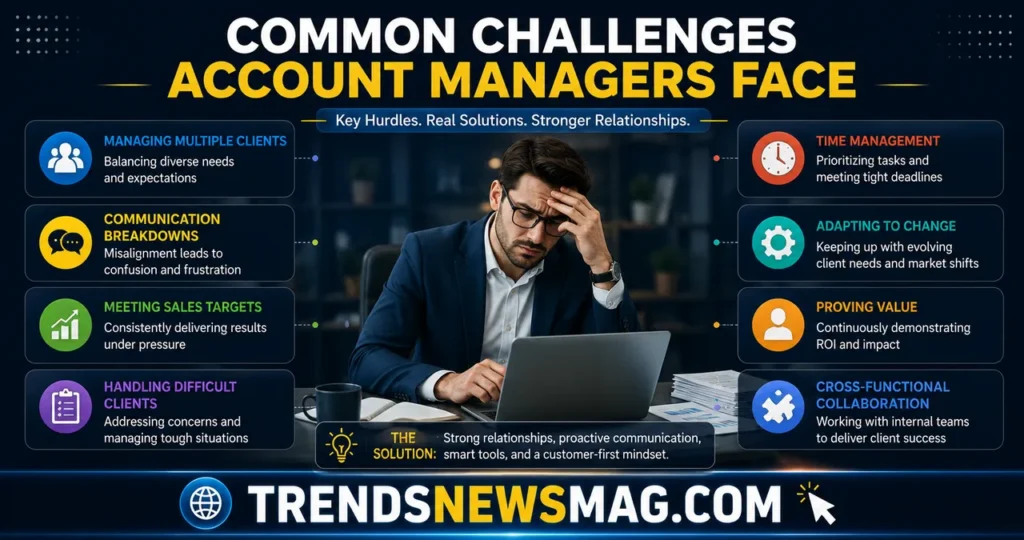
Despite the rewarding aspects of the role, account management comes with its fair share of challenges that rarely make it into the polished version of an account manager job description. Managing client expectations, particularly when internal teams can’t deliver exactly what was promised during the sales process, creates ongoing tension that account managers must navigate diplomatically. This often means having difficult conversations, delivering unwelcome news, and finding creative solutions that satisfy the client without overpromising on behalf of internal teams who ultimately execute the work.
Portfolio overload represents another persistent challenge, particularly in companies that underinvest in account management staffing relative to their client base. When account managers are stretched too thin across too many accounts, the quality of relationship management inevitably suffers. This tension is magnified during broader corporate restructurings or operational downsizings—much like the market shifts observed during the major Wells Fargo layoffs—where remaining staff must suddenly balance scaling workloads alongside strict retention goals, leading to a vicious cycle where dissatisfied clients require even more intensive attention, further straining already limited bandwidth. This challenge highlights why staffing ratios matter enormously when companies think about scaling their account management function alongside overall business growth.
Internal misalignment between sales, product, and account management teams can also create friction that account managers must constantly manage. Sales teams focused on closing new deals sometimes make promises that stretch beyond what the product can actually deliver, leaving account managers to manage the resulting client disappointment. Similarly, product teams operating on their own roadmap priorities may not always align with the specific feature requests that account managers know would strengthen client relationships. Successfully navigating these internal dynamics requires political savvy alongside pure relationship management skills.
Emotional burnout deserves honest acknowledgment as well. Constantly managing other people’s problems, absorbing frustration during difficult conversations, and maintaining composure even when clients are unreasonable takes a genuine psychological toll over time. Companies that recognize this reality and provide adequate support, whether through manageable workloads, clear escalation paths, or simply a culture that validates the emotional labor involved, tend to retain their account management talent far more effectively than those that treat the role as purely transactional.
The Future of Account Management as a Career
The account management profession continues evolving alongside broader shifts in how businesses operate and how customers expect to be served. The increasing emphasis on customer experience as a competitive differentiator has elevated the strategic importance of account management within many organizations, moving it from a purely operational function toward a more strategic, revenue-critical role. Companies increasingly recognize that retaining existing customers costs significantly less than acquiring new ones, which has fueled greater investment in account management teams and technology.
Data-driven decision making has also transformed how account managers approach their work. Modern account management increasingly relies on customer health scores, predictive analytics around churn risk, and sophisticated CRM systems that provide real-time visibility into account status. This shift means that today’s account managers need stronger analytical capabilities than their predecessors, even as the fundamental relationship-building skills remain equally important. The most successful professionals in this field combine genuine interpersonal warmth with a comfortable fluency in data and technology.
The blurring lines between account management, customer success, and sales will likely continue as companies experiment with organizational structures that best serve their specific business models. Some organizations are moving toward fully integrated revenue teams where the traditional boundaries between these functions dissolve entirely, while others maintain clear separation to allow for specialized expertise. Regardless of structural preferences, the underlying skills that make someone successful in account management, communication, empathy, organization, and commercial awareness, remain consistently valuable across whatever specific title or structure a company adopts.
Conclusion
Understanding what goes into a comprehensive account manager job description matters whether you’re building out your company’s client-facing team or exploring this career path for yourself. The role demands a unique combination of relationship-building finesse, commercial awareness, and organizational discipline that doesn’t always come naturally, but can absolutely be developed with the right mindset and experience. From managing renewals and expansion revenue to serving as the internal advocate for client needs, account managers occupy a genuinely pivotal position within modern business operations.
For companies, writing an accurate and compelling job description means going beyond generic responsibilities and painting a realistic picture of what success looks like in the role, including specific metrics, growth opportunities, and the actual day-to-day rhythm of the position. For job seekers, understanding these nuances helps target opportunities that align with genuine strengths, whether that means gravitating toward relationship-heavy roles in agency environments or revenue-focused positions in technology companies. Either way, account management remains one of the more dynamic, people-centered career paths available today, offering substantial room for growth for those willing to master its particular blend of empathy and strategic thinking.
What is the difference between an account manager and a project manager?
Account managers primarily focus on maintaining and growing client relationships over the long term, handling renewals, upsells, and overall client satisfaction, while project managers concentrate on executing specific deliverables within defined timelines and budgets. In many organizations, these roles work closely together, particularly in agency settings, with the account manager serving as the client-facing relationship owner while the project manager handles internal execution details. Some smaller companies combine both functions into a single role, but larger organizations typically separate them to allow for specialized focus on their distinct skill sets.
Do you need a specific degree to become an account manager?
Most companies list a bachelor’s degree as preferred rather than strictly mandatory in their account manager job description, and the specific field of study tends to be quite flexible. Degrees in business, marketing, or communications are common, but many successful account managers come from entirely different academic backgrounds, having developed relevant skills through customer-facing work experience instead. Employers increasingly prioritize demonstrated relationship management ability and relevant industry experience over specific educational credentials, particularly for candidates who can showcase a track record of successful client management in previous roles.
What industries hire the most account managers?
Technology and software companies represent one of the largest employers of account managers, given the emphasis on recurring revenue and subscription-based business models that require ongoing client relationship management. Advertising and marketing agencies also hire extensively for these roles, along with financial services, insurance, healthcare, and manufacturing sectors. Essentially, any industry built around long-term client relationships and repeat business, rather than one-time transactions, tends to maintain robust account management teams as a core part of their organizational structure.
How is success measured in an account manager role?
Success metrics vary by company and industry, but common measurements include client retention rates, net revenue retention, upsell and cross-sell revenue generated, customer satisfaction scores, and the overall health of the account portfolio. Many companies also evaluate qualitative factors like the strength of client relationships and the account manager’s ability to identify and communicate growth opportunities within existing accounts. Unlike traditional sales roles measured purely on new deal closure, account manager success tends to be evaluated through a more holistic lens that considers both immediate revenue impact and long-term relationship health.
Can an account manager transition into a sales role?
Yes, this transition happens quite frequently, and the skills developed in account management translate remarkably well to sales positions. Account managers already possess strong negotiation abilities, deep understanding of client psychology, and experience articulating value propositions, all of which are directly applicable to new business sales roles. Many companies actually view account management experience as valuable preparation for sales leadership positions specifically, since these professionals understand both sides of the customer lifecycle, from initial acquisition through long-term retention and growth.
What makes someone successful in an account manager job description role versus struggling in it?
The professionals who thrive in account management typically combine genuine curiosity about their clients’ businesses with strong emotional intelligence and disciplined organizational habits. Those who struggle often either lean too heavily toward being purely reactive customer service providers without driving strategic value, or conversely, push too aggressively on sales without adequately nurturing the underlying relationship. The most successful account managers strike a careful balance, proactively identifying opportunities while maintaining the trust and rapport that keeps clients loyal over the long term, ultimately treating every account as a long-term partnership rather than a series of individual transactions.
Trending Today: [MotoAssure BBB]