The Complete Starbucks Schedule Guide: How Partners Check, Manage, and Master Their Shifts in 2026


Walk into any Starbucks store before opening and you’ll notice something interesting: the baristas already know exactly where they need to be, what time they clock in, and who’s covering the espresso bar versus the drive-thru window. None of that happens by accident. Behind every smooth morning rush sits a carefully built Starbucks schedule, generated through a mix of software, store-level planning, and old-fashioned communication between managers and their teams.


If you’re a new partner trying to figure out how shift assignments work, a job seeker wondering how flexible the hours really are, or a curious customer who just wants to understand why your favorite barista seems to work such odd hours, this guide covers everything. We’ll walk through how the scheduling system functions from the inside, how partners view and manage their shifts, what happens when life gets in the way of a planned shift, and how the whole process has evolved to keep up with a workforce that increasingly wants flexibility without sacrificing consistency.
This isn’t a shallow overview. We’re going deep into the mechanics, the terminology, the common frustrations, and the practical tips that make navigating a Starbucks schedule far less stressful than it sounds.
How the Starbucks Schedule System Actually Works
Every Starbucks store operates on a rolling schedule that’s built roughly one to three weeks in advance, depending on the store’s staffing levels and the manager’s planning habits. Store managers and shift supervisors use a centralized workforce management platform, historically known internally as Teamworks (sometimes referred to by partners simply as “the scheduling system” or by its interface name), to build out shift assignments based on projected sales, labor budgets, and partner availability.
The process starts with something called a labor forecast. Corporate systems analyze historical sales data, local events, seasonal trends, and even weather patterns to predict how busy a store will be during any given hour of the week. A store near a college campus, for example, will see wildly different demand patterns than one in a suburban strip mall or an airport terminal. That forecast then translates into labor hours, which store managers distribute across their team through the schedule.
Once the forecast is set, managers open their scheduling dashboard and begin assigning partners to shifts based on who’s available, who has requested specific days off, and who needs a certain number of hours to hit their target weekly average. This is where things get more human. A store manager isn’t just plugging numbers into a spreadsheet; they’re balancing dozens of individual preferences, skill levels, and personal circumstances every single week. Someone might have finals coming up. Another partner might have just become a parent and needs mornings free for daycare drop-off. The Starbucks schedule reflects all of that behind-the-scenes juggling, even if the end result looks like a simple grid of names and times.
Partners typically receive their schedule about one to two weeks before it takes effect, though this varies by region and by how far in advance a particular store plans. In busier markets or during peak seasons like the holiday rush, schedules might be finalized further out to give partners more lead time. In slower markets, some managers build week-to-week, which can feel less predictable for partners trying to plan their personal lives around work.
The Role of Availability in Building a Schedule
Every partner fills out an availability profile when they’re hired, and this document becomes the backbone of every schedule built afterward. Availability isn’t just a list of days you can work; it’s a detailed breakdown of the specific hours you’re free on each day of the week, along with any recurring commitments like classes, a second job, or childcare responsibilities.
This availability profile directly shapes what a partner’s Starbucks schedule can look like. If you’ve told the system you’re only free after 3 p.m. on weekdays, you won’t be popping up for opening shifts no matter how short-staffed the morning crew is. Managers are generally required to schedule within the bounds of what a partner has submitted, which protects partners from being assigned hours that conflict with school, family, or other obligations.
That said, availability isn’t set in stone. Life changes, and Starbucks allows partners to update their availability through the same portal used to check their schedule, usually with a required notice period before it takes effect. This flexibility is one of the more underrated aspects of working there compared to some other retail and food service jobs, where availability changes can take weeks to process or require awkward face-to-face negotiations with a manager.
Checking Your Starbucks Schedule Online and Through the App
For years, checking a Starbucks schedule meant physically walking into the store and looking at a printed sheet taped to the wall in the back room. That still happens in some locations, especially for partners who prefer a quick glance during their shift, but the overwhelming majority of schedule-checking now happens digitally.
Partners access their schedule primarily through the Starbucks partner portal, often referred to internally by its interface name, which is accessible through a web browser or through the Starbucks partner mobile app depending on the region and system version in use. Once logged in with partner credentials, the schedule appears as a weekly or biweekly calendar view showing shift start times, end times, assigned roles, and sometimes notes from the manager about specific responsibilities for that shift.
The mobile experience has improved significantly over the past few years. Instead of needing store Wi-Fi or a personal computer, partners can pull up their Starbucks schedule from their phone whether they’re at home, commuting, or even standing in line at a different Starbucks location. This matters more than it might seem at first glance. Retail and food service scheduling has historically been one of the more unpredictable aspects of hourly work, and having instant access to shift information reduces a huge amount of everyday stress.
Here’s a breakdown of the most common ways partners interact with their schedule:
| Method | Best For | Typical Access Time | Notes |
|---|---|---|---|
| Partner mobile app | Quick daily checks, shift swap requests | Anytime with signal | Most widely used method among newer partners |
| Partner web portal | Detailed weekly planning, availability updates | Anytime with internet access | Better for viewing full pay periods at once |
| In-store printed schedule | Partners without smartphone access | During store hours only | Still used as a backup in many locations |
| Manager announcement | Last-minute changes or urgent coverage needs | Real-time during shifts | Common for emergency schedule adjustments |
This table captures the practical reality that most partners don’t rely on a single method. A typical partner might glance at the app before bed to confirm tomorrow’s start time, then double-check the printed version taped in the break room out of habit. Redundancy isn’t a bad thing when your income depends on showing up at the right place at the right time.
Why the Digital Shift Matters for Partners
The move toward app-based scheduling wasn’t just a convenience upgrade; it fundamentally changed how partners relate to their work hours. Before mobile access became standard, a partner might not know about a schedule change until they physically arrived at the store, sometimes finding out they’d been cut from a shift they’d planned their entire day around. Now, notifications can alert partners in near real-time when something changes.
One barista, reflecting on the shift in workplace culture, put it simply: “I used to have to call the store just to ask if I was working Saturday. Now I just check my phone before I even get out of bed.” That small shift in accessibility has ripple effects across a partner’s whole life, from arranging childcare to planning a second job around their primary Starbucks schedule.
It’s also worth noting that digital access hasn’t eliminated the occasional glitch. Sync issues between the scheduling backend and the partner-facing app do happen, particularly during system updates or major software rollouts. Experienced partners often recommend cross-referencing the app with the version posted in-store whenever something looks off, just to be safe.
Understanding Shift Types Within a Starbucks Schedule
Not every shift on a Starbucks schedule looks the same, and understanding the different categories helps explain why two partners working the same day might have completely different experiences. Opening shifts typically start well before the store’s public hours, sometimes as early as 4:30 or 5 a.m., and involve setup tasks like brewing the first batches of coffee, prepping pastry cases, and running through equipment checks. These shifts tend to be quieter in terms of customer volume but demanding in terms of physical setup work.
Mid-shifts fall during the store’s busiest windows, generally covering the morning rush and into the early afternoon. These are often the most hectic hours on any Starbucks schedule, especially on weekdays when commuters and remote workers alike are lining up for their caffeine fix. Closing shifts wrap up the day with cleaning, inventory counts, and securing the store, often extending slightly past the posted closing time to finish these tasks properly.
Some stores, particularly those in airports, hospitals, or 24-hour retail centers, run overnight shifts as well. These are far less common but do exist within certain regional Starbucks schedule structures, catering to locations that never fully close. Overnight shifts tend to attract a specific type of partner: night owls, students with daytime classes, or people who simply prefer working when the world is quieter.
Split Shifts and Their Growing Rarity
Split shifts, where a partner works a few hours in the morning, has a break of several hours, then returns for another block later in the day, used to be more common in food service generally. Within the modern Starbucks schedule structure, they’ve become increasingly rare, largely because they’re unpopular with partners and create scheduling complications for managers trying to hit labor efficiency targets.
When split shifts do appear, they’re usually tied to unusual circumstances, like a store needing extra coverage during a specific promotional event or a partner specifically requesting that structure to accommodate something like a class schedule that falls in the middle of the day. Most managers try to avoid them altogether because they eat into a partner’s day without necessarily benefiting anyone involved.
How Many Hours Does a Typical Starbucks Schedule Include

This is one of the most frequently asked questions among both prospective and current partners, and the honest answer is: it depends heavily on employment classification, store needs, and individual availability. Starbucks generally distinguishes between full-time and part-time partners, though the company has historically been somewhat flexible with this categorization compared to strict retail norms.
Part-time partners, who make up the majority of the hourly workforce, typically see anywhere from 15 to 30 hours per week on their Starbucks schedule, though this fluctuates based on seasonal demand, store staffing levels, and how much availability a partner has provided. Full-time status, which unlocks additional benefits eligibility in many cases, generally requires an average of at least 20 hours per week over a set period, though the specific threshold and benefit structure can vary by region and should be confirmed directly with a store manager or HR resource, since policy details shift over time.
It’s worth noting that Starbucks has faced public scrutiny in the past over scheduling consistency, particularly around the challenge of guaranteeing a stable Starbucks schedule for partners who need predictable income. In response, the company has made public commitments over the years toward more consistent scheduling practices, including guaranteeing a minimum number of hours in certain circumstances and providing more advance notice for schedule changes. These commitments have evolved over time and can differ by store and by local labor regulations, so partners are always encouraged to check current store-level policy rather than relying solely on general industry knowledge.
Seasonal Fluctuations and Their Effect on Hours
Anyone who has worked retail or food service knows that hours ebb and flow with the seasons, and Starbucks is no exception. The lead-up to the holidays, particularly the weeks surrounding the launch of seasonal beverages, tends to bring a noticeable uptick in available hours as stores staff up for increased foot traffic. A Starbucks schedule built in early November often looks dramatically different from one built in a quieter month like February.
Conversely, the period right after the holidays and into the early part of the year tends to see hours pull back as customer traffic normalizes. Partners who rely heavily on their Starbucks schedule for a specific income level often learn to anticipate these seasonal dips and plan accordingly, whether that means picking up shifts at a second job during slower months or building a small financial cushion during the busier holiday season.
Back-to-school season is another notable inflection point, particularly for stores located near college campuses or in areas with a high concentration of students. Availability changes en masse as students head back to classes, forcing managers to essentially rebuild significant portions of their scheduling approach within a short window.
Requesting Time Off and Managing Schedule Conflicts
Life doesn’t pause just because a Starbucks schedule has already been posted, and the company does provide structured ways for partners to request time off or adjust their availability. Time-off requests are typically submitted through the same digital platform used to view the schedule, and partners are generally encouraged to submit these requests as far in advance as possible, particularly for high-demand periods like major holidays when many partners are competing for the same days off.
The approval process usually falls to the store manager or an assistant manager, who has to balance individual requests against overall staffing needs. This is where seniority and communication style can genuinely matter. A partner who’s built a good working relationship with their manager and who submits requests well in advance tends to have an easier time getting approval than someone who asks for a specific day off at the last minute, especially during a period the store already anticipates being short-staffed.
For unexpected situations, such as sudden illness or a family emergency, most stores have an informal but well-understood process for finding last-minute coverage. This often involves a group messaging thread among partners at a given location, where someone who can no longer work their shift posts the details and waits to see if a colleague is willing to pick it up. Managers are typically looped in to approve the swap once coverage is confirmed, ensuring the official Starbucks schedule record stays accurate for payroll and labor tracking purposes.
The Shift Swap Process in Detail
Shift swapping deserves its own explanation because it’s one of the more valuable flexibility tools available to partners. Rather than needing a manager to completely rebuild a schedule around a single request, two partners can often agree between themselves to trade shifts, subject to manager approval to make sure the swap doesn’t create labor compliance issues or put someone into overtime unexpectedly.
The practical steps generally look something like this: a partner identifies a shift they can’t work, posts it (either digitally through the scheduling platform’s swap feature, if available at that store, or informally through a team chat), and waits for another eligible partner to claim it. Once claimed, the manager reviews and approves the change, which then updates the official Starbucks schedule so payroll and labor reporting remain accurate.
Not every store has a fully digital swap feature enabled, which means the process can look slightly different from location to location. Some managers prefer handling all swap requests personally to maintain tighter control over labor costs and skill coverage, particularly making sure that certified partners, like those trained on specific equipment or food safety protocols, aren’t accidentally swapped out of a shift that requires their certification.
The Human Side of Scheduling: Manager Perspectives
It’s easy to think of a Starbucks schedule as purely a technical output of software and algorithms, but the reality on the ground involves a significant amount of human judgment. Store managers are essentially solving a puzzle every single week, one that has to account for labor budgets handed down from corporate, individual partner needs, seasonal demand shifts, and the simple reality that people get sick, have family emergencies, or occasionally just don’t show up.
A manager who has run a busy urban location for several years described the balancing act this way: “You’re never just filling slots. You’re thinking about who works well together during a rush, who needs more hours this month because rent went up, who’s got finals coming and needs lighter weeks. The software gives you a framework, but the actual schedule is still a judgment call.” That sentiment echoes across countless Starbucks locations, where the difference between a smoothly run store and a chaotic one often comes down to how thoughtfully the manager approaches this weekly task.
This human element also explains why two stores in the same city, even ones just a few miles apart, can have noticeably different scheduling cultures. One store might prioritize consistency, giving partners the same general shift pattern week after week to support predictable routines. Another might lean into flexibility, rotating shifts more frequently to accommodate a workforce made up largely of students with constantly shifting class schedules. Neither approach is inherently better; they simply reflect what works best for that particular team and customer base.
Common Scheduling Challenges Partners Face
No system is perfect, and the Starbucks schedule process has its share of recurring frustrations that partners across different locations tend to mention. Understanding these challenges isn’t about criticizing the company unfairly; it’s about setting realistic expectations for anyone considering the job or currently navigating it.
Inconsistent hours rank among the most commonly cited frustrations, particularly for partners who need predictable income to budget effectively. Even with company-wide commitments toward more consistent scheduling, individual store performance and staffing levels can still create week-to-week variability that makes financial planning harder than it should be. This is especially true for partners working in markets with strong seasonal swings, where the gap between a busy December schedule and a quiet February one can feel jarring.
Short notice for schedule changes is another recurring issue, though it’s become less common as digital tools have improved communication speed. Still, situations arise where a manager needs to adjust the Starbucks schedule on short notice due to unexpected call-outs or sudden shifts in projected business, and not every partner has the flexibility to accommodate last-minute changes, particularly those juggling school, childcare, or a second job.
Availability mismatches represent a subtler but equally real challenge. A partner might submit fairly open availability when first hired, only to find their personal circumstances change significantly a few months later. If they don’t proactively update their availability profile, they can end up with a Starbucks schedule that no longer fits their actual life, leading to unnecessary stress and, in some cases, difficult conversations with management about repeated conflicts.
How Partners Successfully Navigate These Challenges
Despite these hurdles, plenty of partners find ways to make the system work well for them, and their strategies offer useful guidance for anyone new to the role. Proactive communication tends to be the single biggest factor separating partners who feel in control of their schedule from those who feel constantly blindsided by it. Regularly updating availability, submitting time-off requests early, and maintaining a good relationship with the scheduling manager all contribute to a smoother experience.
Building relationships with fellow partners also pays off significantly, particularly when it comes to shift swaps. A partner who’s built goodwill by covering for colleagues in the past generally finds it easier to get coverage themselves when they need it. This kind of informal support network, while not officially part of the company’s scheduling infrastructure, plays a real role in how smoothly the day-to-day Starbucks schedule actually functions at the store level.
Some partners also recommend treating the scheduling app as a daily habit rather than a once-a-week check-in. Given that changes can happen with relatively short notice, particularly during high-volume periods, checking the app regularly reduces the chance of missing an update or showing up unaware that a shift has changed.
How Corporate Policy Shapes the Local Starbucks Schedule
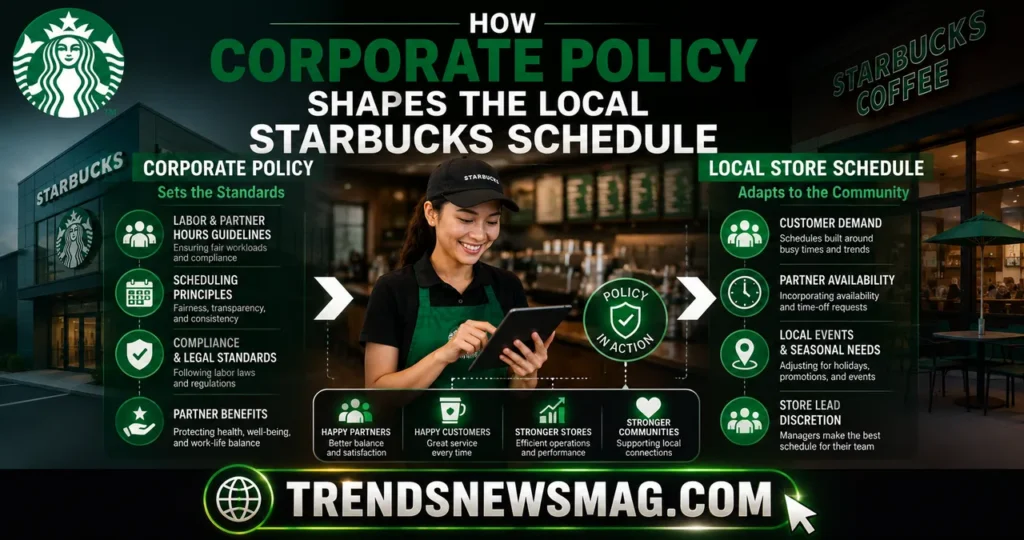
While individual store managers have significant day-to-day control over building the actual Starbucks schedule, corporate policy sets the guardrails within which that scheduling happens. Labor budgets, minimum staffing requirements for safety and service standards, and broader company commitments around scheduling fairness all flow down from corporate decision-making into the local scheduling process.
One area where this has been particularly visible is in the company’s public statements around scheduling consistency and advance notice. Following years of feedback from partners and broader public conversation around retail scheduling fairness, Starbucks has made various commitments over time, including efforts to provide schedules further in advance and to offer more predictable hours where possible. The specifics of these commitments have shifted over the years and can vary by store type, region, and local labor law, which sometimes imposes its own requirements around predictive scheduling that companies must follow regardless of internal policy.
Local labor laws deserve particular attention here because they can meaningfully affect how a Starbucks schedule is built in certain cities and states. Some jurisdictions have enacted “fair workweek” or “predictive scheduling” laws that legally require employers to provide advance notice of schedules, often with financial penalties for last-minute changes. Stores operating in these jurisdictions may follow noticeably different scheduling timelines than stores in areas without such regulations, which explains some of the regional variation partners notice when comparing notes with friends who work at Starbucks in different cities.
Balancing a Starbucks Schedule With School, Family, or a Second Job
One of the reasons Starbucks has historically attracted a diverse workforce, from students to parents to people building a second income stream, is the relative flexibility built into the scheduling system compared to some other hourly employers. That said, flexibility only works well when partners actively manage their end of the equation, particularly their availability profile and their communication with management.
Students juggling a Starbucks schedule alongside coursework often find success by submitting detailed, semester-specific availability updates at the start of each term, clearly blocking out class times and study commitments rather than leaving broad gaps that a manager might otherwise try to fill. This proactive approach tends to result in a schedule that genuinely respects academic obligations rather than creating constant friction.
Parents managing childcare responsibilities around their Starbucks schedule frequently lean on the shift swap system and early time-off requests to handle the inevitable unpredictability that comes with young children, from sick days to school events. Building a relationship with a small group of trusted co-workers who are willing to help with swaps can make an enormous difference here, effectively creating a small safety net within the larger scheduling system.
For those balancing a second job alongside their Starbucks role, clear communication with both employers about availability constraints is essential. Managers generally try to respect these boundaries, but they can only do so effectively if they have accurate, up-to-date information about when a partner is genuinely unavailable versus when they simply prefer not to work.
Technology’s Ongoing Impact on Scheduling Accuracy
The tools behind the modern Starbucks schedule have come a long way from paper printouts and phone calls. Predictive analytics now play a significant role in forecasting labor needs, pulling from historical sales data, regional trends, and even factors like local weather forecasts to help managers staff appropriately for the days ahead. This reduces the likelihood of a store being drastically overstaffed or understaffed, which benefits both the business and the partners working there, since overstaffing can mean cut hours while understaffing means unnecessarily stressful shifts.
Mobile accessibility has also improved communication around last-minute changes. Push notifications alert partners when something on their Starbucks schedule shifts, reducing the chances of a miscommunication leading to a missed shift or an unexpected no-show. This kind of real-time visibility has become something of an industry standard across food service and retail, but Starbucks’ scale means the investment in reliable scheduling technology has an outsized impact on day-to-day operations across thousands of stores.
That said, technology isn’t a complete substitute for good management practices. The most sophisticated scheduling software still relies on a manager entering accurate information, respecting partner availability, and making thoughtful judgment calls about labor distribution. Stores with strong management tend to have smoother, more predictable schedules regardless of which specific software version they’re running, while stores with weaker management can struggle even with excellent tools at their disposal.
Tips for New Partners Learning to Navigate Their Schedule
Anyone starting a new role at Starbucks benefits from a few practical habits when it comes to managing their schedule effectively. First, download and familiarize yourself with the partner app or portal immediately, rather than waiting until you actually need to check something urgently. Understanding how to read the interface, where to find shift details, and how to submit availability changes before you’re in a time crunch saves considerable stress down the line.
Second, take your initial availability submission seriously and be realistic rather than overly restrictive or overly open. Submitting availability that’s too narrow can limit your hours significantly, since managers naturally prioritize partners who can fill more of the store’s needs. On the other hand, submitting availability that doesn’t reflect your actual life will lead to a Starbucks schedule full of conflicts you’ll need to resolve later, creating unnecessary friction with your manager.
Third, build a habit of checking your schedule at consistent intervals, ideally a few times a week, rather than only glancing at it once when it’s first posted. Changes can and do happen, and staying informed protects you from the stress of showing up unprepared or missing a shift you didn’t realize had shifted.
Finally, don’t underestimate the value of simply talking to your manager. A five-minute conversation about an upcoming conflict, whether it’s a wedding, a big exam, or a family trip, almost always produces a better outcome than trying to solve the problem entirely through digital requests after the fact. Managers appreciate partners who communicate proactively, and that goodwill tends to pay dividends when you need a favor down the road.
How Seasonal Hiring Affects the Overall Schedule
During peak seasons, particularly the holiday period from November through early January, many Starbucks locations bring on seasonal or temporary staff to handle increased customer volume. This influx of new partners has a ripple effect across the entire store’s Starbucks schedule, as managers work to integrate new team members while still honoring the established hours and preferences of existing staff.
Existing partners sometimes worry that seasonal hires will cut into their available hours, and while this can happen to some degree, most well-run stores try to balance the equation by giving seasonal staff the additional volume-driven hours rather than pulling significant hours away from established partners. Communication from management during this period tends to increase specifically to manage these concerns and keep the team informed about how the seasonal schedule will be structured.
Once the holiday rush ends, stores typically scale back down, and seasonal partners either transition into a more permanent part-time role if there’s ongoing need, or their employment naturally winds down as the Starbucks schedule contracts back to typical staffing levels. This cyclical pattern is well understood by experienced partners, many of whom have seen multiple holiday seasons come and go and know roughly what to expect each year.
Comparing Starbucks Scheduling to Other Retail and Food Service Jobs
For anyone weighing a job at Starbucks against other retail or food service opportunities, it’s worth understanding how the scheduling experience generally compares. Many partners who’ve worked in other food service environments before joining Starbucks note that the digital tools available for checking and managing a Starbucks schedule tend to be more robust than what they experienced elsewhere, particularly at smaller independent businesses that may still rely on paper schedules or basic text message coordination.
That said, Starbucks isn’t uniquely immune to the broader challenges facing hourly retail work, including the tension between labor cost control and providing stable, predictable hours for staff. Larger chains with more resources to invest in workforce management technology, predictive analytics, and structured policies around advance notice tend to offer a somewhat more consistent experience than smaller operations, and Starbucks generally falls into that better-resourced category. Still, individual store management quality remains a significant variable regardless of company size, meaning two Starbucks locations can offer meaningfully different day-to-day scheduling experiences.
Read more: Mobile Homes For Sale Near Me
Conclusion
The Starbucks schedule is far more than a simple list of shift times; it’s the product of predictive technology, corporate labor policy, and genuinely thoughtful management working together to keep thousands of stores running smoothly every single day. For partners, understanding how the system works, from submitting accurate availability to using the shift swap process effectively, makes an enormous difference in how manageable and predictable work life actually feels.
Whether you’re a student trying to fit shifts around classes, a parent balancing childcare, or someone building a second income stream, the tools and flexibility built into the modern scheduling system generally support a workable arrangement, provided you stay proactive about communication and regularly check your Starbucks schedule for updates. Like any workplace system, it isn’t flawless, but the combination of digital accessibility, manager judgment, and partner initiative tends to produce a scheduling experience that many in the food service industry consider a solid benchmark compared to smaller operations without the same resources.
For the most current and store-specific details on scheduling policies, partners should always refer to official company resources, such as the information available through Starbucks’ official corporate website, since specific policies and tools can change over time.
FAQs
What is the best way to check my Starbucks schedule if I don’t have the app installed yet?
If you haven’t installed the partner app, the fastest option is logging into the partner web portal through a browser on any computer or smartphone, using the credentials provided during onboarding. Most stores also keep a printed version of the current Starbucks schedule posted in the back room as a backup, so checking with a manager or a fellow partner in person works as a temporary solution while you get the app set up. It’s worth prioritizing the app installation early on, since it becomes the primary and most convenient way to stay updated once you’re actively working shifts.
How far in advance is a typical Starbucks schedule usually posted?
Most stores post the upcoming Starbucks schedule roughly one to two weeks before it takes effect, though this can vary based on the store’s specific planning habits, regional policy, and local labor laws that may require a minimum notice period. Busier stores or those located in areas with predictive scheduling regulations often post schedules further in advance to comply with legal requirements and reduce last-minute disruptions for staff. If you’re unsure about your specific store’s timeline, asking your manager directly during onboarding is the most reliable way to know what to expect.
Can I request specific days off on my Starbucks schedule, and how far ahead should I ask?
Yes, partners can submit time-off requests through the same digital platform used to view their schedule, and submitting these requests as early as possible significantly improves the odds of approval, especially for high-demand periods like major holidays or weekends during peak season. Because managers have to balance requests against overall staffing needs, requests submitted just a few days before a desired day off are far less likely to be approved compared to those submitted several weeks in advance. Building a habit of planning ahead for known commitments, like a wedding or a vacation, makes a noticeable difference in how smoothly your Starbucks schedule accommodates your personal life.
What happens if I need to swap a shift at the last minute due to an emergency?
Most stores have an informal but well-established process for handling last-minute shift swaps, often involving a group chat or messaging thread among partners at that location where someone can post an urgent need for coverage. Once another eligible partner agrees to take the shift, a manager typically needs to approve the change to keep the official Starbucks schedule accurate for payroll and labor compliance purposes. While emergencies are understandably stressful, most managers appreciate prompt communication over silence, so reaching out as soon as you know about a conflict gives your team the best chance of finding a solution.
Does my Starbucks schedule stay consistent week to week, or does it change frequently?
This depends heavily on the individual store, the season, and how the manager chooses to structure shifts. Some locations prioritize consistency, giving partners a similar rotation of shifts week after week to support predictable routines, while others adjust more frequently based on fluctuating customer demand, staff availability changes, or seasonal hiring patterns. If schedule consistency is particularly important to you, it’s worth discussing this directly with your manager during the hiring process or early in your employment, since they can often provide insight into how that specific store typically handles the balance between flexibility and predictability.
How many hours can I expect on a part-time Starbucks schedule?
Part-time partners typically see somewhere between 15 and 30 hours per week, though this range fluctuates based on store staffing needs, seasonal demand, and the availability a partner has submitted. Hours tend to increase during busier periods like the holiday season and decrease during quieter months, so it’s wise not to assume a completely flat, unchanging number of hours throughout the year. If a consistent minimum number of hours matters significantly to your financial planning, having an open conversation with your manager about expectations can help set realistic boundaries around your typical Starbucks schedule.
Trending Today: [Starbucks Partner Hours]