Dunkin Donuts Jobs in 2026: Your Complete Guide to Pay, Positions, and Getting Hired Fast

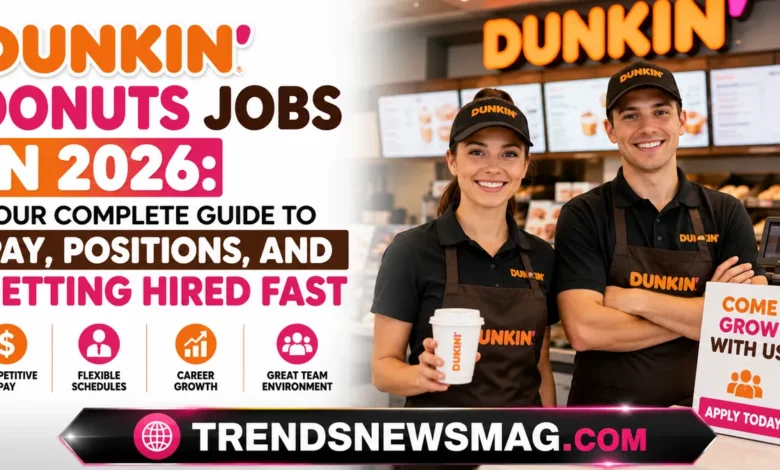
If you’ve ever stood in line at six in the morning watching a crew member juggle three iced coffees, two breakfast sandwiches, and a line of impatient commuters without breaking a sweat, you’ve probably wondered what it would take to be on the other side of that counter. Dunkin Donuts jobs have quietly become one of the most searched-for entry points into the workforce in America, and for good reason. The brand is everywhere, the hiring need is constant, and the path from application to first paycheck is often shorter than people expect.


This isn’t a company that hides its hiring intentions. Walk past almost any location and you’ll likely spot a “Now Hiring” sign taped to the window, sometimes right next to the drive-thru speaker. That visibility says something about the scale of the operation. With thousands of locations spread across the country, the demand for crew members, bakers, shift leaders, and managers never really slows down. People move, schedules change, students graduate, and someone always needs to fill that gap behind the counter.
What makes this topic worth digging into isn’t just the sheer number of openings, though. It’s the variety. Dunkin Donuts jobs span everything from a teenager’s very first paycheck to a multi-decade career in restaurant operations, and even into corporate roles at the company’s headquarters in Canton, Massachusetts. Understanding how all of these pieces fit together, what each role actually pays, what the application process looks like in practice, and what working life is really like day to day, can save you weeks of guesswork. Let’s walk through it properly.
Understanding the Dunkin Donuts Job Market Right Now
The first thing anyone researching Dunkin Donuts jobs needs to understand is the franchise structure, because it changes almost everything about how hiring works. Dunkin’ itself, as a brand, is owned by Inspire Brands, the same parent company behind Arby’s, Buffalo Wild Wings, and Sonic. But the actual restaurants you walk into are almost never owned or operated by that parent company directly. They’re owned by independent franchisees, individual businesspeople or regional operating groups who’ve licensed the right to run a Dunkin’ location.
This matters enormously for job seekers. It means that when you apply for a crew member position at a location near you, you’re not technically applying to “Dunkin’ Brands” or “Inspire Brands.” You’re applying to whichever franchise group owns that particular store. Some of these are small operations running two or three shops. Others, like Cafua Management Company, operate hundreds of locations across multiple states. The practical effect is that pay rates, benefits, scheduling flexibility, and even the interview process can vary noticeably from one Dunkin’ to the next, even if they’re only a few miles apart.
As of mid-2026, hourly pay for Dunkin Donuts jobs in the United States averages somewhere around $18 to $19 an hour nationally, though that figure shifts depending on location, role, and shift timing. According to ZipRecruiter salary data, most workers in crew-level roles earn between roughly $17.79 and $20.19 per hour, depending on experience, location, and employer. Early morning shifts, which tend to be harder to staff because almost nobody loves a 4:30 a.m. alarm, often carry a slightly higher rate to compensate. It’s a small but telling detail that shows franchisees are willing to adjust on the margins to keep their stores fully staffed during the brand’s busiest hours.
It’s also worth noting that the overall job market for this kind of work has stayed remarkably resilient. Quick-service restaurants, Dunkin’ included, tend to hire consistently because turnover in entry-level food service is naturally high. People move on to other jobs, go back to school, or simply decide the early mornings aren’t for them. That churn means new positions open up constantly, which is actually good news if you’re job hunting, since it means timing your application around some imaginary “hiring season” isn’t really necessary. Dunkin Donuts jobs are posted and refilled essentially year-round.
The Most Common Dunkin Donuts Job Titles You’ll Encounter
If you start browsing listings, you’ll notice the same handful of job titles repeating across nearly every location, and understanding what each one actually involves will help you figure out where you fit best.
The Crew Member role is the backbone of every store and the most frequently advertised of all Dunkin Donuts jobs. As a crew member, you’ll be expected to move around the store quite a bit, and the first area most new employees train on is the cash register, followed by learning to operate various cooking appliances to prepare food for customers. In practice, this means you’ll rotate between taking orders, building sandwiches, brewing coffee, restocking supplies, and keeping the front and back of house clean. It’s physically active work, rarely boring, and it teaches you to multitask in a way that’s genuinely useful in almost any future job.
Closely related is the Barista function, which at Dunkin’ often overlaps with the crew member role rather than existing as a fully separate position, though some locations do post it distinctly. This is where you’ll learn the specifics of espresso machines, cold brew systems, and the seasonal specialty drinks that drive a huge chunk of Dunkin’s business, especially in the fall when the pumpkin-flavored lineup returns and lines stretch out the door.
Then there’s the Baker, sometimes listed as Donut Finisher, a role that exists at locations with on-site baking operations rather than ones that simply receive pre-made product. This is typically an overnight or very early morning shift, and the work is more solitary and detail-oriented than the front-counter roles. These positions involve preparing donuts, muffins, and bagels, and applying frosting or glazing to meet brand standards. If you’re someone who prefers working with your hands in a quieter environment before the store opens to the public, this can be one of the more satisfying Dunkin Donuts jobs available, even though the schedule isn’t for everyone.
Shift Leader is the natural next step up for crew members who show reliability and leadership potential. Shift Leaders are generally responsible for coaching crew members throughout their shift to execute operational brand standards and deliver a great guest experience, typically setting goals, providing job assignments, and motivating others. This is often the first taste someone gets of supervisory responsibility, and many successful restaurant managers point back to their time as a shift leader as the period where they actually learned how a business runs day to day.
Above that sits the Assistant Restaurant Manager and Restaurant Manager tier. These roles carry real operational weight, covering everything from inventory ordering and labor scheduling to hitting sales targets and ensuring the location passes health and safety inspections. A Restaurant Manager is, in essence, running a small business on behalf of the franchisee, even if they don’t own it themselves. They are responsible for the overall operation of the restaurant according to Dunkin’ standards, franchisee standards, and compliance with all applicable laws. Pay at this level climbs substantially, often into salaried territory, and the role frequently comes with bonus structures tied to store performance.
Finally, there’s a smaller but important category: corporate roles. These exist not at the store level but at the company’s actual headquarters and regional offices, covering functions like marketing, finance, human resources, supply chain, and brand strategy. Inspire Brands completed its acquisition of Dunkin’ Brands in December 2020, and Dunkin’ and Baskin-Robbins now operate as distinct brands within the Inspire portfolio. If you’re interested in the business side of how a coffee and donut empire is actually run, rather than the day-to-day store operations, this is the track worth researching separately, since the application process and required qualifications look quite different from store-level hiring.
How Much Do Dunkin Donuts Jobs Actually Pay?
Money is usually the first question on everyone’s mind, and rightly so. Let’s get specific, because vague answers don’t help anyone planning a budget or comparing job offers.
Here’s a snapshot of typical pay ranges across common Dunkin Donuts jobs, compiled from current market data and franchise postings:
| Position | Typical Hourly/Salary Range | Notes |
|---|---|---|
| Crew Member (Cashier/Counter) | $15.00 – $17.50/hr | Varies by shift time and region |
| Crew Member (Early Morning Shift) | $16.00 – $17.00/hr | Often pays a premium for 5–6 a.m. starts |
| Barista | $15.50 – $18.00/hr | Specialty drink training sometimes included |
| Baker / Donut Finisher | $16.00 – $19.00/hr | Overnight differential common in some markets |
| Shift Leader | $17.00 – $20.00/hr | Often includes small leadership bonus |
| Assistant Restaurant Manager | $40,000 – $52,000/yr | Frequently salaried, varies by franchise |
| Restaurant Manager | $48,000 – $65,000/yr | Bonus potential tied to store performance |
| Corporate Roles (entry to mid-level) | $55,000 – $90,000+/yr | Highly role-dependent, based at HQ or regional offices |
These figures are reasonable benchmarks rather than fixed guarantees, and that distinction matters a lot. Because every location is independently owned, two Dunkin’ stores on opposite sides of the same city can post genuinely different wages for the exact same job title. A franchisee in a high cost-of-living metro area competing against other fast-food chains for staff will often pay noticeably more than a rural location where the labor market is less competitive.
One franchisee posting reviewed during this research broke down their actual shift-based pay structure with admirable transparency, listing rates like sixteen-fifty an hour for a 5 a.m. to 1 p.m. shift, sixteen-twenty-five for 6 a.m. to 2 p.m., and so on, with afternoon shifts occasionally paying slightly more to offset the less desirable hours. That kind of granular, shift-specific pricing is fairly common across the industry and worth asking about directly during your interview, since it’s rarely spelled out clearly in the initial job posting.
It’s also worth mentioning tips, since some locations allow tip jars at the counter or accept tips through their point-of-sale system. This isn’t universal, and it’s not something to count on as guaranteed income, but in busier locations, particularly ones near office parks, hospitals, or transit hubs, tips can meaningfully supplement the base hourly wage. If tipping potential matters to your decision, it’s a fair question to raise during the interview rather than assuming.
What the Application Process Actually Looks Like
Applying for Dunkin Donuts jobs has become almost entirely digital, and the process is intentionally streamlined because franchisees need to fill positions quickly. In 2026, applying for a career at Dunkin’, formerly known as Dunkin’ Donuts, is primarily done through online job portals rather than in-person applications, though some locations still accept walk-ins.
The starting point for most applicants is the official careers website, where you can search open positions by zip code, city, or job category. From there, the typical flow looks like this: you create a basic profile, often just a name, contact information, and either an uploaded resume or a quick form covering your availability and prior experience. Many of these platforms save your resume automatically, effectively making the process a one-click application for future openings.
One detail that surprises a lot of first-time applicants is how quickly some locations respond. Many applicants report hearing back from Dunkin’ within a few days of submitting an application, though response times vary considerably from store to store. Franchisees managing several locations sometimes use automated scheduling tools that can book an interview slot almost immediately after you apply, particularly if the listing was marked as urgent. Speaking of which, keep an eye out for “Urgent Hire” tags on listings. These typically signal that the manager wants to interview candidates right away rather than letting applications sit in a queue for a week, which can be a useful shortcut if you’re hoping to start earning sooner rather than later.
Once you’ve landed an interview, preparation doesn’t need to be elaborate, but a little goes a long way. Bring a government-issued ID, since most locations need it for onboarding paperwork regardless of how the interview itself goes. If you have any food handling certifications from previous jobs, bring documentation of those too, since it can occasionally speed up training. Dress reasonably neat and casual; nobody expects a suit for a counter position, but showing up looking like you care makes a real difference to a hiring manager juggling a dozen interviews that week.
Questions you should expect in a typical interview for entry-level Dunkin Donuts jobs tend to be fairly predictable: availability across different shifts, comfort with fast-paced multitasking, prior customer service experience if any, and a basic scenario question like how you’d handle an upset customer. Managers aren’t looking for rehearsed corporate answers here. They’re listening for whether you sound reliable, level-headed, and genuinely willing to show up on time consistently, because in food service, dependability is worth more than almost any other single trait.
For roles above entry level, like shift leader or assistant manager, expect a slightly deeper conversation about prior leadership experience, even informal experience like coordinating a school event or managing a small team in a previous job. Franchisees promoting from within often prioritize internal candidates, so if you’re already working a crew position and eyeing a step up, expressing that interest directly to your manager is frequently more effective than waiting for a formal posting.
Qualifications and Skills That Actually Matter
A common misconception about Dunkin Donuts jobs is that they require no skills at all, which undersells what actually makes someone successful in these roles. Formal education requirements are minimal. A high school diploma or equivalent is often preferred but not always strictly required, particularly for entry-level crew positions.
What genuinely matters more than a diploma is a specific combination of practical abilities. Familiarity with point-of-sale systems, coffee machines, and food safety procedures is typically required, alongside exceptional teamwork, a positive attitude, and the ability to multitask under pressure. None of these are things you necessarily walk in already knowing; they’re trainable. But hiring managers are looking for signs that you can pick them up quickly and stay calm when six orders are stacking up during a Saturday morning rush.
Basic math ability is another underrated requirement. Even with modern point-of-sale systems doing most of the calculation work, employees still need to handle cash drawers accurately, make correct change when systems glitch, and track inventory counts during slower periods. It’s not advanced math by any stretch, but comfort with numbers under time pressure separates strong performers from ones who struggle.
Age requirements vary by state and by the specific tasks involved. Most locations set a minimum hiring age around sixteen for general crew positions, though certain tasks involving more hazardous equipment, like deep fryers or certain bakery machinery, sometimes require employees to be eighteen. Baker and donut finisher roles in particular often carry an explicit eighteen-and-over requirement, partly due to the equipment involved and partly due to liability concerns around safety training for younger workers.
Beyond the formal requirements, soft skills make a surprisingly large difference in how long someone lasts and how quickly they advance. The ability to stay friendly with customers even during chaotic rushes, the discipline to follow food safety protocols consistently rather than cutting corners when nobody’s watching, and a genuine willingness to help coworkers when the store gets overwhelmed all tend to separate employees who get promoted from ones who plateau or burn out within a few months.
As one longtime franchise operator put it during an interview about staffing challenges in the quick-service industry, “You can teach someone to make a latte in an afternoon. You can’t teach someone to actually care whether the customer’s morning goes well.” That distinction, between technical competence and genuine service mindset, shows up constantly in how managers evaluate and promote staff across Dunkin Donuts jobs.
Benefits, Perks, and What You Can Realistically Expect
This is the area where franchise variability creates the most confusion, so let’s be precise about what’s typical versus what’s guaranteed.
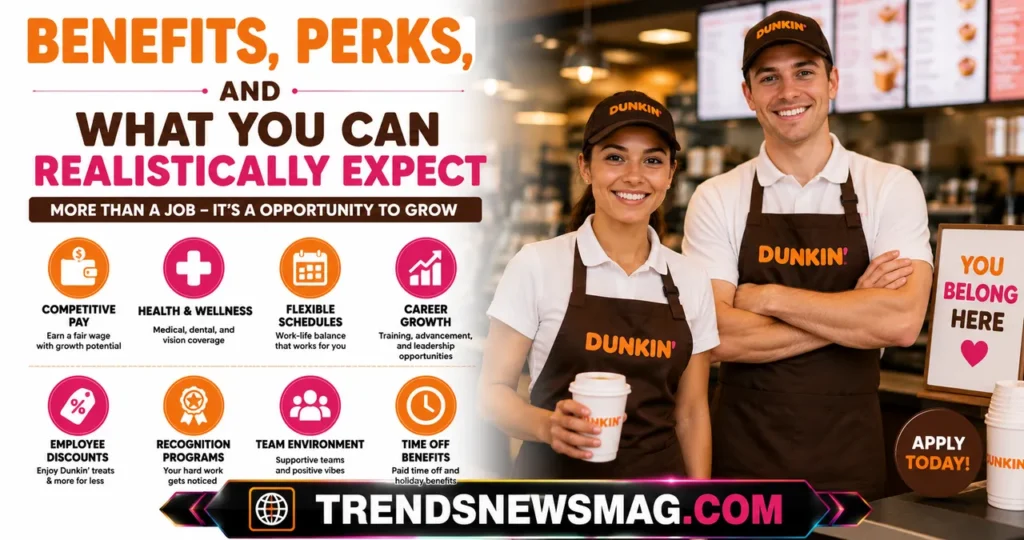
Health insurance availability depends heavily on whether you’re working full-time and on how the individual franchisee structures their benefits package. Dunkin’ offers health insurance to eligible employees, though specific availability depends on franchisee policy and employment status. The benefits commonly offered across locations include health insurance, paid time off, life insurance, dental insurance, disability insurance, employee discounts, flexible work schedules, vision insurance, and retirement plans, though all of these vary significantly from location to location and even by job position within the same store.
A point worth clearing up directly, because it causes genuine confusion online: tuition reimbursement is not a standard benefit at the franchise store level. Dunkin’ does not offer tuition reimbursement to store-level employees, and it also does not provide relocation assistance. However, this changes once you move into corporate territory. Corporate employees of Dunkin’ Brands become eligible for tuition reimbursement of up to $5,000 annually, but only after six months of service. So if you’ve seen conflicting information online about whether Dunkin’ helps pay for school, the honest answer is: it depends entirely on whether you’re talking about a corporate position or a store-level job, and the two are governed by completely different policies.
Employee discounts are real and fairly consistent across locations, though the exact percentage varies. Staff members generally pay for their food and drinks with roughly a 10% discount while on duty, though some locations allow staff to get items free while working, and many offer around a 30% discount on items when employees are off-duty. One Glassdoor reviewer working at a particular location described their experience more specifically, noting that the first drink or meal of a shift came at a fifty percent discount as long as it was finished before clocking out, while other items were offered at half price. These details genuinely differ store by store, so don’t assume your friend’s discount structure at their Dunkin’ will match yours.
Retirement savings options like 401(k) plans do exist at many locations, though enrollment eligibility, employer matching, and vesting schedules again depend on the specific franchisee’s policies. If retirement benefits matter to your decision between job offers, this is absolutely worth asking about directly rather than assuming based on general brand reputation.
Paid time off follows a similar pattern of variability. Many full-time employees can expect somewhere around ten to twenty paid vacation days per year, alongside six to ten paid sick days and a similar range of personal days, though these numbers fluctuate meaningfully from store to store. Part-time employees, who make up a large share of the workforce in entry-level Dunkin Donuts jobs, often have more limited or no PTO at all, which is worth clarifying before you accept an offer if work-life balance is a priority for you.
At the corporate level, the benefits picture looks considerably more robust and standardized, since these employees work directly for Dunkin’ Brands rather than an independent franchisee. Corporate employees receive medical and dental plans with a company contribution, access to free on-site fitness classes and a gym, healthy café options, personalized health evaluations including biometric screening, and fitness and nutrition seminars and challenges. There’s also a “Dress for Your Day” policy that allows casual dress unless a specific meeting requires business attire, plus discounts on packaged coffee, K-Cups, and tea for at-home enjoyment. It’s a noticeably more polished benefits package than what most store-level employees see, which makes sense given the difference in employer structure and the kind of long-term career investment corporate roles represent.
What a Typical Day Actually Feels Like
Job postings and benefits charts only tell part of the story. What does the actual rhythm of working a Dunkin’ shift feel like, and how does it differ across roles?
Opening shifts, especially the earliest ones starting around 4:30 or 5 a.m., have a distinct character. The store is quiet at first, lights flickering on, machines warming up, and there’s a kind of focused calm before the first wave of commuters arrives. Then, almost without warning, the morning rush hits, and for two or three hours straight, it’s a steady stream of orders, mostly coffee and breakfast sandwiches, moving as fast as the team can produce them. Crew members describe this window as the most physically demanding part of the day, requiring sharp focus and constant communication with teammates to avoid bottlenecks at the register or the drink station.
Midday tends to settle into a more manageable pace, with steady but less frantic traffic, giving staff time to restock, clean, and handle the kind of routine tasks that get neglected during the rush. This is often when newer employees get more hands-on training, since managers have slightly more bandwidth to actually explain the why behind procedures rather than just barking instructions during chaos.
Evening shifts vary enormously by location. Some Dunkin’ stores near office parks or schools see a meaningful afternoon pickup around 3 or 4 p.m. as people grab an iced coffee on the way home, while others slow down considerably after lunch and coast quietly until close. Closing duties typically involve the less glamorous but essential work of deep cleaning equipment, restocking for the next morning’s opening crew, and reconciling the cash drawer.
For bakers working overnight, the experience is almost entirely different from the customer-facing roles. It’s quieter, more solitary, and centers on precision and timing rather than rapid customer interaction. Dough needs to rise on schedule, donuts need to be fried and glazed in sequence, and everything needs to be ready before the doors open. Bakers must typically be over eighteen years of age and possess the ability to use and learn a wide array of baking and kitchen equipment and tools. It’s a role that rewards methodical, detail-oriented people who don’t mind working while most of the world is still asleep.
Across all of these shift types, one constant theme emerges from worker reviews and interviews: the pace is genuinely fast, and the work is more physically demanding than people sometimes expect from a “coffee shop job.” You’re on your feet essentially the entire shift, moving between stations, lifting supply boxes, and managing a continuous flow of small tasks simultaneously. It’s not heavy labor in the way construction or warehouse work is, but it’s far from sedentary, and that’s worth knowing going in.
Career Growth and Long-Term Potential
One of the more compelling aspects of Dunkin Donuts jobs, often overlooked by people who view this as purely a stopgap teenage job, is the realistic potential for long-term career advancement within the broader organization.
The promote-from-within culture is genuinely common across franchise operations, partly out of necessity. Training an external hire for a management position from scratch takes far longer and carries more risk than promoting someone who already understands the store’s operations, knows the regular customers, and has proven their reliability over months or years of crew-level work. While the core belief at many franchise groups is to promote from within, they also remain open to bringing in individuals with relevant experience or skill sets suited to the quick-service and full-service restaurant industry.
A genuinely inspiring example of this trajectory comes from the company’s own employee storytelling. Taylin Matthews started her career serving customers at her hometown Dunkin’ while also attending cosmetology school, eventually becoming a full-time hair stylist, but after working in salons, she found herself craving something different and rejoined the Dunkin’ team, first as a full-time Crew Manager. From there, she moved into a Customer Relations Coordinator position with Dunkin’ Brands, developed her career leading the Franchisee Support Navigator team, and most recently became an Operating Systems Manager for Beverages. She describes her current role as taking her back to where it all started, testing products and equipment at her hometown Dunkin’, and says she believes she is “living proof that hard work pays off.”
Stories like this aren’t universal outcomes, of course, and it would be misleading to suggest every crew member ends up shaping product development at headquarters. But the underlying pattern, starting at the counter and climbing through shift leadership into store management and potentially corporate operations, is a real and well-worn path within this industry. It’s also worth noting that experience gained in these roles, particularly inventory management, scheduling, customer conflict resolution, and team leadership, transfers surprisingly well to other industries entirely, which is part of why so many people treat Dunkin Donuts jobs as genuine career building blocks rather than dead-end work.
For those specifically eyeing the management track, the realistic timeline from crew member to shift leader is often somewhere between three and nine months of consistent, reliable performance, depending on the location’s staffing needs and how quickly openings arise. The jump from shift leader to assistant manager typically takes longer, often a year or more, and usually requires demonstrating comfort with the administrative side of the business: scheduling, ordering, basic financial tracking, and handling employee issues without constant oversight from above.
Comparing Dunkin Donuts Jobs to Other Quick-Service Employers
It’s natural to wonder how working at Dunkin’ stacks up against similar entry-level opportunities at competitors like Starbucks, McDonald’s, or regional coffee chains. The honest answer is that the experience is broadly comparable in terms of pace and required skills, but a few distinctions stand out.
Compared to Starbucks, which operates primarily through company-owned stores rather than franchises, Dunkin’s franchise model means more variability in pay, benefits, and management culture from one location to the next. Starbucks has historically marketed itself around more standardized, centrally-controlled benefits, including broader tuition assistance programs for store-level employees through partnerships with universities, something that Dunkin’s franchise structure generally doesn’t replicate at the store level given what we covered earlier about tuition reimbursement being corporate-only.
On the other hand, Dunkin’ locations are often more numerous and geographically dense in certain regions, particularly the Northeast and Mid-Atlantic United States where the brand originated and maintains its strongest market presence. This density can translate into more flexibility for employees who want to transfer between locations, whether due to moving, schedule conflicts, or simply wanting a change of environment. In some cases, Dunkin’ may allow employees to transfer to another location, though it’s ultimately up to the discretion of the franchisee and the local management team.
Compared to traditional fast-food chains like McDonald’s, the work itself at Dunkin’ skews slightly more toward beverage preparation and less toward heavy kitchen line cooking, though the breakfast sandwich and food menu has expanded considerably in recent years, narrowing that gap. Pay tends to land in a fairly similar range across these major chains in any given local market, since they’re all competing for the same pool of available workers and have to stay roughly competitive to maintain adequate staffing.
Tips for Standing Out During the Hiring Process
If you’re serious about landing one of these positions quickly, a handful of practical strategies consistently improve your odds.
Apply to multiple nearby locations rather than just one. Because each store is independently managed, staffing needs and hiring urgency vary store by store, even within the same city. A location two miles away might be desperately understaffed while another nearby store has a full roster and no immediate openings. Casting a slightly wider net dramatically improves your odds of landing an interview quickly.
Be explicit and honest about your availability from the very start. Managers scheduling for early morning, overnight, or weekend coverage are often more motivated to hire candidates who can reliably fill those harder-to-staff shifts, even if you’d personally prefer a different schedule long-term. Being upfront and flexible early on, then gradually negotiating toward your preferred hours once you’ve proven reliability, tends to work better than insisting on ideal hours from day one.
Follow up if you haven’t heard back within about a week. This isn’t pushy; it signals genuine interest and can nudge your application back to the top of a manager’s queue, particularly at busier locations where applications can occasionally get buried.
Mention any relevant prior experience clearly, even if it feels minor. Previous cash handling experience, any customer service role, food safety certifications, or even informal experience managing a small team for a school project or community event can meaningfully differentiate you from other entry-level applicants who have none of that to mention.
Finally, treat the interview itself as a two-way conversation. Ask about the specific shift-based pay structure, realistic advancement timelines at that location, and what the team culture is actually like. Hiring managers generally respond well to candidates who show genuine curiosity about the role rather than just nodding along passively, and asking thoughtful questions often leaves a stronger final impression than any rehearsed answer about your strengths and weaknesses.
The Honest Drawbacks Worth Knowing About
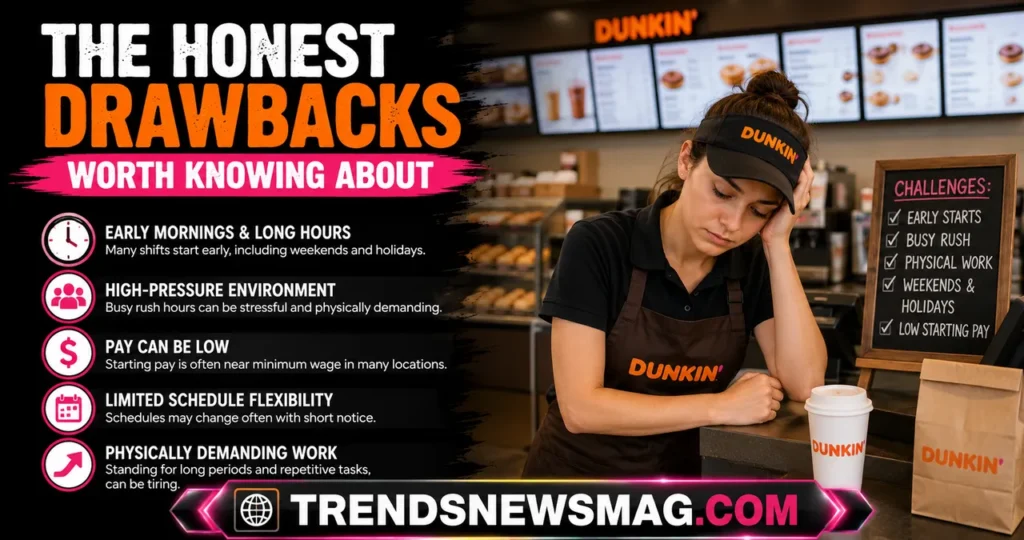
No fair guide to Dunkin Donuts jobs would be complete without acknowledging the genuine downsides that current and former employees consistently raise.
Pay, while competitive within the quick-service sector, still sits at a level many workers describe as just adequate rather than generous, particularly for those trying to support themselves entirely on a single part-time position. One reviewer summarized their experience candidly, noting that the pay is minimum wage but that it’s probably the perfect job for someone in college or school, since the work itself is good and easy if you’re comfortable with customers of all kinds of personalities.
Understaffing is a recurring complaint across many locations, particularly during economic periods when hiring becomes more competitive across the broader labor market. Common frustrations mentioned include rude customers, understaffing, hours getting cut unpredictably, and inconsistency tied to bad franchise ownership or a general lack of operational structure at certain stores. This again ties back to the franchise model: a well-run, adequately staffed location can feel dramatically different from a poorly managed one just a few miles away, even though both carry the same Dunkin’ branding out front.
Career development perceptions are mixed as well, though perhaps more positive than some assume. As of June 2026, employees rate their career opportunities at an average of 2.7 out of 5 stars based on more than fourteen thousand anonymously submitted reviews. That’s a middling score, suggesting that while the promotion pathways genuinely exist, as the Taylin Matthews example illustrates, many employees either aren’t aware of them, don’t stay long enough to pursue them, or find the pace of advancement slower than they’d hoped.
Benefits inconsistency, which we covered in detail earlier, remains probably the single most common point of confusion and occasional frustration among workers comparing notes online. Because eligibility and generosity vary so much by franchisee, employees sometimes feel like they’re getting a worse deal than colleagues at other locations doing the exact same job, which is, in fairness, often literally true given the decentralized ownership structure.
How Location and Regional Demand Affect Your Odds
Geography plays a bigger role in your job search than most people initially assume. In states like Texas, for example, there are hundreds of open Dunkin’ positions available at any given time across the state, reflecting both the brand’s expansion into newer markets and consistent turnover in existing locations.
In more saturated, long-established Dunkin’ markets like Massachusetts, Rhode Island, and the broader New England region where the brand was founded in 1950, competition for positions can occasionally be slightly higher simply because so many people grew up with Dunkin’ as a default part-time job option, creating a deeper applicant pool. Founded in 1950, Dunkin’ has grown into America’s favorite all-day, everyday stop for coffee and baked goods, earning a number one ranking for customer loyalty in the coffee category for fourteen consecutive years according to Brand Keys. According to the official Dunkin’ Wikipedia Page, the company now operates more than 13,100 restaurants across 41 countries worldwide, based out of Canton, Massachusetts.
In newer or rapidly expanding markets, particularly in parts of the South and West where Dunkin’ has been opening locations more aggressively in recent years, hiring urgency tends to run higher, simply because these stores often open with smaller existing local applicant pools and need to build a full staff quickly from scratch. If you live in one of these expansion regions, you may genuinely find it easier and faster to land an interview compared to a long-saturated Northeastern market.
Urban locations near transit hubs, hospitals, and office districts typically see higher customer volume and correspondingly more consistent staffing needs throughout the day, which can mean more available shifts and overtime opportunities for employees who want them. Suburban and rural locations, by contrast, often have more concentrated rush periods around commute times and school schedules, with quieter stretches in between, which suits people who prefer a more predictable, less constantly hectic pace.
Frequently Asked Questions About Dunkin Donuts Jobs
What is the minimum age to apply for Dunkin Donuts jobs?
Most locations set the minimum hiring age at sixteen for general crew member positions, though this can vary slightly depending on state labor laws and the specific franchisee’s policies. Certain roles involving heavier equipment, such as bakery positions working with industrial mixers or fryers, often require employees to be at least eighteen due to both safety considerations and liability concerns. If you’re sixteen or seventeen, it’s worth confirming directly with the specific location, since some franchisees set their own slightly stricter internal age policies even beyond what state law technically requires, and scheduling rules around break requirements also tend to differ for workers under eighteen.
How long does it typically take to hear back after applying?
Response times vary considerably depending on the individual franchisee and how urgently that specific location needs to fill the role. Many applicants report hearing back within just a few days, particularly when a listing is marked as an urgent hire, since these are positions managers want filled quickly. That said, it’s not unusual for the process to take a week or slightly longer at less urgently staffed locations. If you haven’t heard anything after about a week, following up directly with the store, either by phone or in person, is a completely reasonable and often effective next step rather than simply waiting indefinitely.
Do Dunkin Donuts jobs offer health insurance to part-time employees?
This depends heavily on the specific franchisee and your classified employment status. Full-time employees are considerably more likely to have access to health insurance options, though even then, the specific plans, coverage levels, and company contribution amounts vary from one franchise group to another. Part-time employees at many locations have limited or no access to health benefits at all, since eligibility is often explicitly tied to working a minimum number of hours per week on a consistent basis. If health coverage is an important factor in your decision, it’s worth asking directly during your interview rather than assuming based on general brand reputation, since the actual answer can differ enormously even between two stores in the same town.
Can you really build a long-term career starting from an entry-level Dunkin Donuts job?
Yes, genuinely, and this is one of the more underappreciated aspects of working in this industry. The promote-from-within culture at most franchise operations is not just marketing language; it reflects a practical business reality where training and promoting existing, proven employees is generally faster and less risky than hiring management candidates from outside. The realistic path runs from crew member to shift leader, typically within several months of consistent performance, then potentially toward assistant manager and full restaurant manager roles over the following one to two years. From there, particularly motivated and skilled individuals have moved into regional franchise support roles or even corporate positions with Dunkin’ Brands itself, as illustrated by real employee career stories the company has highlighted.
What’s the actual difference between applying to a franchise location versus a corporate position?
The distinction matters more than most applicants initially realize. When you apply to a specific store location, whether through a general job board or the store’s own listing, you’re applying to work for that location’s independent franchisee, who sets their own wages, benefits, and management policies, separate from Dunkin’ Brands corporate. When you apply for a corporate position, you’re applying to work directly for Dunkin’ Brands or its parent company Inspire Brands, typically in office-based roles covering marketing, finance, operations support, human resources, or brand strategy, based primarily out of the company’s headquarters and regional offices. Corporate roles generally come with more standardized, comprehensive benefits packages, including things like tuition reimbursement after six months of service, which simply isn’t available at the franchise store level. The application processes, required qualifications, and typical experience levels expected also differ considerably between these two tracks, so it’s worth being clear about which type of role you’re actually pursuing before you apply.
Is it difficult to get hired at Dunkin Donuts without prior experience?
Generally, no. The vast majority of entry-level Dunkin Donuts jobs are explicitly designed to be accessible to first-time job seekers, and many locations actively prefer training someone from scratch over trying to accommodate habits learned at a different chain. What matters far more than prior experience is demonstrated reliability, a willingness to learn quickly, comfort interacting with customers under time pressure, and flexibility around scheduling, particularly for harder-to-staff shifts like early mornings or weekends. Basic skills like simple math for handling transactions and comfort following food safety procedures are typically taught on the job during a structured initial training period rather than expected as a prerequisite. If anything, having no prior bad habits from a different employer can occasionally work in your favor, since training can proceed without first having to undo previously learned shortcuts.
Final Thoughts on Pursuing Dunkin Donuts Jobs
Stepping back from all the specifics on pay tables, benefit structures, and application timelines, the bigger picture here is fairly clear. Dunkin Donuts jobs represent one of the more accessible, consistently available entry points into the workforce, whether you’re a teenager looking for your very first paycheck, a college student needing flexible part-time hours around classes, or someone exploring a genuine long-term career path in restaurant operations and eventually corporate brand management.
The franchise ownership structure is the single most important thing to understand before you apply, since it explains nearly every inconsistency you’ll encounter while researching pay, benefits, and workplace culture online. Two stores carrying the exact same orange and pink signage can offer meaningfully different experiences depending entirely on who owns and manages that particular location. That’s not a flaw in the system so much as it’s simply how the franchise model works across the entire quick-service restaurant industry, not just at Dunkin’.
What stays consistent across nearly every location is the fundamental nature of the work itself: fast-paced, customer-facing, physically active, and genuinely useful as a training ground for skills that transfer well beyond the coffee counter. Time management, multitasking under pressure, basic financial handling, and customer service fundamentals learned during a stint at Dunkin’ show up as valuable, transferable experience on resumes years later, regardless of where someone’s career eventually leads.
If you’re actively job hunting right now, the most practical next step is simple: search openings near your specific location, apply to a handful of stores rather than just one, be upfront about your availability, and treat the interview as a genuine two-way conversation about whether the specific location and team feels like a good fit. The opportunities are genuinely out there, hiring urgency is real and constant, and for the right person, what starts as a quick paycheck can absolutely turn into something more substantial down the line.
Trending Today: [Benny Safdie]
Read more: Just as restaurant managers rely on genuine feedback to evaluate their staff and keep operations running smoothly, customers look for transparent data before choosing a business partnership. If you want to see how industry reliability is measured through public feedback, check out our latest deep dive into Ironmartonline Reviews to learn how modern platforms maintain their business transparency.