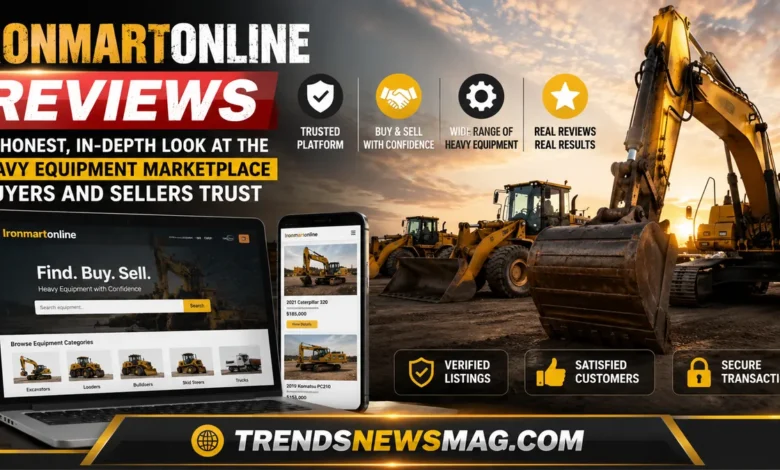
Ironmartonline Reviews: An Honest, In-Depth Look at the Heavy Equipment Marketplace Buyers and Sellers Trust

When you’re shopping for a used excavator, a dump truck, or a fleet of forestry equipment, the stakes are a lot higher than picking out a new pair of boots. A single bad decision can cost tens of thousands of dollars, derail a project timeline, or leave a small contractor stuck with a machine that breaks down on its first job. That’s exactly why so many buyers and sellers searching for heavy equipment marketplaces eventually land on Ironmartonline, and why so many of them go looking for an honest answer before they commit any money.


Ironmartonline has built a name for itself in a fairly narrow but high-value corner of e-commerce: used heavy construction equipment, trucks, trailers, and related machinery. It isn’t trying to be the next Amazon. It isn’t selling phone cases or kitchen gadgets. It’s a specialized marketplace built around equipment that costs real money and requires real expertise to evaluate. That focus is part of what makes it worth examining carefully, because the rules of trust, transparency, and due diligence work differently here than they do for ordinary online shopping.
This review walks through what Ironmartonline actually is, how its business model works, what categories of equipment it covers, what its service offerings look like, where it shines, where buyers and sellers should stay cautious, and how to use the platform wisely if you decide to move forward. The goal isn’t to hype the platform or tear it down. It’s to give you a grounded, practical picture so you can make your own informed call.
What Is Ironmartonline and How Does It Work
Ironmartonline is a heavy equipment marketplace based in Flanders, New Jersey, operating under the company name IronmartOnline. It functions primarily as a listing, marketing, and brokerage platform for used construction equipment, agricultural machinery, commercial trucks, trailers, and a wide range of specialty vehicles. Rather than owning a warehouse full of inventory the way a traditional dealership might, Ironmartonline connects equipment owners who want to sell with buyers across the country and, in many cases, internationally.
The basic mechanics are straightforward once you understand the model. A seller — often a contractor, a fleet manager, a farm operation, or a smaller dealer — submits their equipment for listing. The Ironmartonline team builds out a professional listing page with photos, specifications, condition notes, and pricing. That listing then gets marketed across the platform’s own site and distribution channels to reach buyers who are actively searching for that type of machine. On the buyer’s side, the experience looks a lot like browsing any equipment classifieds site, except the categories are deep and the listings tend to include more detail than a typical “for sale by owner” post.
What separates Ironmartonline from a pure classifieds site is the layer of service wrapped around the listings. The platform offers equipment appraisal and valuation, financing assistance, brokerage support, and even commercial real estate listings tied to equipment-heavy businesses like contracting yards and dealerships. This combination of marketing reach and hands-on support is the core value proposition: sellers get help creating a listing that actually performs, and buyers get more context than a bare-bones ad would normally provide.
It’s worth being precise about the equipment categories involved, because the breadth here is genuinely large. Browsing the live inventory turns up everything from log skidders and feller bunchers used in forestry work, to Mack dump trucks and Freightliner tractors, to backhoes, excavators, asphalt pavers, wood chippers, and antique construction equipment that’s become a niche collector category in its own right. Manufacturer coverage spans the major industry names — Caterpillar, John Deere, Komatsu, Volvo, Case, Bobcat, Kubota, Mack, Peterbilt, Kenworth, and dozens more — which tells you the platform isn’t narrowly focused on one brand ecosystem or one type of buyer.
The Business Model Behind Ironmartonline
Understanding how Ironmartonline actually makes money and structures its services helps explain both its strengths and its limitations. At its core, this is a marketing and brokerage business layered on top of a classifieds-style listing platform. Sellers pay for the visibility and professional presentation their equipment receives, and in many cases work with a broker who manages buyer inquiries, negotiations, and the back-and-forth that comes with selling a $40,000 excavator to someone three states away.
This model has a direct effect on the buying experience too. Because listings are professionally created rather than dashed off in five minutes by a private seller, photos tend to be clearer, specifications more complete, and condition descriptions more detailed. That said, it also means Ironmartonline itself is not always the party that owns or has physically inspected every piece of equipment listed. In many cases, it operates as an intermediary connecting a buyer to a seller, with the platform’s team facilitating communication rather than acting as the final guarantor of the machine’s condition.
That distinction matters enormously in heavy equipment sales, where “as-is” is the default sales condition almost everywhere in the industry — not just on Ironmartonline. A seasoned equipment buyer told an industry forum something that captures this reality well: “the listing tells you what the seller wants you to know; the inspection tells you what’s actually true.” That’s not a knock against any specific platform. It’s simply how used heavy equipment sales work across the entire industry, whether you’re buying from a dealer lot, an auction house, or an online marketplace.
Ironmartonline’s services extend beyond simple listings in ways that are genuinely useful for businesses managing equipment as an asset class rather than a one-off purchase. The equipment appraisal and valuation service, for instance, gives fleet owners a way to understand what their machinery is actually worth before they decide whether to sell, trade, or hold. Financing options connect buyers with funding so equipment purchases don’t have to be all-cash transactions, which matters a great deal for smaller contractors operating on tight margins. And the commercial real estate listings — somewhat unusual for an equipment marketplace — suggest the company has built relationships within the broader contracting and industrial real estate space, not just the machinery niche.
Equipment Categories and Inventory Depth
| Category | Examples Available | Typical Buyer |
|---|---|---|
| Heavy Construction Equipment | Excavators, backhoes, dozers, motor graders, skid steers, wheel loaders | General contractors, excavation companies |
| Trucks | Dump trucks, tractors, flatbeds, tankers, roll-offs, service utility trucks | Trucking companies, hauling contractors |
| Trailers | Lowboy, flat deck, gooseneck, tag-a-long, dump trailers | Equipment haulers, owner-operators |
| Forestry & Arborist | Feller bunchers, log skidders, wood chippers, stump grinders | Logging operations, tree service companies |
| Asphalt, Paving & Concrete | Pavers, rollers, milling machines, cement mixers | Paving contractors, municipal road crews |
| Agricultural Equipment | Tractors, farm implements, specialty ag machinery | Farm operations, ag equipment dealers |
| Aggregate & Demolition | Crushers, screeners, tub grinders, material handlers, shears | Quarry operators, demolition contractors |
| Transportation & Specialty | Boats, motorhomes, classic vehicles, military surplus | Niche and collector buyers |
This kind of breadth is one of Ironmartonline’s clearer advantages over smaller, single-category equipment sites. A contractor who needs both an excavator and a dump trailer doesn’t have to bounce between three or four different platforms. A forestry operation looking for a used feller buncher today and a wood chipper next quarter can build a relationship with one marketplace rather than starting from scratch each time. That said, breadth isn’t automatically the same thing as depth in every category — buyers searching for a very specific or rare machine should still expect to check back periodically, since inventory in any single subcategory will naturally ebb and flow based on what sellers currently have listed.
Services Beyond the Listings
The “Services” section of Ironmartonline’s offering is where the platform distinguishes itself most clearly from a basic online classifieds page, and it deserves a closer look because these services shape the entire buying and selling experience.
Selling your equipment through the platform starts with what’s essentially a full-service listing creation process. Instead of a seller fumbling through uploading blurry phone photos and a two-line description, the team builds out a complete listing — proper photography, organized specifications, and marketing copy designed to actually convert browsers into serious inquiries. For a seller who doesn’t have time to manage a sales process on top of running a business, this hands-off structure is a genuine convenience. The tradeoff, naturally, is that this kind of service typically comes with fees or commission built into the final sale price, which is standard practice across the brokered equipment industry and not unique to this platform.
Financing is the second major service layer. Heavy equipment purchases routinely run into five and six figures, and very few buyers — even established companies — want to write a check for the full amount in cash. By connecting buyers to financing options at the point of purchase, Ironmartonline removes a meaningful friction point in the sales process. This is particularly valuable for smaller operations and owner-operators who may have strong cash flow but don’t necessarily have six figures sitting in a business checking account.
Equipment appraisal and valuation rounds out the picture for business owners thinking strategically about their equipment as assets rather than just tools. A construction company evaluating whether to upgrade its excavator fleet, for example, benefits from knowing the realistic resale value of its current machines before making that decision. This kind of valuation work also matters for insurance purposes, loan collateral assessments, and even estate or business-sale situations where equipment needs a documented, defensible value.
The heavy equipment broker function ties all of this together. Rather than a buyer or seller working purely through self-service listings, a broker acts as a go-between who manages communication, helps negotiate terms, and smooths over the logistical complications that come with selling something the size of a bulldozer. For buyers and sellers who are newer to the heavy equipment space — say, a landscaping company making its first major equipment purchase, or a retiring contractor liquidating a small fleet — that brokered layer of support often makes the difference between a smooth transaction and a frustrating one.
Is Ironmartonline Legitimate
This is the question almost everyone searching for Ironmartonline reviews actually wants answered, and it deserves a straightforward response rather than a vague non-answer.
Based on verifiable, publicly available information, Ironmartonline operates as a real, established business with a physical address in Flanders, New Jersey, a working phone line, an active inventory of listings updated regularly, and a defined service catalog covering brokerage, financing, and appraisal. It is not a fly-by-night operation throwing up a website and disappearing after a few months. The company maintains an active presence across multiple channels, including its own blog and social platforms, which is consistent with a marketplace that has been operating for an extended period rather than one that just appeared overnight.
That said, “legitimate business” and “risk-free transaction” are two different things, and conflating them is where a lot of buyers get into trouble — not just on this platform, but across the entire used heavy equipment industry. Ironmartonline functions largely as an intermediary and marketing platform rather than a fully vertically integrated dealer that personally inspects, certifies, and guarantees every machine that passes through its listings. That structure is common across the industry and isn’t inherently a red flag, but it does mean the responsibility for verifying a machine’s actual condition, ownership documentation, and mechanical history falls substantially on the buyer.
A heavy equipment appraiser interviewed by an industry trade publication put it plainly: “the platform can get you in front of the right machine, but only an inspection tells you whether it’s the right machine for your money.” That’s a useful filter to apply to any equipment marketplace, not just this one. Legitimacy answers the question of whether the business itself is real and operating in good faith. It does not answer the question of whether any individual machine on the site is mechanically sound, accurately described, or priced fairly — those things require buyer-side verification regardless of which platform you’re using.
Pros and Cons for Buyers
Buyers researching Ironmartonline tend to land in roughly the same place once they understand how the platform actually operates, and it’s worth laying out both sides clearly rather than leaning too hard in either direction.
On the positive side, the sheer category breadth saves real time. Instead of running separate searches across half a dozen regional dealer sites, a buyer can filter through construction equipment, trucks, trailers, and specialty machinery from a single starting point. Listings tend to be more thorough than typical private-party ads, since the platform’s team builds them out professionally rather than leaving sellers to write their own bare-bones descriptions. The financing and appraisal services also add practical value that a pure classifieds site wouldn’t offer — a buyer who needs funding doesn’t have to go shop that separately before they can even move forward on a purchase.
On the more cautious side, buyers should go in understanding that this is fundamentally an “as-is” marketplace, which is standard for used heavy equipment everywhere but still worth stating directly. Inventory turnover means a specific machine you’re eyeing might already be under negotiation or sold by the time you call, particularly for popular models in good condition. And because the platform connects buyers to sellers rather than acting as the final inspector of every machine, buyers carry real responsibility for arranging their own inspection, verifying maintenance records, and confirming clear title before any money changes hands.
None of these cautions are unique criticisms of Ironmartonline specifically — they apply to essentially every used heavy equipment marketplace, including dealer auctions and classified listing sites run by other companies. The difference between a smooth purchase and an expensive mistake almost always comes down to how much diligence the buyer does, not which platform facilitated the introduction.
Pros and Cons for Sellers
Sellers evaluating Ironmartonline are usually weighing a fairly simple tradeoff: pay for professional marketing and brokerage support, or handle the sale entirely on their own through free or low-cost classified channels.
The case for using a brokered platform like this one centers on reach and presentation. A professionally built listing with quality photos and complete specifications tends to attract more serious inquiries than a hastily written private ad, and getting equipment in front of a national — sometimes international — pool of buyers expands the odds of finding the right purchaser quickly, especially for less common machinery that might not move fast on a purely local market. For a business owner who doesn’t have the bandwidth to field calls, negotiate, and manage logistics on top of running daily operations, having a broker handle that load is a legitimate time-saver.
The tradeoff is straightforward too: brokerage and marketing services aren’t free, and any commission or fee structure will affect the seller’s net proceeds compared to a private sale where no middleman is involved. Sellers should also be realistic about timelines. Specialty or niche equipment — an unusual antique dozer, for example, or a piece of forestry equipment with a narrow buyer pool — may simply take longer to sell regardless of how well it’s marketed, because the universe of qualified buyers for that specific machine is smaller to begin with. That’s a market reality more than a platform shortcoming, but it’s worth setting expectations around before listing.
For sellers moving multiple pieces of equipment as part of a fleet downsize or business wind-down, the appraisal and valuation service is particularly useful upfront, since it gives a documented baseline for pricing decisions rather than guessing at value based on what a similar machine sold for somewhere else months ago.
How to Buy Heavy Equipment Safely Through an Online Marketplace
Whether you’re using Ironmartonline or any comparable platform, the fundamentals of safe heavy equipment buying don’t change, and they’re worth walking through in detail because skipping even one of these steps is how buyers end up with expensive regrets.
Start with the listing itself, but treat it as a starting point rather than a final answer. Photos and specifications give you a reason to inquire further, not a reason to skip verification. Once you’ve identified a machine that fits your needs, the next step is direct contact with the seller or broker to ask pointed questions: hours of operation, maintenance history, any known mechanical issues, reason for sale, and whether the title is clear of liens. A seller or broker who answers these questions readily and specifically is a good sign. Vague or evasive answers are worth treating as a caution flag.
From there, arrange an in-person inspection whenever it’s geographically and financially feasible, or hire a qualified third-party inspector if the machine is far away. This single step is the difference between the success story of a Georgia excavation company that carefully inspected a mini excavator before buying — finding only minor wear and completing a purchase that saved them thousands compared to dealership pricing — and the cautionary tale of a first-time buyer who skipped inspection on a dump truck, relied solely on photos, and ended up facing repair costs that erased the entire discount they thought they were getting. Both of these situations involve the same basic platform category; the outcome difference came entirely from buyer preparation, not from anything the marketplace itself did differently.
Verify ownership documentation before any payment changes hands. For titled vehicles like trucks, confirm the title matches the seller’s identity and is free of liens. For non-titled heavy equipment, ask for a bill of sale, maintenance records, and — where possible — confirmation that no outstanding loans are attached to the machine. Use secure, traceable payment methods rather than informal wire transfers to unfamiliar accounts, and be especially cautious with any deal that pressures you to move faster than your due diligence process allows.
Finally, sort out transportation and logistics before finalizing the purchase, not after. Heavy equipment shipping is genuinely complex — oversized loads often require special permits, specific trailer types, and experienced haulers — and underestimating this cost or timeline is one of the more common surprises that catches first-time buyers off guard.
How to Sell Equipment Successfully on a Marketplace Platform
Sellers benefit from a similarly disciplined approach, regardless of which marketplace they choose. Pricing realistically from the start matters more than almost anything else. Overpricing relative to comparable listings doesn’t just slow down a sale — it can actually make a perfectly good machine look suspicious to buyers who are comparison-shopping and notice the gap immediately. An honest appraisal, whether from the platform’s own valuation service or an independent source, gives sellers a defensible number to work from rather than an emotionally anchored one based on what they originally paid.
Documentation accelerates everything on the seller’s side too. Buyers move faster and negotiate less aggressively when maintenance records, hour meters, and service history are organized and ready to share upfront. A seller who can immediately produce documentation when a serious buyer asks for it signals professionalism and reduces the back-and-forth that often stalls deals.
Photography and description quality genuinely affects buyer interest, which is part of why brokered platforms that handle this professionally tend to outperform bare-bones private listings. Clear photos from multiple angles, honest notes about wear or needed repairs, and specific details about hours and condition build the kind of trust that gets a buyer to pick up the phone instead of scrolling past.
Sellers should also be upfront about realistic timelines with themselves. Some categories of equipment — common models in good condition — tend to move quickly. Specialty or older machines may sit longer simply because the buyer pool is smaller. Setting expectations accordingly, rather than assuming every listing will sell within days, helps sellers make smarter decisions about whether to hold firm on price or negotiate.
Comparing Ironmartonline to Other Equipment Marketplaces
It’s useful to place Ironmartonline within the broader landscape of how people buy and sell used heavy equipment, because the platform doesn’t exist in a vacuum.
Traditional equipment auctions remain a major channel, particularly for liquidations and large fleet dispersals. Auctions can move equipment quickly and create competitive bidding that sometimes drives prices up in the seller’s favor, but they also come with their own buyer risks — limited inspection windows, “as-is” terms that are often even stricter than typical marketplace listings, and the pressure of bidding in real time without unlimited time to deliberate.
Dealer networks, particularly for major brands like Caterpillar or John Deere, offer a different value proposition entirely. Buying from an authorized dealer often comes with some form of inspection or limited warranty, along with service support after the sale, but typically at a meaningfully higher price point than a private-party or marketplace purchase, since you’re paying for that additional assurance.
Pure classifieds sites, where private sellers list equipment with minimal or no professional support, sit at the opposite end of the spectrum from a brokered platform. These sites often have the lowest prices because there’s no middleman taking a commission, but buyers get correspondingly less support, less verification, and less polished listings to work from.
Ironmartonline positions itself in the middle of this spectrum — more support and listing quality than a bare classifieds site, more flexibility and typically lower prices than buying new from an authorized dealer, and a broader, more searchable inventory than most single-region auction houses can offer on any given week. Where it lands for any individual buyer or seller depends heavily on what they’re optimizing for: speed, price, support, or selection.
Practical Tips for First-Time Heavy Equipment Buyers
First-time buyers in this space face a steeper learning curve than they often expect, mostly because heavy equipment doesn’t behave like consumer goods in terms of depreciation, maintenance cost, or resale value. A few practical habits make a meaningful difference.
Learn the specific model history before falling in love with a listing. Some machine models have known weak points — a particular transmission that tends to fail, an engine series with documented issues — and a few minutes of research into the specific make and model can save thousands in unexpected repairs. Asking an experienced operator or mechanic to walk through a prospective purchase, even informally, is worth far more than it costs.
Budget beyond the purchase price itself. Transportation, any immediate repairs identified during inspection, registration or titling costs, and insurance all add up, and buyers who only budget for the listed sale price routinely find themselves caught short. Building in a cushion of ten to fifteen percent above the purchase price for these incidental costs is a reasonable starting rule of thumb.
Resist the pressure of a “deal that won’t last.” Heavy equipment marketplaces, by their nature, create some urgency — popular machines do sell quickly — but legitimate sellers and brokers understand that a buyer spending tens of thousands of dollars needs time to verify what they’re purchasing. Genuine urgency and manufactured pressure feel different once you’ve seen a few transactions, and learning to tell them apart protects you from rushed decisions.
Conclusion
Ironmartonline occupies a real and useful niche in the used heavy equipment market: a broad, professionally managed marketplace that connects buyers and sellers of construction machinery, trucks, trailers, and specialty equipment, backed by financing, appraisal, and brokerage services that go beyond a simple classifieds listing. The company’s New Jersey base, active inventory, and multi-decade presence in this space support a reasonable conclusion that it operates as a legitimate, established business rather than a questionable or fly-by-night operation.
At the same time, legitimacy as a business doesn’t eliminate the need for buyer and seller diligence that applies across the entire used heavy equipment industry. Every machine purchased through Ironmartonline, or through any comparable marketplace, deserves independent verification — inspection, documentation review, and clear-eyed budgeting for transportation and incidental costs. Sellers, in turn, benefit from realistic pricing, organized documentation, and patience with timelines that vary by equipment category.
Used thoughtfully, with the buyer and seller responsibilities outlined throughout this guide kept firmly in mind, Ironmartonline can be a genuinely valuable tool for businesses and individuals navigating the heavy equipment market — provided everyone involved treats the platform as a starting point for a transaction, not a substitute for the careful verification that high-value equipment purchases always demand.
FAQs
Is Ironmartonline a legitimate company or a scam?
Ironmartonline operates as a real, verifiable business based in Flanders, New Jersey, with an active inventory, a working customer service line, and an established service catalog covering listings, brokerage, financing, and appraisal. There’s no public evidence suggesting it operates fraudulently as a company. That said, legitimacy at the company level doesn’t guarantee every individual transaction is risk-free, since the platform functions partly as an intermediary connecting buyers to sellers. Buyers should always perform independent verification — inspection, title checks, and documentation review — on any specific piece of equipment before completing a purchase, exactly as they would with any used heavy equipment marketplace.
How does pricing and commission work for sellers on Ironmartonline?
Sellers using Ironmartonline’s full-service listing and brokerage support should expect some form of fee or commission structure tied to the eventual sale, which is standard across brokered equipment marketplaces rather than something unique to this platform. The exact terms aren’t published as a flat public rate, since pricing for brokerage services often depends on the equipment category, value, and scope of marketing support involved. Sellers considering the platform should request clear written terms covering commission percentage, any upfront listing fees, and the duration of the listing agreement before committing equipment to the platform, so there are no surprises once a sale closes.
What types of equipment can I find on Ironmartonline?
The inventory spans a genuinely wide range, including heavy construction equipment like excavators, backhoes, dozers, and skid steers; commercial trucks ranging from dump trucks to tractors and flatbeds; trailers in multiple configurations; forestry and arborist equipment such as feller bunchers and wood chippers; asphalt and paving machinery; agricultural equipment; aggregate and demolition machinery like crushers and material handlers; and even niche transportation categories including boats, motorhomes, and antique or classic vehicles. Major manufacturers represented include Caterpillar, John Deere, Komatsu, Volvo, Mack, Case, Bobcat, and dozens of others, making this one of the broader category ranges among specialized equipment marketplaces.
Should I buy equipment without inspecting it in person first?
Buying heavy equipment without an in-person inspection, or at minimum a qualified third-party inspection, carries real risk regardless of which marketplace facilitates the listing. Photos and written descriptions communicate what a seller wants to highlight, but they can’t substitute for hearing an engine run, checking hydraulic function, examining undercarriage wear, or verifying hour-meter accuracy in person. If geography makes an in-person visit impossible, hiring a local independent equipment inspector before finalizing payment is a worthwhile expense relative to the size of most heavy equipment purchases. Skipping this step is consistently the single biggest factor behind buyer regret stories across the used equipment industry, not a problem specific to any one platform.
Does Ironmartonline offer financing for equipment purchases?
Yes, financing assistance is listed among Ironmartonline’s core services, designed to help buyers fund equipment purchases without paying the full amount in cash upfront. This kind of financing support is particularly valuable for smaller contractors and owner-operators who need access to working equipment but don’t have six-figure sums available immediately in liquid cash. As with any equipment financing arrangement, buyers should compare the terms offered through the platform against other financing sources, such as their own bank or equipment-specific lenders, to confirm they’re getting competitive interest rates and repayment terms before committing.
How long does it typically take to sell equipment through a marketplace like this?
Timelines vary significantly based on the type of equipment, its condition, and current market demand. Common, in-demand machines in solid condition — a popular model of skid steer or a well-maintained dump truck, for example — tend to attract buyer interest relatively quickly because the pool of qualified buyers is large. Specialty, older, or niche equipment, such as an unusual piece of antique machinery or specialized forestry equipment, often takes longer to sell simply because fewer buyers are actively searching for that specific type of machine at any given time. Sellers who go in with realistic expectations about their equipment category, rather than assuming every listing sells within days, tend to navigate the process with far less frustration.
Trending Today: [Is The View Cancelled]