Keys are one of those everyday objects we barely think about until we’re standing outside a locked door, patting down our pockets, wondering where we left them. Yet behind that small metal object—or increasingly, that tiny plastic fob or smartphone app—lies a surprisingly rich history of engineering, security innovation, and design evolution. Understanding the types of keys available today isn’t just a matter of curiosity; it’s genuinely useful knowledge whether you’re a homeowner replacing a lock, a business owner setting up an access control system, or simply someone who wants to understand why your car key looks nothing like the one your grandparents used.


This article takes a deep dive into the many types of keys that exist across residential, commercial, automotive, and digital contexts. We’ll explore how they work, what makes each one unique, and where you’re likely to encounter them in daily life. By the end, you’ll have a much clearer picture of how something as simple as a key can be so mechanically diverse and, in some cases, remarkably sophisticated.
The Basic Anatomy of a Key and Why It Matters
Before jumping into the various types of keys, it helps to understand what actually makes a key a key. At its core, a key is a tool designed to operate a lock by aligning internal components—usually pins, wafers, or discs—in a precise pattern that allows the lock’s cylinder to rotate. The blade of the key, often called the “bit” or “bitting,” contains a series of cuts or grooves that correspond exactly to the mechanism inside the lock it’s meant to open.
This seemingly simple relationship between key and lock is actually the product of centuries of refinement. Early keys were bulky, often made of iron, and worked with equally simple lock mechanisms. As locksmiths and engineers began to prioritize security, the internal complexity of locks grew, and so did the precision required in key cutting. Today, a single millimeter of difference in a key’s cut can mean the difference between a door opening smoothly and not opening at all. This precision is why locksmiths use specialized machines to cut duplicates, and why a poorly cut key can damage a lock over time.
Understanding the basic anatomy also helps explain why there are so many types of keys in the first place. Different locks require different mechanisms, and different mechanisms require differently shaped and cut keys. A key that works beautifully in a pin tumbler lock will do absolutely nothing in a disc detainer lock. This diversity isn’t arbitrary—it reflects decades of security innovation, each generation of lock design responding to the last generation’s vulnerabilities.
Traditional Metal Keys and Their Enduring Role
When most people picture a key, they’re picturing the traditional metal key—flat, notched, and instantly recognizable. These keys have been around in some form for centuries, though the modern version, paired with pin tumbler locks, really took shape in the 1800s thanks to inventors like Linus Yale Jr. Traditional metal keys remain incredibly common today because they’re inexpensive to produce, easy to duplicate, and compatible with a huge range of residential and commercial locks.
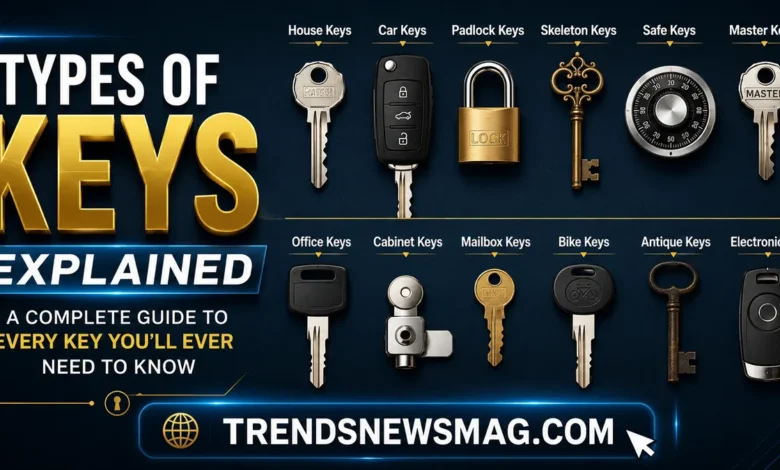
Within this broad category, there are several distinct types of keys worth knowing about. Flat keys are the simplest, with cuts along one edge, commonly used for older or basic locks. Then there are the more advanced cylindrical or “tubular” keys, which have circular cuts arranged around a central shaft rather than a flat blade—these are often found on vending machines, elevators, and some bike locks because they’re harder to pick with conventional tools.
Another traditional variant is the double-sided key, which has identical cuts on both edges so it can be inserted either way. This is a small but genuinely helpful design improvement, especially for locks used frequently, since it removes the frustration of fumbling to find the “right side up.” On the other end of the spectrum, you have skeleton keys—simple, often ornate keys designed to open a range of old-fashioned warded locks. While skeleton keys are largely decorative or antique-use today, they represent one of the earliest widely used types of keys and are still occasionally found operating old furniture locks, cabinets, and heritage doors.
As one veteran locksmith put it during an interview about the durability of traditional lock systems, “People assume mechanical keys are outdated, but the truth is, a well-made pin tumbler lock paired with a quality key is still one of the most reliable security combinations out there.” That sentiment reflects why, despite all the smart lock innovation in recent years, traditional metal keys haven’t disappeared—they’ve simply been joined by newer options rather than replaced entirely.
Types of Keys Based on Lock Mechanism
If you want to really understand types of keys, it helps to categorize them not by appearance but by the lock mechanism they’re designed to operate. This is where things get genuinely interesting from an engineering standpoint, because each mechanism solves the security puzzle differently.
Pin tumbler keys are the most widely used category worldwide. These keys interact with spring-loaded pins inside the lock cylinder; when the correct key is inserted, it pushes the pins to precisely the right height, aligning them at the “shear line” and allowing the cylinder to turn. This is the mechanism behind the vast majority of residential door locks, padlocks, and many commercial applications. The precision required means even a slightly worn key can eventually fail to operate the lock properly, which is why locksmiths recommend getting duplicates cut directly from the original rather than from a copy of a copy.
Wafer tumbler keys operate on a similar principle but use flat wafers instead of round pins. These are common in older car locks, cabinet locks, and some lower-security padlocks. They tend to be easier to manufacture and slightly less secure than pin tumbler systems, which is part of why the automotive industry largely moved away from pure wafer systems for primary vehicle locks, though they still appear in glove compartments and ignition backups on older models.
Disc detainer keys are a step up in complexity, using rotating discs rather than static pins or wafers. This design, often found in high-security padlocks and some European lock brands, is notably resistant to picking, which is why you’ll often see disc detainer systems used for bike locks, storage units, and shipping container security. The keys themselves usually have distinctive, more angular cuts compared to standard pin tumbler keys.
Then there are lever lock keys, historically significant and still used in some safes, older doors, and heritage buildings, especially in the UK and parts of Europe. Lever locks use a series of levers that must be lifted to precise, different heights simultaneously, and the keys for these locks tend to be larger and heavier than their pin tumbler counterparts. Because lever locks can be engineered with a huge number of possible lever combinations, they remain a respected choice for high-security applications even today.
Automotive Keys: A Category That Has Transformed Dramatically
Few areas illustrate the evolution of types of keys as dramatically as the automotive industry. If you compare a car key from the 1980s to one from today, you’d be forgiven for thinking they belong to entirely different categories of technology altogether—because in many ways, they do.
Basic mechanical car keys, once the standard, are flat metal keys cut specifically for a vehicle’s ignition and door locks, often using wafer or pin tumbler systems. These are still found on older vehicles and some budget models in certain markets, valued for their simplicity and low replacement cost. However, the vast majority of modern vehicles have moved toward transponder keys, which look like traditional keys but contain a small embedded chip that communicates with the car’s immobilizer system. Without the correct chip signal, the engine simply won’t start, even if the mechanical cut is correct. This dual-layer security—mechanical and electronic—has significantly reduced traditional car theft methods like hot-wiring.
Beyond transponder keys, many vehicles now use remote key fobs, which combine a mechanical key blade (often hidden inside the fob itself) with buttons for locking, unlocking, and sometimes remote start functionality. These fobs communicate with the car via radio frequency signals, and manufacturers have had to continuously upgrade encryption to stay ahead of relay attacks, where thieves intercept and amplify the fob’s signal to unlock a car without the owner’s knowledge.
The most advanced category currently in widespread use is the smart key or proximity key system, sometimes marketed as “keyless entry” or “keyless start.” These keys don’t need to be physically inserted anywhere; as long as the fob is within a certain range, sensors in the door handles and dashboard detect its presence, allowing the owner to unlock the car and start the engine with the push of a button. While incredibly convenient, security researchers have pointed out vulnerabilities in some early smart key systems, prompting manufacturers to introduce motion-sensing fobs that stop transmitting when stationary, reducing the window for relay-based theft. Valet keys, discussed in more detail later in this guide, also fall under this automotive umbrella and highlight just how many layers of access control now live inside a single car key.
Master Key Systems and Their Practical Applications
For anyone managing a building with multiple locks—apartment complexes, office buildings, hotels, schools—understanding master key systems is essential. This category of types of keys is less about mechanism and more about hierarchy and access control, and it’s genuinely clever once you understand how it works.
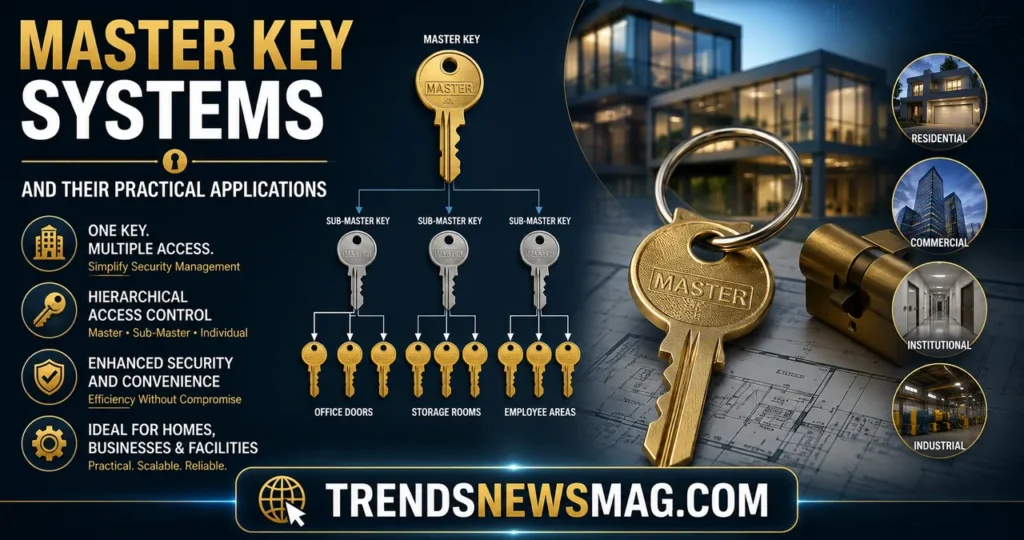
A master key system is designed so that a single “master key” can open every lock within a building or complex, while individual “change keys” only open their specific assigned lock. This is achieved through a more complex pin tumbler design, where each lock has additional pin segments—sometimes called “master wafers” or “split pins”—that allow multiple different key cuts to align the pins correctly at the shear line. It’s a bit like having multiple correct answers to the same lock, each answer corresponding to a different key.
Beyond simple master keying, larger institutions often use grand master key systems, which add another layer of hierarchy. In a hospital, for example, individual staff might have change keys to their own supply closets, department heads might have master keys to their entire wing, and facility management might hold a grand master key that opens every lock in the building. This tiered structure balances convenience for administrators with security for individual spaces, ensuring that access is distributed logically rather than handing out unrestricted keys to everyone.
There’s also a subcategory known as restricted or high-security keys, which are legally protected from unauthorized duplication. These keys often require a signed authorization card at a locksmith or manufacturer before a copy can be cut, and the blanks themselves are only distributed to licensed dealers. Property managers and businesses handling sensitive information frequently invest in restricted key systems precisely because it closes off the common vulnerability of someone making an unauthorized copy at a neighborhood hardware store. It’s a small but meaningful upgrade in the broader landscape of types of keys, and one that pays for itself the moment you consider the cost of a full rekeying after a security breach.
Digital and Electronic Keys Reshaping Modern Access
The rise of digital keys represents perhaps the most significant shift in how we think about access control in the last two decades. Unlike traditional metal keys, digital keys don’t rely on a physical cut pattern at all—they use encrypted data, radio signals, or biometric verification to grant access, and they’re becoming increasingly common in both residential and commercial settings.
Keycards and fobs, often used in hotels, offices, and apartment buildings, are among the most familiar digital key formats. These typically use RFID (radio-frequency identification) or magnetic stripe technology to communicate with a reader mounted near the door. What makes these especially practical for property managers is the ability to deactivate a lost card instantly and issue a new one, without needing to rekey the entire lock—something that would be far more expensive and time-consuming with traditional metal keys. Hotels in particular have embraced this system because it allows them to set specific access windows tied to a guest’s reservation dates, automatically expiring the key’s functionality at checkout.
Smartphone-based digital keys are the next evolution, allowing a phone to function as the actual key through Bluetooth or NFC technology paired with a dedicated app. This is increasingly common in newer smart home ecosystems and even some rental car services, where the entire access process—unlocking, starting, and even sharing temporary access with another person—happens entirely through an app. The convenience is undeniable, though it does raise valid questions about what happens if your phone battery dies or the app experiences a technical glitch, which is why most manufacturers still include a backup physical key or a PIN code entry option as a failsafe.
Biometric keys take digital access even further by removing the need for any physical object altogether. Fingerprint scanners, facial recognition, and even iris scanning are increasingly integrated into smart locks, particularly in high-security environments and increasingly in residential smart locks marketed to tech-savvy homeowners. While biometric systems offer a compelling level of convenience since you can never really “forget” your fingerprint at home, they do come with their own considerations around data privacy and the occasional false rejection, especially if a scanner gets dirty or a finger is injured. As someone deeply involved in smart home security once noted, “Biometric access is fantastic until the technology has an off day—that’s why redundancy always matters in any access system, digital or otherwise.” This is exactly why most homeowners installing a biometric lock are advised to keep a traditional keyed backup alongside it, rather than relying on a single point of entry.
Padlock Keys and Their Specialized Variations
Padlocks occupy a unique space in the world of security hardware because they’re portable, versatile, and used across an enormous range of applications—from securing a garden shed to locking down a shipping container. Naturally, this means the types of keys used for padlocks vary quite a bit depending on the security level required and the specific use case.
Standard padlock keys typically operate on either a pin tumbler or wafer mechanism, similar to residential door locks, and are widely available in hardware stores. These are perfectly adequate for low-risk applications like lockers, sheds, or bike racks where the primary goal is deterring casual tampering rather than defeating a determined intruder. Many standard padlocks also come with keyed-alike options, meaning you can purchase multiple padlocks that all open with the same key—incredibly convenient for someone managing several gates or storage units who doesn’t want to juggle a dozen different keys.
At the higher end, you’ll find combination-resistant padlocks paired with disc detainer or high-security pin tumbler keys, often used in industrial settings, cargo security, and government applications. These keys are frequently made from hardened steel or brass alloys designed to resist both physical tampering and environmental wear, since padlocks are often exposed to rain, dust, and temperature extremes in ways that indoor door locks simply aren’t. Some premium padlock brands also incorporate anti-bump and anti-pick pins directly into the key design itself, adding irregular cuts that make it significantly harder for lock-picking tools to manipulate the internal pins even with sustained effort.
There’s also a growing category of combination padlocks that don’t use a traditional key at all, relying instead on a numeric or alphabetic code entered via rotating dials. While these remove the risk of losing a physical key, they introduce a different vulnerability—forgetting the code—which is why many combination padlocks include a backup keyway accessible only by the manufacturer or a locksmith with proper documentation. This hybrid approach reflects a broader trend across many types of keys and locking mechanisms: the goal isn’t to eliminate physical keys entirely, but to add redundancy and flexibility depending on the user’s needs.
Comparing Common Key Types at a Glance
To make sense of everything covered so far, it helps to see how the major categories stack up against each other in terms of security, cost, and typical use case. The table below summarizes some of the most common types of keys discussed throughout this guide.
| Key Type | Typical Mechanism | Security Level | Common Use Case |
|---|---|---|---|
| Flat metal key | Pin tumbler / wafer | Moderate | Residential doors, cabinets |
| Tubular key | Circular pin arrangement | Moderate to high | Vending machines, bike locks |
| Transponder key | Chip-based immobilizer | High | Modern vehicles |
| Smart proximity key | RFID / radio signal | High | Keyless entry vehicles, smart homes |
| Restricted key | Patented pin tumbler | Very high | Commercial buildings, offices |
| Disc detainer key | Rotating disc system | High | High-security padlocks |
| Keycard / fob | RFID or magnetic stripe | Moderate to high | Hotels, offices, apartments |
| Biometric key | Fingerprint / facial scan | Very high | Smart homes, secure facilities |
This comparison makes it clear that there’s no single “best” key across the board—each type of key is designed with specific tradeoffs in mind, balancing convenience, cost, and the level of security required for its intended environment.
Specialty and Uncommon Key Variations Worth Knowing
Beyond the mainstream categories, there are several specialty types of keys that serve very specific purposes, and knowing about them can be genuinely useful in particular situations. Abloy keys, for instance, use a rotating disc detainer mechanism that’s widely regarded as one of the most pick-resistant designs available, commonly found in Scandinavian-made high-security locks used in banks and government facilities.
Skeleton keys, as mentioned earlier, deserve a bit more attention because of their unique design philosophy. Unlike modern keys that need an exact cut to function, skeleton keys are deliberately filed down to bypass the internal wards of older lock designs, working on the principle of exclusion rather than precise matching. This made them practical in an era before mass manufacturing allowed for precise, unique cuts on every lock, though it also meant security was inherently weaker, since a single skeleton key could often open many different locks of a similar style.
Barrel keys are another interesting variation, cylindrical in shape with a hollow center, historically used for cabinets, trunks, and older furniture pieces. Their design allows them to slide over a central post inside the lock rather than fitting into a narrow keyway, and while they’re largely a thing of the past for security purposes, antique furniture restorers and collectors still occasionally need to source or recreate these keys for period-accurate pieces.
Then there are car valet keys, a lesser-known but genuinely practical type of key included with many vehicles. Valet keys are cut to open the driver’s door and start the ignition but are deliberately restricted from opening the glove compartment or trunk, giving vehicle owners a way to hand their car over to a valet or mechanic without granting full access to personal belongings stored inside. It’s a small design choice, but one that reflects thoughtful consideration of real-world use cases within the broader landscape of automotive types of keys.
How to Choose the Right Type of Key for Your Needs
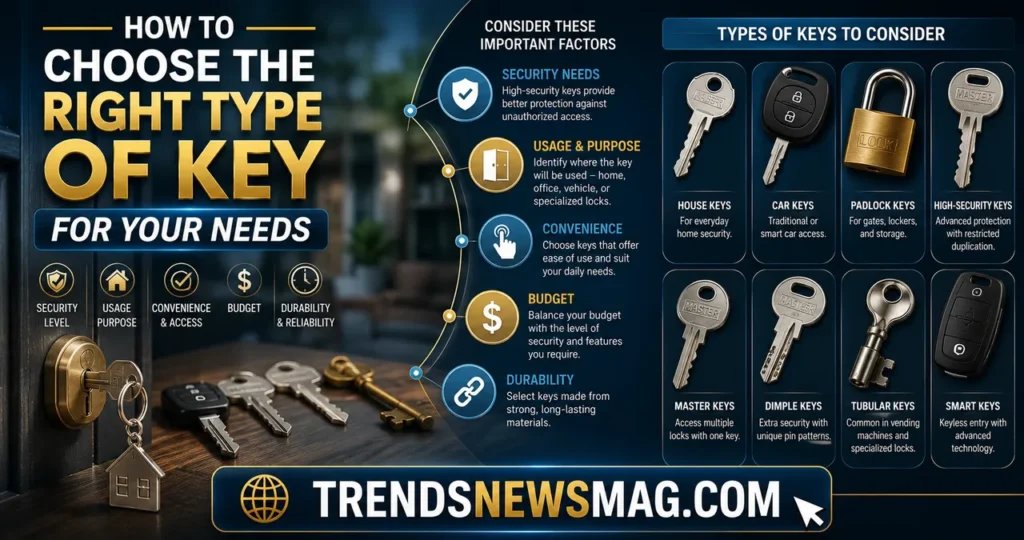
With so many types of keys available, choosing the right one for a specific situation can feel overwhelming, but breaking it down into a few practical questions makes the decision much easier. The first consideration is always the level of security required. A garden shed doesn’t need the same protection as a home office storing sensitive documents, so matching the key and lock mechanism to the actual risk involved prevents both overspending and, more dangerously, under-protecting valuable assets.
Convenience is the second major factor, and it’s one that’s easy to underestimate until you’re living with an inconvenient system daily. For households with children, elderly family members, or anyone who might struggle with fine motor precision, a simple keycard or smart lock with a keypad backup often proves far more practical than a traditional key that needs to be inserted and turned correctly every single time. Similarly, for property managers overseeing multiple units, a master key system or digital access platform saves enormous amounts of time compared to managing dozens of individual physical keys.
Cost naturally plays a role as well, and it’s worth thinking about both upfront and long-term expenses. While a basic pin tumbler key and lock might cost very little initially, the cumulative cost of rekeying after a lost key, replacing worn mechanisms, or upgrading security after a break-in can add up considerably. Digital and smart key systems often carry a higher initial investment but can reduce long-term costs associated with rekeying, especially in commercial or rental properties where tenant turnover means frequent access changes.
Finally, compatibility with existing infrastructure matters more than people often realize. Retrofitting an older building with modern digital key systems can require significant electrical and structural work, whereas simply upgrading to a higher-security traditional key and lock might achieve similar security improvements at a fraction of the cost and disruption. A qualified locksmith or security consultant can walk through these tradeoffs in detail, but understanding the basic categories of types of keys covered in this guide puts you in a much stronger position to ask the right questions and make an informed decision.
The Future of Keys in an Increasingly Connected World
It’s worth stepping back to consider where types of keys are headed as technology continues to evolve. The trend over the past decade has clearly favored digital and app-based access, driven by consumer demand for convenience and the broader push toward smart home integration. Companies continue to invest heavily in biometric authentication, cloud-connected locks, and even blockchain-based access credentials for high-security commercial applications, suggesting that the definition of a “key” will continue to broaden well beyond a physical object you carry in your pocket.
That said, physical keys are unlikely to disappear entirely, and there’s good reason for that persistence. Mechanical systems don’t rely on batteries, internet connectivity, or software updates, which makes them remarkably resilient in situations where digital systems might fail—during a power outage, for instance, or in a remote area without reliable connectivity. Many smart lock manufacturers acknowledge this reality by including a traditional keyway as a backup even on their most advanced digital products, a quiet admission that redundancy still matters enormously in access control design.
There’s also a growing conversation around the environmental and manufacturing considerations tied to different types of keys. Traditional metal keys require far fewer resources to produce and maintain compared to electronic systems with circuit boards and batteries, and they don’t contribute to electronic waste in the same way. As sustainability becomes a bigger factor in product design across industries, it wouldn’t be surprising to see renewed interest in durable, long-lasting mechanical key systems even as digital options continue to expand in parallel.
Conclusion
Keys, in all their many forms, remain one of the most fundamental tools of daily security and access, even as the technology behind them continues to evolve at a remarkable pace. From the humble flat metal key that’s been protecting homes for generations to sophisticated biometric and smartphone-based systems, understanding the different types of keys available today genuinely helps you make smarter decisions about security, convenience, and cost. Whether you’re choosing a simple padlock for a storage unit, setting up a master key system for a commercial building, or exploring smart lock options for your home, the underlying principles remain the same: match the key and lock mechanism to the actual level of risk and convenience you need, and don’t be afraid to combine traditional and digital systems where it makes sense. For readers interested in going even deeper into lock mechanisms and security standards, resources like the Associated Locksmiths of America offer detailed, authoritative information for anyone looking to expand their knowledge further.
FAQs
What are the most common types of keys used in homes today?
The most common types of keys found in residential settings are traditional pin tumbler keys, which operate standard door locks, alongside an increasing number of smart keys and keypad entry systems for homeowners seeking added convenience. Many households still rely primarily on flat metal keys for interior doors while using a smart lock or keycard system for the main entrance, creating a hybrid approach that balances familiarity with modern convenience.
How do I know which type of key my lock needs?
The easiest way to determine which type of key your lock requires is to examine the keyway itself, since different mechanisms—pin tumbler, wafer, or disc detainer—have distinctly shaped keyholes. If you’re uncertain, a locksmith can quickly identify the lock brand and mechanism and cut an appropriate replacement key, often within minutes, without needing to replace the entire lock.
Are digital keys safer than traditional metal keys?
Digital keys often provide stronger security against physical picking and unauthorized duplication compared to standard metal keys, since encrypted signals are much harder to replicate without specialized equipment. However, they introduce different vulnerabilities, such as hacking attempts or battery failure, so the overall safety depends heavily on the specific implementation and whether backup access methods are properly in place.
Can all types of keys be duplicated at a regular hardware store?
No, not all types of keys can be duplicated at a standard hardware store. Restricted and high-security keys require authorization from the property owner or original locksmith, and many transponder or smart keys need specialized programming equipment that most general hardware stores simply don’t carry, meaning you’ll often need to visit a dealership or specialized locksmith instead.
What should I do if I lose a master key to a building?
Losing a master key is a serious security concern because it potentially compromises access to every lock within that system, not just a single door. The safest course of action is to contact a professional locksmith immediately to assess whether a full rekeying of the master key system is necessary, since simply replacing the lost key without changing the underlying pin configurations leaves the building vulnerable if the lost key falls into the wrong hands.
Trending Today: Apollo Group TV Review