Apollo Group TV Review 2026: Features, Safety, Legal Risks & Best Legal Alternatives Explained

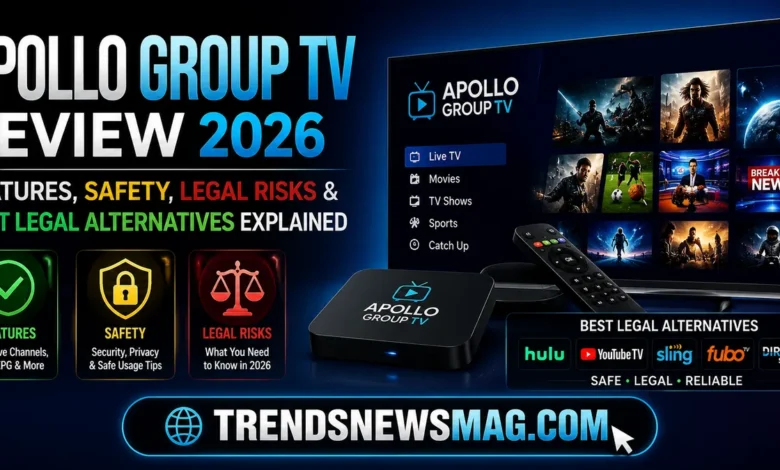
Streaming has quietly rewritten the rules of home entertainment, and somewhere in that rewrite, a category of services emerged that promises the world for pennies on the dollar. Apollo Group TV is one of the names that keeps popping up in forums, Reddit threads, and word-of-mouth recommendations from a neighbor who swears they’re “getting every channel for ten bucks a month.” If you’ve landed here because you’ve heard that pitch and want to know whether it’s too good to be true, you’re asking exactly the right question at exactly the right time.


This piece isn’t a sales page. It’s not going to tell you how to install anything or where to find a login. Instead, we’re going to walk through what Apollo Group TV actually is, how services like it operate behind the scenes, what real risks are involved — legally, financially, and technically — and then spend real time on the legitimate streaming platforms that deliver similar convenience without the baggage. By the end, you’ll have a clear, honest picture of where Apollo Group TV fits into the broader IPTV conversation and what smarter, safer options look like for 2026.
What Is Apollo Group TV? Understanding the IPTV Landscape
Apollo Group TV belongs to a category of products generally referred to as IPTV apps — Internet Protocol Television services that deliver live channels and on-demand content over an internet connection rather than through traditional cable or satellite infrastructure. On the surface, that description also fits completely legal services like YouTube TV or Hulu + Live TV. The technology itself, streaming video over IP networks, isn’t the problem. What separates a legitimate IPTV provider from one like Apollo Group TV is licensing: whether the company distributing the content has actually paid the broadcasters, studios, and sports leagues for the right to retransmit their programming.
Legitimate streaming services negotiate carriage agreements with networks like ESPN, HBO, NBC, and regional sports channels, and those agreements cost real money — often tens or hundreds of millions of dollars annually depending on the size of the platform. That cost gets reflected in subscription pricing, which is why a service like Fubo or YouTube TV runs somewhere between $60 and $95 a month. Apollo Group TV, by contrast, is typically advertised at a fraction of that price while claiming to offer thousands of live channels, every sports package imaginable, and complete on-demand libraries. That pricing gap isn’t a coincidence or a sign of superior efficiency. It’s usually a signal that the underlying content isn’t being paid for at all, and that the service is retransmitting streams it has no legal right to distribute.
It’s worth being precise here rather than alarmist. Not every IPTV app is illegitimate, and the broader IPTV industry includes plenty of legal players. But services that market themselves with phrases like “all channels included,” “no cable bill ever again,” and rock-bottom pricing while offering premium sports leagues, first-run movies, and hundreds of international channels in one bundle almost always fall into the unauthorized category. Apollo Group TV, based on how it’s commonly described and marketed across the platforms where it circulates, fits this pattern closely enough that caution is warranted before anyone hands over payment information or downloads an associated app.
How Unauthorized IPTV Apps Like Apollo Group TV Actually Work
To understand why services in this category are risky, it helps to understand the mechanics behind them. Unauthorized IPTV operations typically source their content by capturing live broadcast feeds — sometimes through legitimately purchased subscriptions that get re-streamed at scale, sometimes through direct feed interception — and then repackage those streams for distribution to thousands or millions of paying subscribers. The operators sit in a legal gray-to-black zone: they’re not the original pirates capturing the feed in many cases, but they’re knowingly redistributing copyrighted material without authorization from rights holders, which is itself a violation of copyright law in most countries.
This distribution model explains a few things that users of Apollo Group TV and similar apps commonly report. Streams can suddenly go dark during major sporting events, particularly high-profile matches, because rights holders and their anti-piracy partners actively monitor and issue takedown requests against unauthorized feeds in real time. Channel lineups shift unpredictably because the underlying source feeds get disrupted or blocked. And customer support, when it exists at all, tends to operate through anonymous channels like Telegram or Discord rather than through a verifiable company with a real address and accountable staff. None of this looks like the operational profile of a business with legal standing to distribute the content it’s selling.
There’s also a financial layer worth understanding. Payment for these services is frequently processed through unconventional means — cryptocurrency, prepaid cards, or third-party payment processors that obscure the actual seller’s identity. This isn’t an accident. It’s a structural choice that makes it harder for payment networks, banking regulators, and rights holders to trace and shut down the operation, and it also makes it significantly harder for a subscriber to dispute a charge or get a refund if the service disappears overnight, which happens routinely in this space. One industry analyst tracking IPTV piracy trends put it plainly: “These services aren’t built for longevity or accountability. They’re built to maximize revenue before enforcement catches up, and the subscriber is the one left holding the risk when it does.”
The Legal Risks of Using Apollo Group TV in 2026
Let’s address the question most people actually want answered: can you get in trouble for using something like Apollo Group TV? The honest answer is that enforcement has historically focused far more heavily on the operators and distributors of unauthorized IPTV services than on individual end users, but that doesn’t mean the risk to consumers is zero, and the enforcement landscape has been shifting.
In the United States, the Digital Millennium Copyright Act (DMCA) and broader copyright statutes make unauthorized distribution and, in some interpretations, knowing consumption of pirated broadcasts a civil and potentially criminal matter. Rights holders and industry groups like ACE (the Alliance for Creativity and Entertainment) have increasingly pursued not just the operators running services like Apollo Group TV, but also resellers and, in a growing number of cases internationally, subscribers themselves. The UK, several EU countries, and Canada have all seen cases where individual IPTV subscribers received warning letters, fines, or in rarer cases, legal action, particularly when the service in question was tied to a larger operator that got raided and had subscriber data seized.
Beyond the direct copyright exposure, there’s a second, less discussed legal risk: many unauthorized IPTV apps require sideloading outside of official app stores, which itself can violate terms of service for streaming devices and, in some jurisdictions, run afoul of laws around circumventing digital protections. Combine that with the payment obscurity mentioned earlier, and subscribers can find themselves in a position where they have no legal recourse, no consumer protection, and a genuine, if statistically modest, risk of legal exposure — all for a service that could vanish without warning. As one consumer rights attorney specializing in digital media noted in an interview on IPTV piracy: “People assume that because millions of others are doing it, the risk must be negligible. But enforcement patterns can change quickly, and when they do, it’s the operators’ subscriber databases that become the roadmap.”
Safety and Security Concerns: Malware, Data Privacy, and Scams
Legal risk is only part of the equation. The safety and cybersecurity concerns tied to unauthorized IPTV apps like Apollo Group TV are, in many ways, more immediately relevant to the average household, because they don’t depend on enforcement trends — they’re baked into how these services are typically distributed and monetized.
Because apps like this usually can’t be listed on official app stores such as the Apple App Store or Google Play (both of which have policies against unauthorized content distribution), users are directed to sideload APK files from third-party websites or install unofficial builds on streaming boxes. This process bypasses the security review that legitimate app stores perform, and it’s a well-documented vector for malware. Security researchers have repeatedly found IPTV-adjacent APKs bundled with adware, spyware, and in some cases more aggressive malware capable of harvesting stored credentials, banking app data, or device information. A device compromised this way doesn’t just risk your streaming account; it risks everything else connected to that device or network.
There’s also the matter of what happens to your payment and personal information once you hand it over. Legitimate streaming services are bound by consumer protection laws, PCI-DSS payment security standards, and public accountability that makes data breaches costly and legally consequential for them. Unauthorized IPTV operators generally have none of that infrastructure or incentive. Subscriber databases from services in this category have leaked or been seized before, exposing email addresses, payment details, and in some cases home addresses tied to shipping for physical set-top devices. And because refunds and chargebacks are difficult or impossible to pursue against anonymous sellers, subscribers who get scammed by a service that simply stops working often have no recovery path at all. It’s the same underlying pattern seen across other corners of the internet where convenience is offered without the guardrails that make convenience safe, a dynamic worth understanding even outside the streaming context — for a broader look at how gaps in oversight create risk in digital spaces, this piece on why technology cannot replace humans is a useful companion read on where automated systems and unverified platforms tend to fail people.
Why “Cheap” IPTV Services Cost More Than You Think
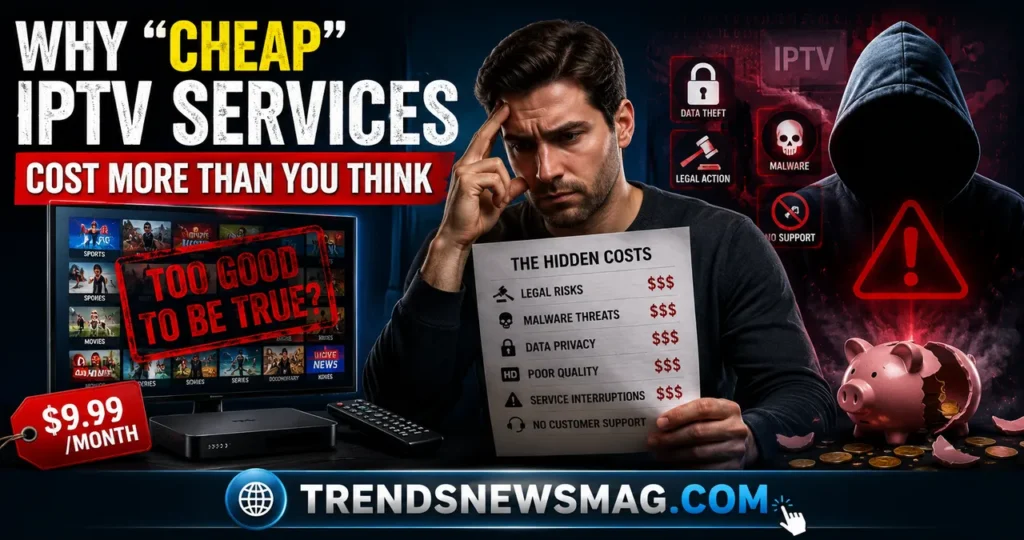
There’s a specific psychological hook that makes services like Apollo Group TV appealing, and it’s worth naming directly: the anchor price of traditional cable, which for years sat well above $100 a month for a full channel bundle, made anything priced at $15 or $20 for “everything” feel like an obvious win. But cheap isn’t the same as inexpensive when you factor in the full cost picture, and that’s a distinction worth sitting with before subscribing to anything in this category.
Start with reliability. Legal streaming platforms invest heavily in content delivery network infrastructure specifically so that a marquee event — a Super Bowl, a Champions League final, a big awards show — doesn’t buffer or drop mid-broadcast for millions of simultaneous viewers. Unauthorized IPTV services, sourcing content through re-streamed or intercepted feeds, routinely struggle exactly when demand and stakes are highest, because that’s also when rights holders’ anti-piracy monitoring is most aggressive. Subscribers report streams cutting out during the exact moments they were watching for — the final minutes of a game, the climax of a live event — which defeats the entire purpose of paying for live sports and entertainment access in the first place.
Then there’s the churn cost. Because unauthorized services get shut down, rebrand, or simply disappear with some regularity, subscribers often find themselves re-subscribing to a “new” service every few months, hunting for the next name that’s replaced the last one that went dark. Each of those transitions carries its own risk of payment fraud, malware exposure, and wasted time, and the cumulative cost — in money, hassle, and security exposure — frequently exceeds what a stable, legal alternative would have cost over the same period. This is the pattern industry observers point to again and again: the sticker price looks like a bargain, but the total cost of ownership tells a different story, not unlike how a discount gadget or unreviewed piece of hardware can end up costing more in returns and replacements than a well-reviewed option would have from the start, a dynamic covered well in this breakdown of the Ozlo Sleepbuds review, where getting the fundamentals right upfront saves money and frustration down the line.
Legal Alternatives to Apollo Group TV: Sling, Fubo, and YouTube TV Compared
This is the part that actually solves the underlying need most people have when they go searching for something like Apollo Group TV in the first place: live channels, sports, and on-demand content, without a traditional cable contract, at a price that doesn’t feel punishing. The good news for 2026 is that the legal streaming landscape has matured enormously, and there are now several mainstream, fully licensed services that genuinely deliver on the cord-cutting promise.
YouTube TV remains one of the most complete offerings, with a large channel bundle that includes most major broadcast networks, cable news, and a strong regional sports network selection in most markets, backed by unlimited cloud DVR storage and a genuinely polished interface across devices. Fubo built its reputation specifically around sports coverage, with deep soccer, international, and niche sports league coverage that other platforms don’t match, making it a strong pick for households where live sports are the primary driver. Sling TV takes a different approach entirely, offering smaller, cheaper, customizable channel bundles (Sling Orange and Sling Blue) that let subscribers pay only for the categories of content they actually want, which makes it the most budget-friendly legal option for people who don’t need an enormous channel count.
Here’s a direct comparison to make the decision easier:
| Service | Starting Price (2026) | Channel Count (approx.) | DVR Included | Best For | Free Trial |
|---|---|---|---|---|---|
| YouTube TV | ~$82.99/month | 100+ | Unlimited cloud DVR | All-around households wanting local + cable channels | Limited trial offers |
| Fubo | ~$79.99/month | 180+ | 250 hours (upgradable) | Sports-heavy households, soccer and international leagues | Occasional promo trials |
| Sling TV | ~$45.99/month | 30–50 (customizable) | 50 hours (upgradable) | Budget-conscious cord-cutters wanting flexibility | Sometimes offered |
| Hulu + Live TV | ~$82.99/month | 95+ | Unlimited cloud DVR | Households already using Hulu/Disney+ bundles | Limited trial offers |
| DirecTV Stream | ~$89.99/month | 90+ | Unlimited cloud DVR | Former satellite customers wanting a familiar lineup | Occasional promo trials |
Every service listed here is fully licensed, meaning the channels you watch are the actual channels, delivered at broadcast quality, with the customer support, refund policies, and accountability that come standard with a legitimate business. None of them require sideloading apps from unofficial sources, none of them ask for cryptocurrency payment, and none of them are at risk of disappearing overnight because of a copyright enforcement action. That stability alone is worth the price difference for most households, especially once you factor in how much time and frustration goes into troubleshooting unreliable unauthorized streams.
How to Spot Unauthorized IPTV Services Before You Subscribe
Given how many services occupy this same space as Apollo Group TV — with names that shift and rebrand constantly — it’s genuinely useful to know the warning signs that distinguish an unauthorized IPTV app from a legitimate streaming platform, especially since new entrants pop up faster than review sites can keep track of them.
The clearest signal is price relative to content breadth. If a service is advertising thousands of live channels, every major sports package, premium movie channels, and international content all bundled together for $10 to $25 a month, that pricing simply doesn’t align with how content licensing works in the real world. Legitimate providers pay enormous sums for carriage rights, and that cost structure makes rock-bottom, all-inclusive pricing mathematically implausible for a legal operation. A second signal is distribution method: legitimate services are available through official app stores — Apple TV, Roku, Amazon Fire TV, Google Play — with verifiable developer information. If a service requires downloading an APK file from a third-party website, entering a code on an unfamiliar activation portal, or installing through a “custom app” on a Firestick, that’s a strong indicator you’re outside the legal ecosystem.
A third signal worth watching for is the payment and support experience. Legitimate companies accept standard payment methods, provide real customer service channels with accountability, and have transparent terms of service and refund policies. Services that push subscribers toward cryptocurrency, gift cards, or anonymous payment processors, and that route support exclusively through Telegram channels or Discord servers with no verifiable business identity behind them, are operating in a way designed to avoid accountability rather than provide it. If you’re evaluating any IPTV option — including ones that market themselves the way Apollo Group TV does — running through these three checks (pricing plausibility, distribution channel, payment transparency) will tell you almost everything you need to know within a few minutes, similarly to how doing quick due diligence before adopting any new piece of tech, whether it’s a productivity tool or a device like the reMarkable 2, tends to save people from disappointing surprises later.
Making the Switch: Tips for Cord-Cutters Who Want It Done Right
If you’ve been using or considering something like Apollo Group TV mainly because traditional cable felt overpriced and rigid, the good news is that switching to a fully legal setup in 2026 doesn’t require sacrificing the flexibility that made cord-cutting appealing in the first place. It just requires a slightly more deliberate approach than grabbing the cheapest option that shows up in a Facebook ad.
Start by mapping out what you actually watch. Most households significantly overestimate how many channels they need and underestimate how much of their viewing is concentrated on a handful of networks plus a couple of streaming apps they already pay for separately. Once you know your must-haves — local news, a specific sports league, HBO or Showtime content, kids’ programming — you can match that list against the comparison table above and pick the legal service that covers it most efficiently rather than paying for a bloated bundle. Sling’s customizable tiers exist specifically for this kind of targeted approach, while YouTube TV and Fubo make more sense for households that want broad, near-cable-equivalent coverage without picking and choosing.
It’s also worth taking advantage of free trials, which most legitimate services offer periodically, to test streaming quality on your actual home network before committing to a monthly plan. Streaming quality depends heavily on your internet connection, router placement, and whether you’re watching on a smart TV app, a streaming stick, or a game console, and a short trial period lets you confirm everything works smoothly during peak usage hours — evenings and weekends — when network congestion is most likely to affect stream quality. Finally, don’t be afraid to combine services strategically rather than looking for one app to do everything; many cord-cutters run a live TV service like Fubo or Sling alongside on-demand platforms like Netflix or Disney+, and the total cost still frequently comes in below traditional cable while offering better content discovery and device flexibility, a principle that also holds true in other areas where picking the right combination of tools matters more than picking a single all-in-one solution, whether that’s choosing software for lawyers or assembling a home entertainment setup that actually fits how you live.
Comparing the User Experience: Legal Platforms vs. Unauthorized Apps
One aspect that often gets overlooked in the Apollo Group TV conversation is the actual day-to-day experience of using the service versus a licensed competitor. Legal platforms invest in interface design, personalized recommendations, multi-profile support, and cross-device syncing because user retention depends on a smooth experience that keeps subscribers engaged month after month. YouTube TV, for instance, lets you set up to six accounts under one household subscription with individual DVR libraries and viewing preferences, something that requires substantial backend infrastructure most unauthorized IPTV apps simply don’t have the resources or incentive to build.
Unauthorized services, by contrast, are typically built around a single priority: getting live streams onto a screen as cheaply and quickly as possible, with minimal investment in the surrounding experience. This shows up in small but meaningful ways — inconsistent channel guides that don’t accurately reflect what’s currently airing, poor search functionality, no meaningful on-demand library organization, and interfaces that feel noticeably dated compared to what subscribers are used to from Netflix, Hulu, or the major live TV platforms. Over time, these gaps compound into a frustrating experience that erodes whatever savings the lower price point initially offered, and it’s a big part of why churn rates for services like Apollo Group TV tend to be so high compared to established legal platforms.
The Sports Fan’s Dilemma: Why Legal Streaming Still Wins
Sports coverage deserves its own focused discussion because it’s frequently the single biggest driver pushing people toward unauthorized IPTV services in the first place. Regional sports networks, out-of-market packages, and international leagues can be genuinely expensive and fragmented across legal platforms, and that friction creates real appeal for a service promising every league and every match in one place for a fraction of the cost.
But the reality of watching sports through an unauthorized feed rarely lives up to that promise. Live sports streams are the single most aggressively monitored and taken down category of content by anti-piracy enforcement, precisely because leagues and broadcasters lose the most revenue when live events are pirated in real time rather than watched after the fact. This means unauthorized sports streams are disproportionately likely to buffer, drop, or go dark entirely during the exact moments that matter most — a last-minute goal, a championship point, a walk-off home run. Fubo has specifically built its business around solving this problem legally, offering deep coverage of soccer leagues, tennis, and international sports that used to require multiple separate subscriptions, while YouTube TV’s regional sports network coverage handles the bulk of NBA, NHL, and MLB regional broadcasts for most U.S. markets. For sports fans specifically, the reliability gap between legal and unauthorized streaming isn’t a minor inconvenience — it’s often the difference between actually seeing the moment you tuned in for and missing it entirely.
What Happens When Unauthorized IPTV Services Get Shut Down
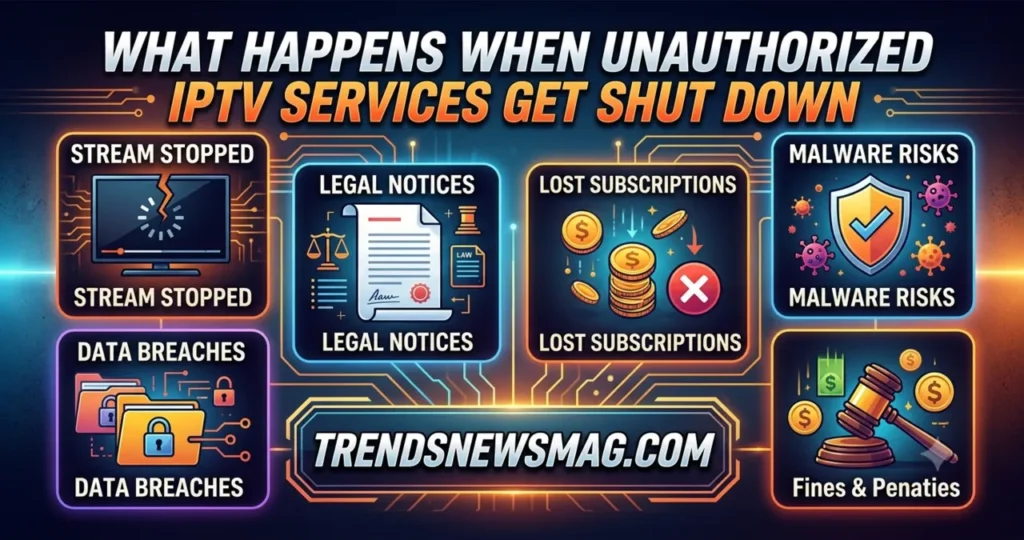
It’s worth spending a moment on what actually happens when a service in this category gets targeted by enforcement action, because it illustrates the practical risk to subscribers more vividly than abstract warnings do. When rights holders and anti-piracy coalitions successfully identify and act against an unauthorized IPTV operation, the typical sequence involves domain seizures, server takedowns, and in higher-profile cases, arrests of the operators. Subscriber access is cut immediately and without warning, often mid-billing-cycle, with no refund mechanism and no customer service to appeal to.
In several documented cases across Europe and North America, law enforcement operations against large IPTV piracy networks have also resulted in subscriber data being obtained as part of the investigation, which has occasionally led to follow-up communication with individual subscribers — sometimes cease-and-desist letters, sometimes settlement demands from rights holders’ legal representatives. While the scale of individual subscriber targeting varies significantly by country and case, the pattern is consistent enough that “this won’t happen to me” isn’t a reliable assumption. As one cybersecurity researcher covering piracy enforcement trends noted, “The operators build these services assuming they’ll eventually be caught. The subscribers rarely make the same calculation, which is exactly why they’re the ones most surprised when it happens.” This is precisely the kind of exposure that a legal subscription eliminates entirely — when you pay for YouTube TV or Fubo, there’s no enforcement action coming, no data seizure risk, no sudden service disappearance tied to a legal crackdown.
The Bigger Picture: How the Streaming Industry Is Responding
It’s also useful to understand that the existence of services like Apollo Group TV isn’t happening in a vacuum — it’s part of a broader tension the entire streaming industry has been navigating for years. As legal streaming has fragmented across dozens of individual platforms, each with its own subscription, password, and app, consumer frustration with the sheer complexity of “legal” streaming has grown right alongside the appeal of all-in-one unauthorized alternatives. Industry analysts have pointed to this fragmentation as a major contributing factor to piracy’s persistence, arguing that when legal options become too scattered and expensive collectively, a meaningful percentage of consumers will seek shortcuts regardless of the risks involved.
In response, the industry has been consolidating in ways that directly address this pain point. Bundle deals between streaming services, expanded live TV options within existing subscriptions, and aggregator platforms that let you manage multiple subscriptions through one interface have all expanded significantly through 2025 and into 2026. Apple TV’s channel bundling, Amazon Prime Video’s channel add-ons, and the increasing overlap between traditional pay-TV alternatives and on-demand libraries are all direct responses to the convenience gap that services like Apollo Group TV have been exploiting. The trajectory suggests that legal streaming is gradually closing the convenience gap that made unauthorized alternatives appealing in the first place, which is good news for anyone weighing the decision in 2026 specifically — the legal options are genuinely better and more comprehensive than they were even two or three years ago.
Conclusion
Apollo Group TV represents a broader category of unauthorized IPTV services that trade on an appealing but ultimately risky proposition: enormous channel bundles and premium sports access at a fraction of what legitimate providers charge. Once you understand how these services actually source and distribute their content, the pricing gap stops looking like a bargain and starts looking like exactly what it is — a signal that licensing costs simply aren’t being paid, with the legal, financial, and security risk of that gap shifted onto the subscriber. Between potential copyright exposure, the very real cybersecurity risks tied to sideloaded apps and unverified payment processors, and the practical unreliability that comes with unlicensed content sourcing, the case against services like Apollo Group TV holds up from almost every angle you examine it from.
The encouraging part of this whole picture is that the legal alternative landscape has genuinely caught up. YouTube TV, Fubo, and Sling TV each solve the specific problem that made cord-cutting and IPTV appealing in the first place — flexibility, reasonable pricing, and freedom from long-term contracts — without any of the downstream risk. Whichever platform fits your household’s actual viewing habits, the combination of reliability, accountability, and legitimate content licensing makes the switch worthwhile, and for most former or prospective Apollo Group TV users, that switch will end up costing less in total than the cycle of re-subscribing to whatever unauthorized service replaces the last one that got shut down. For further reading on how copyright enforcement and consumer protection intersect with streaming piracy, the U.S. Copyright Office’s official resources at copyright.gov offer detailed, authoritative guidance on how these laws apply.
Related Guides:
- Best Streaming Devices for 4K HDR TVs (2026 Guide)
- How to Fix Apple TV Remote Not Working (15 Proven Fixes)
FAQs
Is Apollo Group TV legal to use?
Apollo Group TV operates in a category of IPTV services that typically distribute copyrighted broadcast content without the licensing agreements that legitimate providers pay for, which places it in a legally gray-to-unauthorized zone rather than a clearly legal one. While individual enforcement against subscribers has historically been less common than action against operators, the legal risk isn’t zero, and it has been increasing in several countries as rights holders expand enforcement efforts against both distributors and, in some cases, end users of unauthorized streams.
What makes an IPTV service safe to subscribe to?
A safe IPTV service is one that’s available through official app stores with verifiable developer information, accepts standard payment methods with transparent billing and refund policies, and can demonstrate actual licensing agreements with the broadcasters and networks whose content it distributes. Services like YouTube TV, Fubo, and Sling TV meet all of these criteria, which is part of why they’re consistently recommended as safe, reliable alternatives to unauthorized apps like Apollo Group TV.
Can I get in legal trouble for using an unauthorized IPTV app?
The risk to individual subscribers varies by country and has generally been lower than the risk faced by the operators running these services, but it isn’t nonexistent. Several countries have pursued subscribers directly following enforcement actions against larger IPTV piracy networks, particularly when subscriber payment or account data was recovered during an investigation, so treating the risk as purely theoretical would be a mistake.
Why is Apollo Group TV so much cheaper than services like Fubo or YouTube TV?
The price difference comes down to licensing costs. Legal platforms like Fubo and YouTube TV pay substantial carriage fees to broadcasters and sports leagues for the right to distribute their content, and that cost is reflected directly in subscription pricing. Services like Apollo Group TV typically don’t carry those licensing agreements, which is what allows them to advertise dramatically lower prices for a comparable or even larger channel lineup, but it also means the content is being distributed without authorization from the actual rights holders.
What’s the best legal alternative to Apollo Group TV for sports fans?
For sports-heavy households, Fubo tends to be the strongest legal alternative because of its deep coverage of soccer leagues, international sports, and a broad regional sports network lineup, all delivered through licensed broadcast agreements. YouTube TV is also a strong option for U.S.-focused sports coverage, particularly for NBA, NHL, and MLB regional broadcasts, and both platforms offer considerably more reliable streaming during high-demand live events than unauthorized services typically can.
Will switching from Apollo Group TV to a legal service actually save money long-term?
In many cases, yes, once you account for the full picture rather than just the monthly sticker price. Unauthorized IPTV services frequently get shut down or become unreliable, forcing subscribers into a cycle of re-subscribing to new services, each carrying its own payment and security risk. A stable, legal subscription to a platform like Sling TV or YouTube TV avoids that churn entirely, and when you factor in the time, hassle, and security exposure saved, the total cost of ownership often comes out favorably compared to cycling through unauthorized alternatives.
Trending Today: Krowd Login
Related Guides: