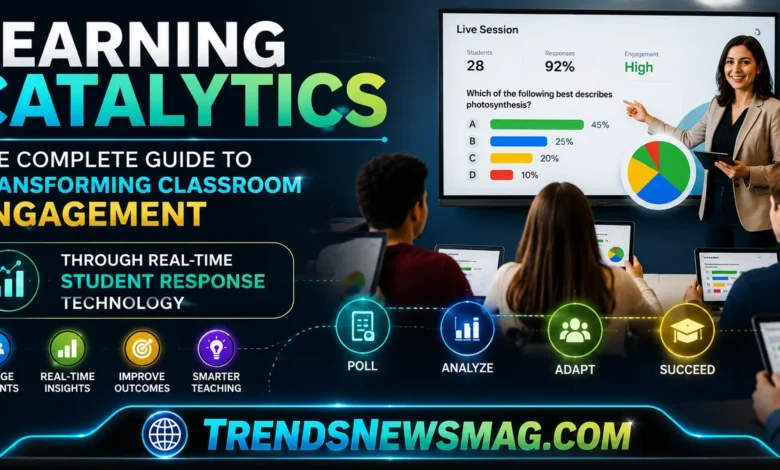
Learning Catalytics: The Complete Guide to Transforming Classroom Engagement Through Real-Time Student Response Technology

Walk into any college lecture hall these days and you’ll notice something has shifted. Professors aren’t just talking at students anymore; they’re pulling out devices, asking questions mid-lecture, and watching real-time data pour in about who actually understands the material. This shift didn’t happen by accident. It’s the product of years of research into how people actually learn, combined with technology that finally caught up to pedagogical theory. Learning Catalytics sits right at the center of this transformation, and if you’ve never used it or even heard of it, you’re about to understand why thousands of instructors across the globe swear by it.


I remember sitting in on a physics class years ago where the professor asked a seemingly simple question about acceleration. Half the room raised their hands confidently for one answer, and the other half for a completely different one. Without a tool to capture that split instantly, the professor might have moved on, assuming most students understood the concept. Instead, because the class was using a real-time polling system, the misunderstanding became visible immediately, and the lesson pivoted right there. That’s the kind of moment Learning Catalytics was built to create, over and over again, in classrooms of every subject and size.
This article dives deep into what Learning Catalytics actually is, how it works, why it matters for modern education, and how instructors and institutions can use it to genuinely improve learning outcomes. Whether you’re a professor considering adopting it, a student curious about the tool your instructor keeps mentioning, or an administrator evaluating educational technology investments, you’ll find practical, grounded insights here rather than vague marketing fluff.
What Learning Catalytics Actually Is and Why It Was Created
Learning Catalytics is a cloud-based, interactive teaching tool developed originally by researchers at Harvard and Massachusetts Institute of Technology before being acquired and integrated into Pearson’s education ecosystem. At its core, it allows instructors to pose questions to students during class and receive instant, individualized responses that reveal exactly how well the material is landing. Unlike a simple clicker system that only supports multiple choice, this platform supports open-ended responses, numerical answers, graphing, ranking, and even drawing on diagrams, which makes it dramatically more flexible than older classroom response systems.
The origin story matters here because it explains the philosophy baked into the tool. Eric Mazur, a physics professor at Harvard, had grown frustrated watching students memorize formulas without truly grasping underlying concepts. He developed a teaching method called peer instruction, where students answer a conceptual question individually, discuss it with a neighbor, then answer again. The data consistently showed improved understanding after peer discussion, but tracking this process manually across a large lecture hall was nearly impossible. Learning Catalytics grew out of the need to digitize and scale this exact process, giving instructors the ability to run peer instruction seamlessly across hundreds of students simultaneously.
What makes this platform different from generic quiz apps is its emphasis on conceptual reasoning over rote recall. A chemistry instructor, for example, can ask students to drag molecules into the correct configuration rather than just picking an answer from a list. A calculus professor can have students sketch a graph representing a function’s behavior, and the system captures that sketch as a data point. This kind of interaction pushes students toward genuine problem-solving rather than guessing games, and it gives instructors far richer data about where misconceptions actually live.
Institutions adopted Learning Catalytics not because it was trendy, but because the underlying research on peer instruction and active learning had already demonstrated measurable improvements in student retention and exam performance. When Pearson integrated the tool into its broader MyLab and Mastering platforms, it became accessible to a much wider range of disciplines beyond physics, spreading into biology, economics, nursing, business, and even humanities courses where conceptual understanding still matters just as much as content memorization.
How the Platform Works in a Real Classroom Setting
Understanding the mechanics helps clarify why so many instructors find this tool genuinely useful rather than gimmicky. At the start of a session, the instructor logs into the platform and either builds a question set in advance or improvises questions live based on how the class discussion is unfolding. Students join using a class code on their own laptops, tablets, or phones, which means institutions don’t need to invest in expensive proprietary clicker hardware that often broke, ran out of batteries, or got lost between semesters.
Once a question is posted, students respond using whatever input type the question requires. This could be selecting one option from a list, typing a numerical value, drawing a line on a graph, or highlighting a region on an image. The instructor’s screen updates in real time, showing a histogram or visual summary of how the class answered. This immediate feedback loop is the heart of the system’s value. Instead of waiting until a graded exam reveals confusion, the instructor sees it happening in the moment and can address it before students walk out the door still confused.
One particularly clever feature involves grouping students based on their answers for peer discussion. If the software detects a roughly even split between two competing answers, it can automatically pair students who chose different responses, encouraging them to explain their reasoning to each other before answering again. This directly operationalizes Mazur’s peer instruction method without requiring the instructor to manually track who answered what. A professor at a mid-sized state university once described this feature to me as “having a teaching assistant in every single seat, quietly making sure nobody just nods along without actually getting it.”
The data collected doesn’t disappear after class ends either. Instructors can export response histories, track individual student participation over the semester, and identify which concepts consistently trip up the majority of the class across multiple sections or even multiple semesters. This longitudinal view lets departments refine their curriculum over time based on actual evidence rather than instinct alone. A biology department chair mentioned that after two years of using this data, they completely restructured how they introduced cellular respiration because the pattern of confusion was so consistent and so clearly tied to a specific point in the lecture sequence.
The Pedagogical Theory Behind Real-Time Formative Assessment
To really appreciate why Learning Catalytics has staying power in higher education, you need to understand the educational theory it’s built on. Formative assessment, as opposed to summative assessment, refers to any evaluation method used during the learning process rather than at the end of it. A midterm exam is summative; it tells you how much a student learned after the fact, when it’s often too late to change course. A quick in-class question about a concept just introduced is formative; it tells you, in real time, whether the teaching approach is working.
Educational researchers have consistently found that formative assessment, when done well, produces larger learning gains than almost any other classroom intervention. The catch is that traditional formative assessment methods, like asking “does everyone understand?” and scanning the room for nods, are notoriously unreliable. Students nod along out of politeness, fear of looking foolish, or simple inattention, not because they genuinely grasp the material. Learning Catalytics solves this by making formative assessment anonymous, immediate, and quantifiable, removing the social pressure that distorts traditional in-class feedback.
There’s also a strong connection here to retrieval practice, a learning phenomenon where actively recalling information strengthens memory far more effectively than passive review. Every time a student answers a Learning Catalytics question, they’re engaging in a small act of retrieval practice, even if the question is conceptual rather than factual. Over the course of a semester, these repeated small retrieval moments compound into stronger long-term retention, which shows up later as improved exam performance and, more importantly, deeper conceptual fluency that persists beyond the course itself.
Cognitive load theory also plays a role in why this tool works so well when implemented thoughtfully. By breaking a lecture into smaller chunks punctuated by active questions, instructors prevent the kind of information overload that happens when students passively absorb forty-five minutes of continuous content. The brief pause to answer a question, discuss with a peer, and reconsider gives working memory a chance to consolidate information before more content gets piled on top. Instructors who’ve shifted from lecture-heavy formats to this more punctuated style often report that students seem less mentally exhausted by the end of class, even though the cognitive engagement during class has actually increased.
Key Features That Set It Apart From Basic Clicker Systems
It’s worth being specific about what actually distinguishes Learning Catalytics from the older generation of classroom response systems, because the differences matter enormously for instructors deciding whether the investment is worthwhile. The table below breaks down some of the core distinctions.
| Feature | Traditional Clicker Systems | Learning Catalytics |
|---|---|---|
| Question types supported | Multiple choice only | Multiple choice, open response, numerical, graphing, image annotation, ranking |
| Hardware requirement | Proprietary remote devices | Any web-enabled device students already own |
| Peer instruction automation | Manual grouping by instructor | Automatic pairing based on divergent answers |
| Data export and analytics | Limited or none | Full response history, longitudinal tracking |
| Question creation flexibility | Pre-set templates only | Fully customizable, live improvisation possible |
| Integration with course platforms | Standalone | Integrates with Pearson’s broader course ecosystem |
This comparison makes clear why so many departments phased out old clicker hardware once this newer approach became available. Beyond the obvious cost savings from not needing to purchase and maintain physical devices, the expanded question types alone open up entirely new possibilities for assessment. A geography instructor can ask students to click the exact location on a map where a particular geological event occurred, capturing spatial reasoning in a way multiple choice simply cannot replicate. A statistics professor can ask students to sketch what they think a distribution looks like before revealing the actual data, which surfaces intuitive misconceptions about probability that would otherwise remain hidden until a test.
Another feature worth highlighting is the ability to run questions asynchronously as homework assignments rather than exclusively during live class sessions. This flexibility matters enormously for hybrid and online courses, where synchronous class time is limited or nonexistent. An instructor can assign a set of Learning Catalytics questions due before the next class session, then use the aggregated data to plan exactly what needs review time versus what the class has already mastered. This turns pre-class reading assignments from a passive chore into an active diagnostic tool, essentially flipping part of the classroom experience without requiring a full flipped-classroom overhaul.
Real-World Applications Across Different Academic Disciplines

While Learning Catalytics originated in physics education, its application has expanded dramatically across disciplines that might seem, at first glance, unsuited to this kind of quantitative interactive tool. Nursing programs use it extensively for clinical reasoning scenarios, where students respond to a patient case description by selecting which interventions they’d prioritize, then discuss their reasoning with classmates before the instructor reveals the evidence-based best practice. This mirrors the actual decision-making process nurses face in clinical settings far more closely than a traditional written exam question ever could.
Economics departments have found the tool particularly useful for addressing common misconceptions about supply and demand, opportunity cost, and market equilibrium, concepts that students often think they understand intuitively but actually misapply in specific scenarios. An economics professor at a large public university described using Learning Catalytics to ask students to predict what would happen to equilibrium price and quantity following a specific market shock, then watching the class split roughly into thirds across three different predictions. “That single question told me more about where my students actually stood than three weeks of homework assignments,” she said. “It reshaped the rest of my unit on market dynamics.”
Language and humanities instructors have also adapted the platform creatively, even though it wasn’t originally designed with their disciplines in mind. A literature professor might ask students to rank a set of textual passages by which best supports a particular thematic argument, generating a data-driven discussion about interpretation and evidence. A history course might use the image annotation feature to have students identify specific elements in a primary source photograph, turning visual analysis into a measurable, discussable classroom activity rather than something only a few vocal students engage with while others stay silent.
Even in disciplines built around numerical problem-solving, like engineering and advanced mathematics, the value goes beyond just checking whether students got the right numerical answer. Instructors frequently use the platform to ask students to predict an outcome before working through a problem step by step, then compare their intuition against the actual mathematical result. This predict-then-verify approach has strong grounding in learning science, since the act of making a prediction, even an incorrect one, primes the brain to pay closer attention to the subsequent explanation and strengthens the eventual correction of the misconception.
Benefits for Students That Go Beyond Just Grades
It’s easy to focus purely on the instructor’s perspective when discussing a classroom technology tool, but the student experience matters just as much, arguably more. For students, one of the most immediate and appreciated benefits is anonymity combined with accountability. Nobody in the room knows which answer belongs to which student unless the instructor specifically chooses to reveal it, which removes the fear of public embarrassment that keeps many students from participating in traditional hands-raised classroom discussion. At the same time, because every student must submit a response, there’s no hiding in the back row and letting more confident classmates carry the conversation.
This combination directly benefits students who experience anxiety around public speaking or who come from educational backgrounds where speaking up in class wasn’t culturally encouraged. International students, first-generation college students, and students who are naturally introverted often report feeling far more comfortable engaging with material through this format than through cold-calling or open floor discussion. A student I spoke with described it simply: “I actually think about the question instead of thinking about whether people will judge my answer. That changes everything about how much I actually learn.”
There’s also a meaningful psychological benefit tied to seeing that confusion is normal and widely shared. When a difficult question reveals that forty percent of the class chose the wrong answer, students who got it wrong realize immediately they’re not alone, which reduces the isolating shame that often accompanies academic struggle. This normalization of mistakes as part of the learning process, rather than evidence of personal inadequacy, aligns closely with what psychologists call a growth mindset, the belief that ability and understanding can be developed through effort rather than being fixed traits. Watching a room full of peers grapple with the same conceptual difficulty tends to make students more willing to ask questions afterward rather than silently assuming they’re simply not smart enough for the subject.
Beyond the emotional and psychological dimensions, there’s a very practical academic benefit too. Students who regularly engage with formative questions throughout a course tend to build stronger metacognitive awareness, meaning they develop a more accurate sense of what they actually know versus what they merely recognize when they see it. This distinction matters enormously for exam preparation. A student who has been tested repeatedly on genuine understanding throughout the semester walks into a final exam with far less unpleasant surprise than a student who assumed passive lecture attendance equaled comprehension. This is one of the quieter but most durable advantages that this kind of active learning tool provides over the course of an entire academic term.
Challenges and Limitations Instructors Should Understand Before Adopting It
No educational technology tool is without its friction points, and being honest about the limitations of Learning Catalytics actually strengthens the case for using it thoughtfully rather than blindly. The most commonly cited challenge involves the learning curve for instructors themselves. Building genuinely good conceptual questions, the kind that reveal misconceptions rather than just testing recall, takes practice and pedagogical skill. An instructor who simply ports over old multiple-choice exam questions without adapting them for the interactive format often gets underwhelming results and may conclude, incorrectly, that the tool itself isn’t valuable.
Device access and connectivity present another practical hurdle, particularly in institutions serving lower-income student populations or in regions with unreliable internet infrastructure. While the bring-your-own-device model saves money compared to proprietary clicker hardware, it does assume every student has consistent access to a working smartphone, tablet, or laptop along with reliable Wi-Fi during class time. Some institutions have addressed this by maintaining a small pool of loaner devices, but this adds administrative overhead that departments need to plan for realistically rather than assuming universal access.
There’s also a legitimate pedagogical concern about over-reliance on any single tool, no matter how well-designed. If every single class session becomes a rapid-fire sequence of questions without adequate time for deeper discussion, extended explanation, or the kind of sustained narrative that helps students see how concepts connect across a broader arc, the tool can end up fragmenting the learning experience rather than enhancing it. The most effective instructors tend to treat Learning Catalytics as one component woven into a broader teaching strategy rather than the entire strategy itself. As one veteran chemistry professor put it, “The tool tells me where the gaps are. It doesn’t replace the work of actually teaching into those gaps.” That distinction, between diagnostic tool and complete teaching method, seems to be the key insight that separates instructors who get transformative results from those who feel the tool underdelivered on its promise.
Cost is a factor worth mentioning honestly as well, since institutional licensing and student access fees can add up, particularly for departments already stretched thin on educational technology budgets. Some students also express frustration when a tool tied to a specific textbook publisher’s ecosystem effectively locks them into purchasing materials from that publisher across multiple courses. Administrators evaluating whether to adopt or continue using this platform need to weigh these financial and structural considerations against the documented pedagogical benefits, ideally by piloting the tool in a limited set of courses before committing to a full department-wide rollout.
Comparing Learning Catalytics to Other Popular Classroom Engagement Tools
The classroom engagement technology market has grown substantially, and instructors today have several legitimate alternatives to consider alongside Learning Catalytics. Tools like Poll Everywhere, Kahoot, Mentimeter, and Top Hat all occupy similar territory, though each carries distinct strengths and weaknesses. Kahoot, for instance, leans heavily into gamification, turning quiz questions into a competitive, timed game show format that students often find energizing but which may not suit deeper conceptual exploration as well as it suits quick factual recall review sessions.
Top Hat markets itself as a more comprehensive course management platform, bundling interactive questions with textbook content, attendance tracking, and discussion boards into a single ecosystem, which appeals to instructors wanting an all-in-one solution rather than a standalone tool. Mentimeter tends to be favored in corporate training and conference settings rather than semester-long academic courses, given its emphasis on quick, visually polished polls rather than sustained pedagogical sequences tied to a curriculum. Poll Everywhere offers strong simplicity and integrates smoothly with presentation software many instructors already use, though it lacks some of the more sophisticated question types, like graphing and image annotation, that give Learning Catalytics its edge in STEM disciplines specifically.
What tends to tip the scales toward Learning Catalytics for many science and math departments is precisely that depth of question variety combined with the peer instruction automation rooted in genuine cognitive science research. An instructor evaluating these tools should honestly assess their discipline’s specific needs. A humanities seminar built around discussion and interpretation might find Mentimeter or Poll Everywhere entirely sufficient, while a large introductory physics or chemistry lecture, where conceptual misconceptions run deep and predictable, will likely benefit more from the specialized question types and research-backed peer instruction workflow that this platform was purpose-built to support.
It’s also worth noting that technology, however sophisticated, cannot fully replace the human elements of teaching that make learning genuinely stick, a point explored thoughtfully in this piece on why technology cannot replace humans, which offers useful perspective for anyone evaluating how much weight to place on any single educational tool. The best instructors treat these platforms as amplifiers of good teaching rather than substitutes for the relationships, judgment, and adaptability that only a human educator brings to a classroom.
Practical Tips for Instructors Just Getting Started
For instructors considering their first semester using Learning Catalytics, starting small tends to produce better results than an ambitious full overhaul of every lecture. Begin with just two or three questions per class session, focused specifically on the concepts you already know, from years of grading exams, tend to trip students up. This targeted approach lets you build comfort with the platform’s interface and question-building tools without overwhelming yourself or your students with a completely restructured class format overnight.
Writing genuinely good conceptual questions is a skill worth investing time into deliberately. The most effective questions aren’t the ones with an obvious right answer that everyone gets correct, since that tells you nothing useful about where understanding breaks down. Instead, aim for questions where you genuinely expect the class to split across two or three plausible answers, ideally including one answer that reflects a common, predictable misconception. If you find that ninety percent of students answer correctly every single time, that’s actually a signal to make your questions more conceptually challenging rather than a sign of teaching success.
Timing matters more than most new users initially realize. Posting a question immediately after introducing a new concept, before students have had time to fully process it, often just measures confusion about the concept’s existence rather than a genuine misunderstanding of its substance. Building in a short buffer, even just a few minutes of explanation or a worked example, before posing the interactive question tends to generate more diagnostically useful data. Similarly, resist the urge to immediately reveal the correct answer the moment responses come in. Give students that crucial peer discussion window first, since that’s where the actual learning happens, not in seeing the histogram of results.
Finally, instructors just starting out should resist the temptation to grade every single Learning Catalytics question for correctness, particularly early in a semester. Grading purely on participation rather than accuracy, at least initially, encourages students to answer honestly rather than strategically guessing what they think the instructor wants to hear. Once students trust that wrong answers won’t tank their grade, response data becomes far more reliable and genuinely useful for diagnostic purposes. This trust-building phase, often just the first few weeks of a semester, tends to pay enormous dividends in data quality and classroom culture for the remainder of the course.
The Broader Shift Toward Active Learning in Higher Education
Learning Catalytics didn’t emerge in isolation. It’s part of a much larger movement within higher education away from the traditional lecture format and toward active learning pedagogies backed by decades of educational research. Studies published in respected journals have repeatedly demonstrated that students in courses using active learning techniques, including real-time interactive questioning, outperform students in traditionally lectured courses on standardized conceptual assessments, even when covering identical content. This isn’t a marginal effect either; some of the most cited research in this area found failure rates in STEM courses dropped substantially when active learning methods replaced pure lecture formats.
This broader shift has implications well beyond any single tool. Universities have begun redesigning physical classroom spaces specifically to support this kind of interactive teaching, moving away from fixed rows of seats facing a single podium and toward flexible seating arrangements that facilitate small group discussion. Faculty development centers at many institutions now offer dedicated training on writing effective conceptual questions and facilitating peer instruction, recognizing that the technology alone accomplishes little without instructors who genuinely understand the pedagogical theory underlying it.
There’s an interesting parallel here to how other forms of media and entertainment have evolved to prioritize interactivity and real-time engagement over passive consumption, a trend you can see reflected even in unrelated spaces like the surge of interactive audio content discussed on platforms similar to Geekzilla Radio, where audience participation has become central to the format rather than an afterthought. Education, entertainment, and information sharing more broadly all seem to be converging on the same insight: people retain and engage with content far more effectively when they’re active participants rather than passive recipients.
This movement toward active learning also intersects meaningfully with equity considerations in higher education. Research has shown that active learning techniques, including the kind of low-stakes, anonymous questioning that Learning Catalytics enables, tend to disproportionately benefit students from underrepresented backgrounds in STEM fields, helping to narrow achievement gaps that persist in traditionally lectured courses. This finding has pushed some institutions to view tools like this not just as a teaching enhancement but as a genuine equity intervention, worth prioritizing in departments actively working to improve retention and success rates among historically underserved student populations.
Measuring the Actual Impact on Learning Outcomes

Skeptical instructors and administrators reasonably want evidence before investing time and money into any educational technology, and fortunately, there’s a meaningful body of research specifically examining outcomes tied to Learning Catalytics and peer instruction more broadly. Physics education research, the discipline where this entire approach originated, has produced some of the most rigorous data. Studies using the Force Concept Inventory, a widely respected assessment tool measuring conceptual understanding of mechanics, have consistently shown larger gains in classes using peer instruction methods compared to traditionally lectured sections covering identical content.
Beyond standardized conceptual assessments, institutions have also tracked more practical outcome measures like course completion rates, withdrawal rates, and grade distributions before and after adopting interactive questioning tools. While it’s admittedly difficult to isolate the effect of a single tool from broader curricular changes that often accompany its adoption, departments that have implemented Learning Catalytics as part of a deliberate active learning initiative frequently report meaningful reductions in D, F, and withdrawal rates, particularly in historically challenging introductory STEM courses that serve as gatekeepers for many majors.
Student satisfaction surveys add another useful data point, even though self-reported satisfaction doesn’t always correlate perfectly with actual learning gains. Course evaluations at institutions using Learning Catalytics extensively often show students specifically praising the sense of real-time feedback and the feeling that instructors genuinely knew whether the class understood the material, as opposed to simply assuming based on silence or nodding. This qualitative feedback, while less rigorous than a controlled experimental study, still matters for understanding the full picture of how a teaching tool affects the classroom experience day to day.
It’s worth acknowledging honestly that not every study or every classroom sees dramatic transformation, and outcomes depend heavily on implementation quality. A poorly trained instructor using low-quality questions with this tool will likely see modest results at best, while a skilled instructor who has invested time in learning the peer instruction methodology and crafting genuinely diagnostic questions tends to see the more dramatic gains reported in the strongest research studies. This variability underscores a point worth repeating throughout any discussion of educational technology: the tool creates opportunity, but the instructor’s pedagogical skill determines how much of that opportunity actually translates into improved learning outcomes for students.
Conclusion
Learning Catalytics represents far more than just another classroom gadget riding a wave of educational technology hype. It’s the digital embodiment of decades of research into how people genuinely learn, built specifically to surface misconceptions in real time rather than letting them fester until a disappointing exam result. From its origins in Harvard physics classrooms to its current widespread use across nursing, economics, humanities, and countless other disciplines, the tool has proven remarkably adaptable while staying true to its core pedagogical mission of making student thinking visible and actionable.
The benefits extend in both directions. Instructors gain unprecedented insight into exactly where their teaching is landing and where it’s falling short, allowing for responsive, evidence-based adjustments mid-lecture rather than after the fact. Students gain a lower-stakes, anonymous way to engage genuinely with difficult material, building both conceptual understanding and the metacognitive awareness that serves them well far beyond any single course. The peer instruction methodology baked into the platform’s design draws on genuinely rigorous cognitive science research rather than untested assumptions about what makes learning stick.
That said, no tool succeeds purely on its own merits. Learning Catalytics works best in the hands of instructors willing to invest genuine effort into crafting thoughtful conceptual questions, willing to build classroom trust around honest participation rather than performance, and willing to treat the tool as one component of a broader active learning strategy rather than a magic solution. For institutions and educators genuinely committed to improving student outcomes, particularly in historically challenging STEM courses, the evidence strongly suggests that Learning Catalytics, implemented thoughtfully, delivers measurable, meaningful improvements in both engagement and genuine understanding. For anyone still on the fence about adopting it, the research summarized by organizations like the Association for Psychological Science offers additional independent perspective worth reviewing before making a final decision, available at https://www.psychologicalscience.org.
FAQs
What exactly is Learning Catalytics used for in a classroom setting?
Learning Catalytics is primarily used to gather real-time feedback from students during a live class session, allowing instructors to instantly see how well the class understands a given concept before moving forward with the lesson. It supports a wide range of question formats beyond simple multiple choice, including numerical responses, graph sketching, and image annotation, which makes it useful across disciplines ranging from physics and chemistry to nursing and economics. Instructors typically use it to identify misconceptions early, facilitate peer discussion around difficult concepts, and adjust their teaching pace based on actual comprehension data rather than assumptions.
Does Learning Catalytics require special hardware or devices for students?
No, one of the significant advantages of this platform compared to older classroom response systems is that it doesn’t require any proprietary hardware like dedicated clicker remotes. Students simply use whatever web-enabled device they already own, whether that’s a smartphone, tablet, or laptop, to log into the session using a class code and respond to questions as they appear. This bring-your-own-device model has made adoption considerably more affordable for institutions while also reducing the logistical hassle of distributing, charging, and maintaining separate hardware devices each semester.
How does Learning Catalytics differ from tools like Kahoot or Poll Everywhere?
While all these platforms fall broadly under the umbrella of classroom engagement technology, Learning Catalytics distinguishes itself through its support for more sophisticated question types, including graphing, ranking, and image-based annotation, along with its built-in automation for peer instruction grouping based on divergent student answers. Kahoot tends to lean more heavily into gamified, competitive quiz formats better suited for quick review sessions, while Poll Everywhere and Mentimeter often prioritize simplicity and integration with presentation slides over deep pedagogical customization. Departments in STEM fields, where conceptual misconceptions are well-documented and predictable, often find the specialized features of Learning Catalytics particularly valuable compared to these alternatives.
Is Learning Catalytics effective for large lecture classes with hundreds of students?
Yes, in fact large lecture classes are precisely the environment where this tool tends to demonstrate its most dramatic value, since traditional methods of gauging comprehension, like asking for a show of hands, become essentially useless once class sizes grow beyond a few dozen students. Learning Catalytics allows an instructor teaching several hundred students simultaneously to receive individualized responses from every single student in the room within seconds, along with automated peer grouping for discussion, something that would be logistically impossible to coordinate manually at that scale. Many of the strongest research studies documenting improved learning outcomes with this platform actually come from large introductory STEM courses specifically because the gap between traditional lecture methods and interactive alternatives is so pronounced at that scale.
What are the biggest challenges instructors face when adopting Learning Catalytics?
The most commonly cited challenge involves the learning curve associated with writing genuinely diagnostic conceptual questions, since simply reusing old exam questions in the new interactive format often produces underwhelming results. Instructors also need to consider practical issues like ensuring reliable student device access and internet connectivity during class time, along with budgeting for institutional licensing costs that can add up across large departments. Perhaps most importantly, instructors need to resist the temptation to let the tool dominate every minute of class time, since the most effective implementations treat Learning Catalytics as one component within a broader, well-rounded teaching strategy rather than a complete replacement for sustained explanation and discussion.
Trending Today: Types of Keys
Read more: Ozlo Sleepbuds Review: Are These Premium Sleep Earbuds Actually Worth the Investment in 2026?