Verizon Google Billion Dollar Deal: Inside The $1B Dark Fiber Agreement Reshaping Data Center Connectivity In 2026

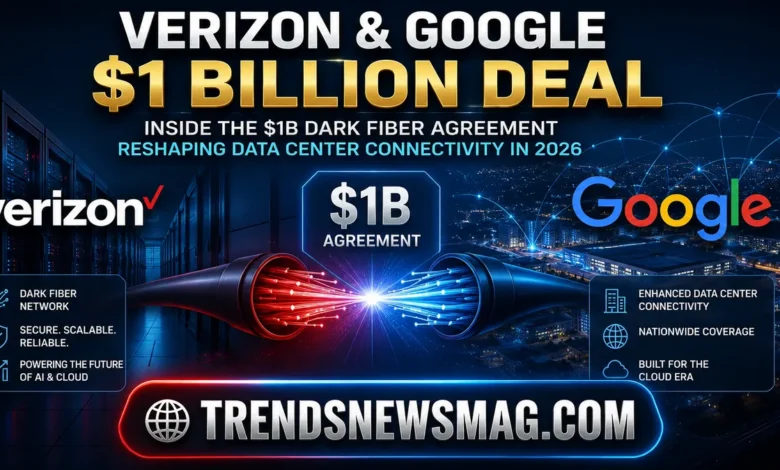
There are announcements that come and go without much notice, and then there are the ones that make an entire industry sit up and pay attention. The Verizon Google billion dollar deal falls firmly into that second category. When Verizon CEO Dan Schulman confirmed during the company’s second-quarter earnings call that Verizon had signed an agreement with Google worth more than a billion dollars, it wasn’t just a routine business update tucked into a quarterly report. It was a signal that the telecom industry’s role in the artificial intelligence boom is expanding in ways that go far beyond wireless plans, home internet, and 5G marketing slogans.


For years, telecom companies like Verizon have been sitting on an underappreciated asset: miles upon miles of fiber-optic cable buried underground, strung across utility poles, and threaded beneath city streets. Much of it has been “lit” fiber, meaning Verizon operates the networking equipment and sells bandwidth as a service. But a growing portion of it is “dark” fiber, unused capacity that a customer can lease and operate independently. That distinction matters enormously when you understand what Google is actually buying in this arrangement, and why the Verizon Google billion dollar deal is being discussed as a bellwether for the next phase of hyperscale data center growth.
This article breaks down exactly what was announced, why it matters, how it fits into the broader AI infrastructure race, what it means for Verizon shareholders and Google’s cloud ambitions, and what similar moves by competitors suggest about where this trend is headed. Whether you’re an investor trying to understand the financial implications, a telecom professional curious about the technical side of dark fiber leasing, or simply someone following the news around big tech’s infrastructure spending spree, this guide covers the full picture.
What Exactly Was Announced
The core of the announcement is straightforward on the surface but carries deep implications once you dig into it. Verizon CEO Dan Schulman said the company has secured a deal with Google, valued at more than $1 billion, to provide dark fiber connectivity for the search giant’s data centers. That single sentence, delivered almost matter-of-factly during a post-earnings call, is the foundation of everything else being written and discussed about this partnership.
Dark fiber, for those unfamiliar with the term, refers to fiber-optic cable that has been installed but is not yet activated with networking equipment. Instead of Verizon lighting up that fiber and selling bandwidth as a managed service, the company leases the raw physical infrastructure to Google, who then installs and operates its own equipment on top of it. This gives the customer greater control over capacity and network design compared to a managed network service. For a company like Google, which runs an enormous global network of data centers that need to talk to each other constantly, this kind of control is invaluable. It allows Google’s engineers to optimize the network exactly the way they want, without waiting on a third party to make changes or upgrades.
The agreement is specifically designed to support connectivity between Google’s data-center facilities, which tells you a lot about the scale of what’s being built. This isn’t about connecting a single office building or a regional data center to the internet backbone. It’s about stitching together a network of massive, power-hungry facilities that need extremely fast, extremely reliable, and extremely high-capacity connections between them. Think of it as building a superhighway system exclusively for Google’s own data traffic, separate from the public roads everyone else uses.
What makes the Verizon Google billion dollar deal particularly interesting is the context in which it was announced. This wasn’t a standalone press release designed to generate headlines. It came out almost as an aside during Verizon’s earnings call, which suggests the company sees this as part of a broader, ongoing strategy rather than a one-off transaction. And that impression is reinforced by what Schulman said next.
Why This Deal Is Bigger Than The Dollar Figure Suggests
A billion dollars is a lot of money by almost any measure, but in the context of the AI infrastructure boom currently sweeping through the tech industry, it’s actually a relatively modest number compared to the capital being deployed elsewhere. What makes this deal significant isn’t just the size of the check, it’s what it represents about the direction Verizon is heading and how deeply intertwined telecom infrastructure has become with the AI data center economy.
Schulman indicated that Verizon expects to disclose additional agreements before the end of 2026, though he did not name the prospective customers or provide individual contract values. He went on to describe the scale of what’s coming. “We have other deals that we expect to announce by year end that taken together are expected to be worth multiple billions of dollars in revenue over the next several years,” Schulman said on Verizon’s post-earnings call. That statement transforms this from a single transaction into what looks like the opening chapter of a much larger strategy. Verizon isn’t just monetizing one relationship with one hyperscaler. It’s positioning its fiber network as critical infrastructure for the entire AI data center buildout happening across the country.
This matters because it changes how you should think about Verizon as a business. For most consumers, Verizon is synonymous with cell phone plans and home internet bundles. But underneath that consumer-facing brand is a company that owns one of the largest fiber networks in the United States, built up over decades through acquisitions, infrastructure investment, and network expansion projects that were originally designed to support wireless backhaul and enterprise connectivity. That infrastructure is now becoming a strategic asset in an entirely different context: feeding the insatiable connectivity needs of AI-driven cloud computing.
The expected agreements would create a multiyear revenue opportunity beyond Verizon’s core consumer wireless and home-internet operations, and that diversification is exactly what investors have been asking telecom companies to pursue for years. Wireless subscriber growth in mature markets like the United States has slowed considerably, and price competition among carriers has squeezed margins. Finding new revenue streams that don’t depend on adding more phone subscribers is a strategic necessity, not just a nice-to-have. The Verizon Google billion dollar deal offers a glimpse of what that diversification can look like in practice.
The Broader Google And Alphabet Spending Context
To really understand why this deal happened now, you have to zoom out and look at what’s going on inside Alphabet, Google’s parent company. The scale of capital spending currently underway at Alphabet is almost hard to comprehend if you’re not following the numbers closely. Alphabet raised its 2026 capital-expenditure guidance to between $195 billion and $205 billion, up from a previous range of $180 billion to $190 billion, with most of the spending directed toward servers, data centers, and networking equipment.
Let that sink in for a moment. We’re talking about a single company planning to spend upward of $200 billion in a single year, primarily on physical infrastructure to support cloud computing and artificial intelligence workloads. That is a staggering figure, and it puts the billion-dollar Verizon deal into proper perspective. From Google’s point of view, a billion-dollar fiber connectivity agreement is a rounding error relative to the total infrastructure budget, but it’s a critical piece nonetheless, because without robust connectivity between data centers, all that server and computing investment doesn’t function as an integrated system.
This spending isn’t happening in a vacuum. It’s a direct response to the explosive demand for AI compute capacity, driven by the growth of large language models, generative AI products, and cloud-based machine learning services that businesses across every industry are now racing to adopt. Google needs data centers that can train and run these models at scale, and those data centers need to be connected to each other with extremely low latency and extremely high bandwidth so that workloads can be distributed efficiently across multiple facilities. That’s precisely the gap that dark fiber leasing from a company like Verizon helps fill.
Interestingly, this aggressive spending is happening even as Alphabet’s cash flow shows some near-term strain. Alphabet reported negative free cash flow of approximately $5.9 billion in the quarter, a reflection of just how much capital is being poured into infrastructure ahead of the revenue that will eventually come from it. This is a classic pattern in capital-intensive technology buildouts: spend heavily now to build the capacity, and monetize it over the following years as demand catches up. It’s a bet that AI infrastructure demand will continue climbing, and companies like Alphabet are clearly willing to run negative free cash flow in the short term to make sure they’re not caught flat-footed on capacity when that demand materializes.
Understanding Dark Fiber And Why It’s The Perfect Vehicle For This Partnership
If you’re new to the term, dark fiber deserves a proper explanation, because it’s central to understanding why this particular structure was chosen for the Verizon Google billion dollar deal rather than a more traditional managed network services contract.
Fiber-optic cable, once installed, has enormous capacity relative to what any single customer typically uses at first. Telecom companies have historically installed more fiber strands than immediately necessary, partly because the cost of digging trenches and laying cable is the expensive part of the process, while the fiber itself is comparatively cheap. Once the trench is dug and the conduit is in the ground, adding extra strands of fiber costs relatively little extra. This means telecom companies often end up with excess capacity, some of which gets “lit” (activated with networking equipment and sold as bandwidth) and some of which remains “dark,” sitting unused until a customer wants to lease it directly.
When a company leases dark fiber, it’s essentially renting the physical glass strands themselves, not a service built on top of them. The customer, in this case Google, brings its own optical transceivers, routers, and networking gear to activate the fiber and run its own traffic over it. This is fundamentally different from buying bandwidth from an internet service provider, where the provider manages the equipment and simply sells you access to a certain amount of throughput.
For a hyperscale cloud provider like Google, dark fiber offers several distinct advantages. First, there’s cost efficiency at scale; once you’re moving the volumes of data that Google moves between its data centers, owning and controlling the transmission equipment can be more economical than paying for managed bandwidth. Second, there’s flexibility and control; Google’s engineers can upgrade the equipment on their own timeline, using their own preferred technology stack, without needing to coordinate with Verizon’s technical teams for every change. Third, there’s security and privacy; running your own equipment over a dedicated fiber path gives you more assurance about how your data is being handled at the physical layer, which matters enormously for a company handling sensitive AI training data and enterprise cloud customer information.
For readers who want to go deeper into how modern connectivity choices affect performance and reliability in everyday consumer technology as well, it’s worth exploring how device ecosystems handle bandwidth-intensive tasks, an area covered in detail in this breakdown of the Honor Magic 5 Pro and how flagship smartphones are increasingly built around high-throughput connectivity demands, which mirrors many of the same principles at play in enterprise fiber deals, just at a much smaller scale.
How This Fits Into Verizon’s Broader Strategy With Google
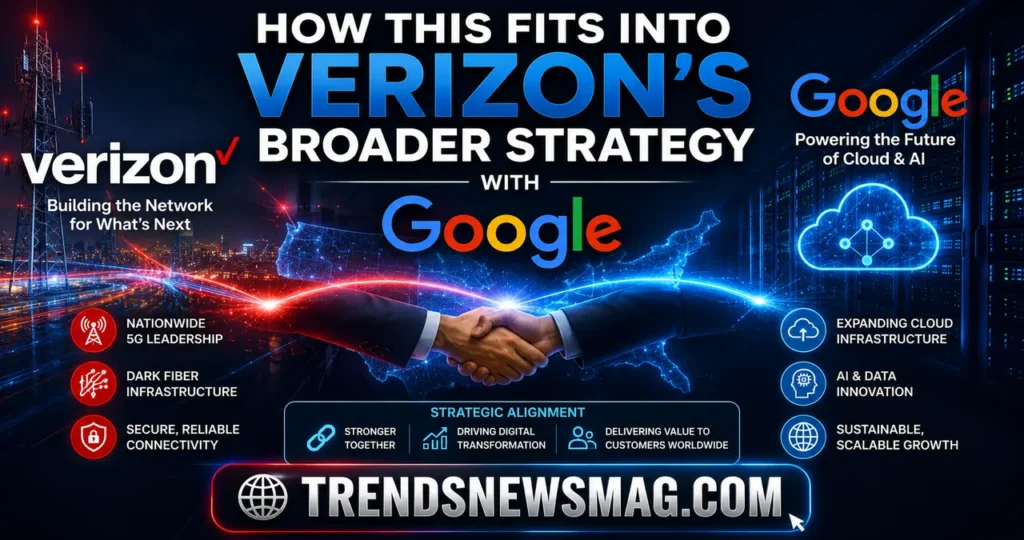
This isn’t the first time Verizon and Google have worked together, and understanding that history helps explain why this new billion-dollar arrangement feels like a natural next step rather than a surprising pivot.
In 2021, Verizon and Google Cloud agreed to combine Verizon’s 5G network with Google’s computing services to support factory automation projects. That earlier partnership was focused on edge computing use cases, essentially bringing Google’s cloud computing power closer to industrial customers by pairing it with Verizon’s low-latency 5G network. It was a smaller, more experimental collaboration compared to what’s being announced now, but it planted the seeds of a working relationship between the two companies’ technical and business teams.
Since then, the relationship has continued to deepen in consumer-facing ways as well. Verizon later offered Google One AI Premium to eligible wireless and home-internet customers, while Google’s Gemini models have been integrated into Verizon’s customer-service systems. These moves show that Verizon has been steadily weaving Google’s AI and cloud products into its own customer experience, whether that’s giving subscribers access to premium AI tools bundled with their phone or internet plans, or using Google’s AI models to power chatbots and support systems that help Verizon customers resolve issues faster.
What’s notable about the new billion-dollar dark fiber agreement is that it concerns data-center connectivity and is separate from the companies’ earlier work involving artificial intelligence, cloud services, and 5G networks. In other words, this isn’t just an extension of the AI product bundling or the 5G edge computing partnership from a few years back. It’s an entirely new category of collaboration, focused purely on physical infrastructure rather than consumer products or cloud software services. That distinction is important because it shows Verizon isn’t just a distribution partner for Google’s AI products anymore; it’s becoming a foundational infrastructure supplier for Google’s own internal operations.
This layered relationship, spanning consumer AI products, enterprise edge computing, and now core data center infrastructure, illustrates a broader trend where the lines between telecom companies and cloud giants are blurring. It’s no longer accurate to think of Verizon purely as a “carrier” and Google purely as a “cloud provider.” Increasingly, these companies are becoming interdependent partners across multiple layers of the technology stack, and the Verizon Google billion dollar deal is the clearest evidence yet of just how deep that interdependence has become.
Financial Implications For Verizon
From a pure investor standpoint, the Verizon Google billion dollar deal deserves close attention because of what it signals about Verizon’s ability to generate new, high-margin revenue streams outside of its traditional consumer businesses. Verizon’s second-quarter earnings call revealed the billion-dollar-plus Google dark fiber deal alongside news of more connectivity revenue ahead and a $9 billion savings plan.
That combination is worth unpacking. On one hand, you have a company actively cutting costs through a multibillion-dollar savings initiative, which typically signals a business trying to improve efficiency and protect margins in a competitive, capital-intensive industry. On the other hand, you have that same company simultaneously landing high-value infrastructure contracts with one of the world’s largest technology companies. That’s a healthy combination for a telecom operator, because it suggests management is squeezing efficiency out of the core business while also opening new doors for growth that don’t require competing on price in the crowded wireless market.
Verizon’s stock performance and valuation metrics around the time of the announcement told an interesting story as well. The company’s current price-to-earnings ratio stood at 10.99, indicating a relatively low valuation compared to its historical performance. A lower P/E ratio can mean different things depending on context; sometimes it reflects market skepticism about future growth, and other times it reflects an undervalued stock that hasn’t yet been recognized for new growth catalysts. Given that this fiber connectivity announcement arrived alongside earnings that beat expectations, some analysts see the current valuation as an opportunity, particularly if these infrastructure deals continue to materialize at the pace Schulman suggested.
It’s also worth noting that insider trading activity around the announcement showed some caution. Insider activity reflected a net sell of $3.5 million over the past three months, indicating a somewhat cautious sentiment among company insiders. This kind of detail doesn’t necessarily contradict the positive news of the Google deal; insider selling can happen for countless personal financial reasons unrelated to a company’s outlook, from tax planning to portfolio diversification. Still, it’s a data point worth watching in the context of a broader financial picture that otherwise leans positive following the earnings beat and the new revenue disclosure.
Here’s a table that breaks down the key financial and strategic elements of the deal for quick reference:
| Element | Detail |
|---|---|
| Deal value | More than $1 billion |
| Announced by | Verizon CEO Dan Schulman |
| Announcement setting | Verizon’s Q2 2026 post-earnings call |
| Type of infrastructure | Dark fiber connectivity |
| Purpose | Connecting Google’s data-center facilities |
| Relationship to prior deals | Separate from 2021 5G/Google Cloud edge computing partnership |
| Future outlook | Additional deals expected by end of 2026, worth multiple billions collectively |
| Alphabet 2026 capex guidance | $195 billion to $205 billion |
| Alphabet quarterly free cash flow | Negative approximately $5.9 billion |
| Verizon cost savings initiative | $9 billion savings plan disclosed alongside the deal |
This table captures why the story extends well beyond a single transaction. It’s a snapshot of two enormous companies aligning their strategic priorities: one looking to diversify revenue through infrastructure monetization, and the other racing to build out AI compute capacity as fast as capital allows.
What This Means For Google’s Data Center Strategy
Shifting focus to Google’s side of the equation, this deal reveals a lot about how the company is approaching its data center expansion in the current AI era. Building data centers is only half the challenge; connecting them efficiently is the other half, and it’s a part of the process that gets far less public attention than the flashy announcements about new AI models or chip partnerships.
Dark fiber connectivity between data centers gives Google’s engineering teams full control over network design and capacity planning, which becomes increasingly important as AI workloads grow more distributed. Training massive AI models often requires coordinating compute resources across multiple data centers simultaneously, especially when a single facility doesn’t have enough power capacity or physical space to house all the necessary hardware for a given project. When that happens, the network connecting those facilities effectively becomes an extension of the computing fabric itself. Latency and bandwidth between data centers can directly affect how efficiently a distributed training job runs, which in turn affects how quickly Google can develop and deploy new AI capabilities.
There’s also a resilience angle to consider. Relying on multiple network providers and multiple physical fiber routes reduces the risk of a single point of failure disrupting operations across Google’s global infrastructure. By securing dedicated dark fiber capacity from Verizon in addition to whatever other providers and self-built fiber routes Google already uses, the company diversifies its physical network dependencies. This kind of redundancy planning has become standard practice among hyperscale cloud providers, particularly after high-profile outages at various cloud providers over the years demonstrated just how costly downtime can be, both financially and reputationally.
It’s also worth pointing out that this deal reflects a broader industry truth: even as companies race to build smarter AI systems, the underlying physical infrastructure, cables, power grids, cooling systems, and data centers, remains the ultimate bottleneck. All the algorithmic innovation in the world doesn’t matter if the physical infrastructure can’t support the compute demands at scale. This is a theme that comes up repeatedly when examining why technology, no matter how advanced, still depends heavily on physical and human systems working in tandem, a topic explored more broadly in this discussion of why technology cannot replace humans, which touches on the surprisingly persistent role of physical infrastructure and human expertise even in an increasingly automated world.
Comparing This Deal To Other Telecom-Hyperscaler Partnerships
The Verizon Google billion dollar deal doesn’t exist in isolation. It’s part of a broader pattern that’s been unfolding across the telecom and cloud computing industries for the past couple of years, as hyperscalers scramble to secure enough network capacity to support their AI ambitions.
Other major telecom and fiber infrastructure companies have signed similar arrangements with cloud providers. Fiber-focused companies have increasingly found that leasing dark fiber to hyperscale customers is one of the most lucrative uses of their existing infrastructure, often more profitable per mile than selling traditional managed bandwidth services to enterprise customers. This shift has led some telecom analysts to describe fiber networks as the new “toll roads” of the AI economy, connecting the data centers where AI models are trained and run.
What sets the Verizon Google billion dollar deal apart from some of these other arrangements is the scale of the companies involved and the strategic importance of the relationship. Verizon isn’t a niche fiber provider looking for its first big hyperscaler contract; it’s one of the largest telecommunications companies in the country, with decades of infrastructure investment behind it. And Google isn’t just any cloud customer; it’s one of the three dominant hyperscale cloud providers globally, alongside Amazon Web Services and Microsoft Azure. When two companies of this size and stature strike an infrastructure deal, it tends to set a benchmark that other companies in the space watch closely, both in terms of deal structure and pricing expectations.
Schulman noted that additional agreements Verizon expects to announce by year end could collectively be worth multiple billions of dollars in revenue over the next several years, and industry watchers widely expect at least some of those additional deals to involve other major cloud providers beyond Google. This pattern, one hyperscaler striking a headline deal followed by others following suit, has played out before in other corners of the tech industry, from cloud computing adoption to AI chip purchasing agreements. It wouldn’t be surprising if, within the next year, we see similar billion-dollar-plus dark fiber agreements announced between Verizon and other major cloud or AI infrastructure companies.
The Technical Side: How Dark Fiber Deployment Actually Works
For readers who want a deeper technical understanding of what’s involved in executing a deal like this, it helps to walk through the practical mechanics of dark fiber deployment, because it’s genuinely more involved than simply flipping a switch.
When Verizon agrees to lease dark fiber to a customer like Google, the first step typically involves identifying which existing fiber routes can be allocated for the agreement, or in some cases, planning and constructing new fiber routes specifically to meet the customer’s connectivity requirements between particular data center locations. Given that this deal is focused on connecting Google’s data centers, it’s likely that at least some of the fiber routes involved connect specific facilities in regions where both companies already have infrastructure, though the specific geographic details of the agreement have not been publicly disclosed.
Once the fiber routes are identified or built, the actual “dark” strands are handed over to Google under a long-term lease agreement, often spanning many years given the capital investment involved in physical infrastructure. Google’s networking teams then install their own optical transmission equipment, which includes transceivers that convert electrical signals into light pulses transmitted through the fiber, amplifiers to boost signal strength over long distances, and routing equipment to direct traffic appropriately across the network. This equipment is typically housed in facilities along the fiber route, sometimes in dedicated huts or existing telecom infrastructure sites leased or owned by Verizon.
Unlike a managed network service, dark fiber gives the customer greater control over capacity and network design, and this technical independence is precisely why sophisticated network operators like Google prefer this model when the scale of their needs justifies the investment in their own equipment. It requires Google to have in-house expertise in optical networking, which the company certainly has given its scale, but it pays off in the form of a network precisely tailored to its performance requirements rather than a one-size-fits-all managed service.
There’s an interesting parallel here to how consumer technology companies approach hardware design for specific use cases rather than settling for generic solutions. Just as companies increasingly build purpose-specific devices tailored to particular needs, such as specialized sleep technology designed around very specific comfort and audio requirements covered in this look at Ozlo Sleepbuds and how purpose-built hardware often outperforms general-purpose alternatives, Google’s approach to owning its own network equipment atop leased dark fiber reflects the same philosophy applied at a massive infrastructure scale: build exactly what you need rather than accepting a generic managed solution.
Why Telecom Companies Are Betting Big On AI Infrastructure Revenue
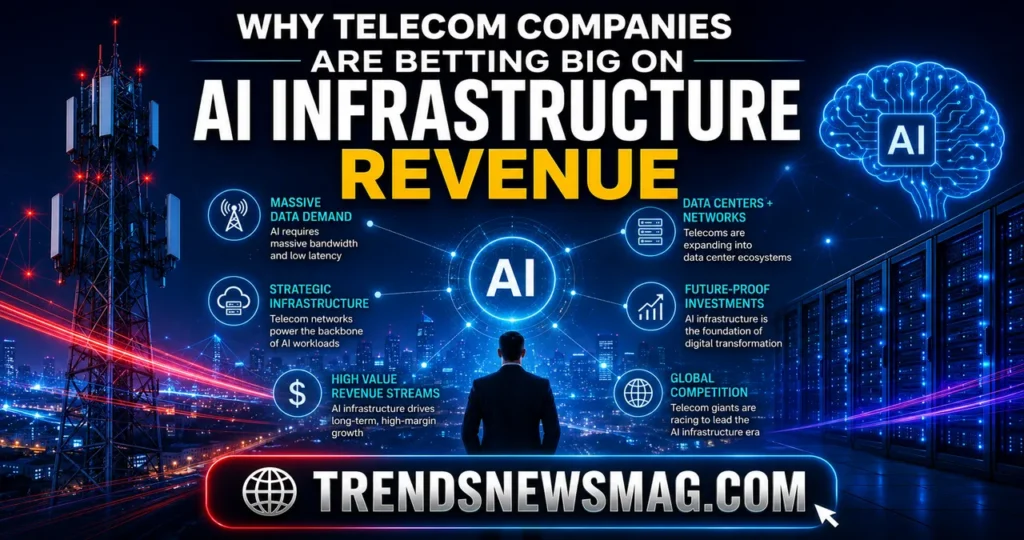
It’s worth stepping back and asking why Verizon, and telecom companies more broadly, are so eager to pursue deals like this in the first place. The answer comes down to a fundamental shift in where growth opportunities exist within the telecommunications industry.
For most of the past two decades, telecom companies grew primarily by adding wireless subscribers, expanding into new markets, and gradually upselling customers to higher-tier data plans as smartphone usage increased. That growth engine has largely run its course in mature markets like the United States, where smartphone penetration is already extremely high and subscriber growth has slowed to a crawl. Price wars between major carriers have also compressed margins on traditional wireless services, making it harder to grow revenue simply by adding more customers or raising prices on existing plans.
Against that backdrop, the explosion of AI infrastructure spending represents a genuinely new growth category that telecom companies are uniquely positioned to capture, precisely because of assets they already own: fiber networks built out over decades. Companies like Verizon don’t need to build entirely new infrastructure from scratch to participate in this boom; they need to monetize infrastructure they’ve already invested in, often infrastructure that was originally built for other purposes like wireless backhaul or enterprise connectivity, and repurpose portions of it for hyperscale data center connectivity instead.
This is an unusually favorable position for telecom companies to be in. Instead of needing to compete against tech giants directly in AI model development or cloud computing services, areas where telecom companies have little competitive advantage, they can instead serve as critical infrastructure suppliers to the very companies building those AI systems. It’s a bit like the difference between competing in the gold rush itself versus selling shovels and supplies to the prospectors; the latter often turns out to be the more consistently profitable business, especially for companies with existing physical infrastructure advantages that would be extraordinarily expensive for a newcomer to replicate.
The Verizon Google billion dollar deal is a concrete example of this strategy playing out in real time, and it’s likely just the beginning of a much larger trend of telecom companies monetizing dark fiber and other physical infrastructure assets to capture a share of AI infrastructure spending that shows no signs of slowing down anytime soon.
Risks And Considerations Worth Understanding
No business story is complete without acknowledging the risks and uncertainties involved, and the Verizon Google billion dollar deal is no exception, even amid the largely positive reception it received.
One consideration is concentration risk. As telecom companies like Verizon increasingly pursue large infrastructure deals with a small number of massive hyperscale customers, they become somewhat dependent on the continued capital spending decisions of those customers. If a company like Google were to scale back its data center expansion plans in the future, whether due to a slowdown in AI demand, a shift in technology architecture that reduces the need for as much physical infrastructure, or broader economic pressures, that could affect the pipeline of future deals that Verizon and similar companies are counting on.
There’s also execution risk to consider on the technical side. Deploying and maintaining dark fiber infrastructure at the scale required to support hyperscale data center connectivity is a complex, capital-intensive undertaking. Delays in construction, unexpected costs, or technical challenges in specific geographic regions could affect the profitability or timeline of these agreements. While Verizon has decades of experience managing fiber infrastructure, the sheer scale of demand coming from AI-driven data center expansion is pushing telecom companies to build and lease infrastructure faster than they’ve historically needed to, which introduces new operational pressures.
Additionally, there’s the broader question of whether the current pace of AI infrastructure investment across the industry is sustainable in the long run. Alphabet’s negative free cash flow of roughly $5.9 billion in the quarter reflects just how much capital is being deployed ahead of clear, immediate returns. If AI adoption and monetization don’t scale as quickly as companies are currently betting, some of this infrastructure spending could eventually slow down or get reassessed, which would have ripple effects on companies like Verizon that are counting on continued demand for fiber connectivity services from hyperscale customers.
That said, most industry analysts currently view these risks as manageable rather than existential, particularly given the diversified nature of Verizon’s overall business and the fact that these infrastructure deals represent incremental revenue on top of, rather than a replacement for, the company’s core wireless and broadband operations.
What Comes Next For Verizon And The Industry
Looking ahead, the most immediate thing to watch is whether Verizon follows through on Schulman’s promise of additional deals before the end of 2026. Verizon expects to disclose additional agreements before the end of the year, which taken together with the Google deal are expected to be worth multiple billions of dollars in revenue over the next several years. If those deals materialize as described, it would confirm that the Verizon Google billion dollar deal was indeed just the first domino in a much larger strategic shift toward infrastructure monetization for AI data centers.
Investors and industry watchers will also be paying close attention to how competitors respond. Other major telecom companies with substantial fiber assets are likely evaluating similar opportunities with hyperscale cloud providers, and it wouldn’t be surprising to see additional billion-dollar-scale announcements from competing carriers in the coming months as the AI infrastructure buildout continues at its current pace.
On Google’s side, the completion and activation of this dark fiber connectivity will likely support the continued expansion of its AI and cloud computing capabilities, feeding directly into products and services that businesses and consumers interact with every day, from Google Cloud’s enterprise offerings to consumer-facing AI tools built on Gemini models. As that infrastructure comes online, it should help Google maintain the network performance and reliability needed to support increasingly sophisticated AI workloads across its global data center footprint.
There’s also a broader industry lesson embedded in this story about how thoughtfully organizations across different sectors are adapting their tools and workflows to keep pace with a rapidly changing technology landscape. Just as telecom and cloud companies are rethinking infrastructure strategy from the ground up, other industries are undergoing similar transformations in how they select and deploy technology tools suited to their specific needs, a trend visible even in specialized professional fields, such as the shift toward purpose-built digital tools covered in this overview of the best software for lawyers, which highlights how even traditionally conservative industries are embracing infrastructure and software choices tailored precisely to their operational demands, much like Google’s approach to dark fiber for its data centers.
High-capacity fiber networks not only benefit tech companies but also power seamless media streaming and live event coverage, from major tech announcements to entertainment updates like the Caleb Hearon tour announcements.
Conclusion
The Verizon Google billion dollar deal represents far more than a single transaction between two large companies. It’s a window into how the AI infrastructure boom is reshaping the telecommunications industry, transforming decades-old fiber networks into strategically vital assets for cloud computing giants racing to build out data center capacity. For Verizon, it signals a meaningful step toward diversifying revenue beyond traditional wireless and broadband services, tapping into an infrastructure monetization opportunity that plays directly to the company’s existing strengths. For Google, it provides dedicated, controllable connectivity between data centers at a moment when Alphabet is investing an extraordinary amount of capital, upward of $200 billion in 2026 alone, into the physical infrastructure underpinning its AI ambitions.
What makes this story worth following closely isn’t just the billion-dollar headline figure, but everything it implies about what’s coming next. With Verizon signaling multiple additional deals before the end of 2026, and with the broader industry clearly moving toward treating dark fiber as critical AI infrastructure, this deal is likely to be remembered as an early, defining example of how telecom and cloud computing companies are converging around shared infrastructure priorities in the AI era. Anyone trying to understand where the next wave of telecom growth and hyperscale infrastructure investment is headed would do well to keep watching how this relationship, and others like it, continue to evolve throughout the rest of the year.
For readers who want to explore the original financial reporting behind this story in greater depth, Reuters’ coverage of Verizon’s earnings call and the Google agreement offers additional detail straight from the source, available at reuters.com.
FAQs
What is the Verizon Google billion dollar deal actually for?
The Verizon Google billion dollar deal is a dark fiber connectivity agreement, meaning Verizon is leasing unused fiber-optic infrastructure to Google so that Google can connect its data-center facilities using its own networking equipment. It’s not a consumer product partnership or a cloud services bundle; it’s purely about physical network infrastructure supporting Google’s data center operations.
How much is the Verizon Google billion dollar deal worth?
The deal was confirmed by Verizon CEO Dan Schulman to be valued at more than $1 billion. Verizon also indicated that additional agreements expected to be announced by the end of 2026 could collectively be worth multiple billions of dollars in revenue over the next several years, suggesting the total value of Verizon’s hyperscaler infrastructure business could grow substantially beyond this initial deal.
Is this the first time Verizon and Google have worked together?
No, this is not the first collaboration between the two companies. Verizon and Google Cloud previously partnered in 2021 to combine Verizon’s 5G network with Google’s computing services for factory automation use cases. Verizon has also offered Google One AI Premium to eligible customers and integrated Google’s Gemini AI models into its customer service systems. However, the new billion-dollar deal is specifically focused on data-center connectivity and is separate from these earlier AI, cloud, and 5G-related partnerships.
Why is Google spending so much on data center infrastructure right now?
Google’s parent company, Alphabet, raised its 2026 capital expenditure guidance to between $195 billion and $205 billion, with the bulk of that spending going toward servers, data centers, and networking equipment. This surge in spending is driven by the rapidly growing demand for AI computing capacity, as Google races to build the infrastructure needed to train and run increasingly sophisticated AI models at scale, both for its own products and for enterprise cloud customers.
What does dark fiber mean, and why does it matter for this deal?
Dark fiber refers to fiber-optic cable that has been physically installed but not yet activated with networking equipment. When a company leases dark fiber, as Google is doing through the Verizon Google billion dollar deal, it gains direct control over the network by installing its own equipment rather than purchasing a managed bandwidth service. This approach gives Google greater flexibility, control over network design, and the ability to optimize connectivity specifically for its own data center performance requirements, which is especially valuable for AI workloads that depend on fast, reliable connections between facilities.
Trending Today: Learning Catalytics
Read more: Apple TV Explained: The Complete 2026 Guide to Streaming, Hardware, and Apple TV+ Originals