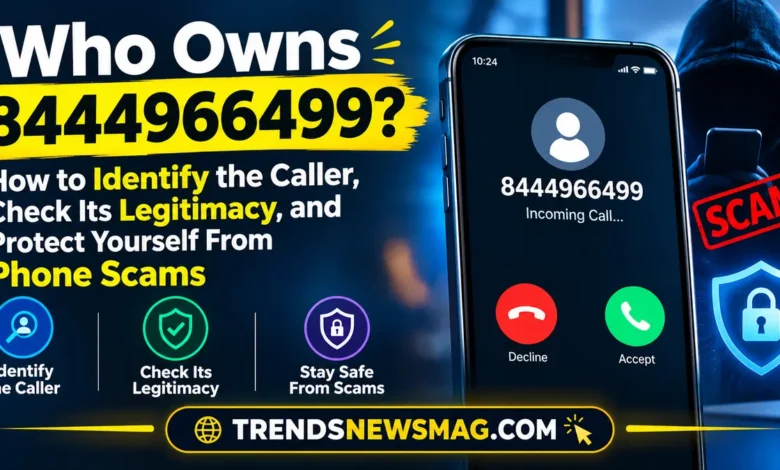
Who Owns 8444966499? How to Identify the Caller, Check Its Legitimacy, and Protect Yourself From Phone Scams

If you have received a call from 8444966499, you may be wondering who is behind it, why they are contacting you, and whether you should answer or call back. An unfamiliar number can create uncertainty, especially when the caller leaves a vague voicemail, claims to represent a company, or repeatedly attempts to reach you without explaining the reason.

The first thing to understand is that identifying a phone number requires more than recognizing its digits. The number may be associated with a legitimate business, a customer service department, a collection agency, a telemarketing operation, or someone attempting to impersonate a trusted organization. In some cases, the number displayed on your phone may not even belong to the person who placed the call.
So, who owns 8444966499? The number uses the 844 prefix, which is part of the North American toll-free numbering system. However, the prefix alone does not establish the registered owner, the company using the number, or the caller’s intentions. A reliable identification requires additional evidence, such as an independently verified business listing, a matching official website, or confirmation from the organization the caller claims to represent.
This guide explains how to investigate the number, understand what toll-free numbers mean, recognize suspicious calling patterns, and decide what to do next. Whether you missed a call, received a voicemail, or have been contacted several times, the goal is to help you make an informed decision without exposing yourself to unnecessary risk.
Who Owns 8444966499?
Determining who owns 8444966499 begins with an important distinction: the number’s format can be identified, but its current subscriber cannot be reliably established from the digits alone. Without a trustworthy, current record linking the number to a specific person or organization, naming an owner would be speculation.
The 844 prefix is used for toll-free telephone services in the North American Numbering Plan. Businesses and other organizations may use toll-free numbers for customer support, appointment scheduling, billing inquiries, sales, technical assistance, and general inquiries. These numbers allow callers within the supported system to reach an organization without paying the traditional long-distance charge associated with the call.
However, a toll-free number is not an automatic indicator of legitimacy. A real company may use one, but a fraudulent caller may also display a toll-free number through caller ID spoofing. The same prefix can therefore appear in very different situations, making verification essential.
Here is a practical overview of what can and cannot be established from the number itself.
| Detail | What can be established |
|---|---|
| Phone number | 8444966499 |
| Formatted version | 844-496-6499 |
| Number category | North American toll-free format |
| Geographic location | The 844 prefix does not identify a particular city or state |
| Possible users | Businesses, service providers, call centers, and other organizations |
| Confirmed owner | Not established without a reliable, current source |
| Caller legitimacy | Cannot be determined from the number alone |
| Recommended action | Verify the caller independently before sharing information |
This distinction matters because online phone directories sometimes display outdated, incomplete, or unverified information. A number may have changed users, been reassigned, or appeared in a report because someone received a suspicious call. A search result that mentions a business is useful evidence to investigate, but it is not necessarily proof that the business placed your particular call.
The most dependable approach is to look for several independent indicators that agree. If a caller claims to represent a bank, for example, check whether the number appears on the bank’s official website or in its authenticated mobile application. If it does not, contact the bank through a separately verified channel rather than relying on the incoming call.
What Does the 844 Prefix Mean?
The 844 prefix is one of several toll-free prefixes used in the North American Numbering Plan. Other familiar toll-free prefixes include 800, 888, 877, 866, 855, and 833. These prefixes allow organizations to provide a recognizable contact number to customers across multiple regions.
A toll-free number generally directs calls through a telecommunications provider or business telephone system. The organization receiving the call may use a traditional telephone network, a cloud-based phone service, or a call center platform. The displayed number does not necessarily reveal the company’s physical headquarters or the location of the individual answering the phone.
For instance, a company headquartered in California might operate a customer support team in another state or country while continuing to use the same toll-free number. A third-party service provider might also manage incoming calls on the company’s behalf. Consequently, the area code cannot reliably tell you where the caller is located.
It is also important to distinguish between a toll-free number and a premium-rate number. Toll-free numbers are designed to let the calling party reach the receiving organization without the traditional toll charge, subject to the relevant telephone service and country. Premium-rate numbers, by contrast, can involve special charges. The fact that a number begins with 844 does not automatically make it suspicious or expensive to call.
Still, you should not assume that every toll-free number is safe. Scammers can manipulate caller ID, and some may deliberately use numbers that resemble legitimate customer service lines. Treat the prefix as a clue about the numbering format, not as a guarantee about the caller’s identity.
Why Might 8444966499 Be Calling You?
There are several possible explanations for an unexpected call from 8444966499. Without a verified association between the number and a particular organization, it is not possible to determine which explanation applies to your situation. The timing of the call, any voicemail, and the context of your recent activities may help narrow down the possibilities.
One possibility is a legitimate customer service call. Companies sometimes contact customers about appointments, service requests, account updates, deliveries, or questions submitted through a website. If you recently contacted a business, purchased a product, or requested a callback, an unfamiliar toll-free number may be related to that interaction.
Another possibility is telemarketing or an automated calling campaign. Businesses may use automated systems to distribute announcements, conduct surveys, or promote services. Some calls are lawful and expected, while others may be unwanted or violate applicable calling rules. A repeated call without a meaningful message can justify caution, although it does not independently prove fraudulent activity.
Debt collection is another possible explanation for an unfamiliar business call, but it should not be assumed without evidence. If a caller claims you owe money, request the company’s legal name, contact information, and written documentation. Do not confirm sensitive information simply because the caller knows your name or refers to an account.
Finally, the call could involve an impersonation attempt. Fraudsters sometimes pretend to represent banks, government agencies, technology companies, delivery services, or subscription providers. They may use urgent language to make the recipient act before checking the facts.
The key principle is simple: the caller’s explanation must be verified independently. A convincing story is not proof of identity, and an unfamiliar number is not proof of criminal activity.
How to Check Whether 8444966499 Is Legitimate
A careful investigation can often reveal whether a call is associated with a recognizable organization or whether there are reasons to treat it as suspicious. Begin by recording the number exactly as it appeared on your phone, including the date and time. If a voicemail was left, preserve it so you can examine the caller’s claims without having to call back.
Next, search for the formatted number, 844-496-6499, and its unformatted version. Search engines may return business directories, discussion forums, consumer complaint pages, or official company contact information. Compare the results rather than accepting the first listing you see. A credible match should ideally connect the number to an established organization through an official source.
Phone lookup services can provide additional clues, but their information should be treated carefully. Some services compile public records and user-submitted reports, which may contain mistakes. Others may have limited information about toll-free numbers. If a directory labels the number as spam, consider that a warning worth investigating rather than conclusive proof.
You can also consult official consumer protection resources. The Federal Trade Commission’s guidance on phone scams explains common scam tactics and how to respond to suspicious calls. For suspected unwanted telemarketing or robocalls, the Federal Communications Commission also provides information about consumer protections and complaint options.
A useful verification process includes these steps:
First, identify the organization the caller claims to represent. Second, visit the organization’s official website independently instead of following a link supplied by the caller. Third, locate its published telephone number and contact its support department. Finally, ask whether it attempted to reach you and whether the stated reason for the call is consistent with its records.
This method is particularly valuable when the caller claims there is an urgent issue with your bank account, tax status, insurance policy, computer, or outstanding payment. A legitimate organization should generally allow you to verify the request through an established contact channel.
What to Do If 8444966499 Appears on Your Caller ID
If you see 8444966499 on your caller ID and do not recognize it, you do not need to answer immediately. Letting an unfamiliar call go to voicemail is a reasonable way to assess whether the caller has a legitimate reason to contact you.
Listen for specific information rather than relying on the caller’s tone. A useful voicemail may identify the organization, explain the general purpose of the call, and provide a way to contact the organization through an official channel. A vague message demanding an immediate callback without identifying the business deserves more scrutiny.
Be cautious if the message threatens arrest, immediate legal action, account closure, or financial penalties unless you respond within minutes. Scammers often use artificial urgency to prevent people from checking the facts. Real organizations may have deadlines, but you should be able to verify them through independent channels.
If you answer, keep the conversation brief until the caller’s identity is established. Ask for the organization’s name, the department involved, and a reference number if applicable. You can then end the call and contact the organization using a telephone number obtained from its official website, a trusted statement, or its authenticated application.
You should not provide your password, one-time verification code, complete payment card details, or banking credentials to an unsolicited caller. Nor should you install remote-access software or follow instructions to transfer money to a supposedly safer account.
If the caller becomes aggressive when you ask for verification, that behavior is a reason to end the conversation. You do not owe an unknown caller access to your personal information, and you should not feel pressured to continue a conversation that makes you uncomfortable.
Warning Signs That an Unknown Toll-Free Call May Be a Scam
The presence of a toll-free prefix does not determine whether a call is safe. Instead, look at the caller’s behavior, the information requested, and whether the story can be independently verified.
One major warning sign is a demand for immediate payment using an unusual method. Fraudulent callers may request gift cards, cryptocurrency, wire transfers, or payments through services that make it difficult to recover the funds. They may describe these payments as fees, penalties, security deposits, or account verification transactions.
Another warning sign is a request for authentication codes. Banks and online services sometimes send one-time codes to confirm that a customer is signing in or authorizing an action. A caller who asks you to read out such a code may be attempting to access your account. Never share a code simply because the caller claims to be from technical support or a fraud prevention department.
Unexpected links and software installation requests also deserve caution. A caller might tell you to visit a website to correct an account problem or download an application so that an agent can inspect your device. If the request was unsolicited, stop and verify it before proceeding.
Pay attention to inconsistencies, too. The caller may use a company name that sounds familiar but provide an email address from an unrelated domain. They may know your name but be unable to explain why they contacted you. They may claim to represent an organization while directing you to a telephone number that does not appear on its official website.
These signs do not establish that every call from 8444966499 is fraudulent. They are practical indicators that the interaction should not continue until the caller’s identity and purpose have been verified.
Can Caller ID Be Faked?
Yes. Caller ID spoofing occurs when the number displayed to a recipient differs from the number actually used to originate the call. Depending on the telephone system and circumstances, a caller may make an incoming call appear to come from a familiar business, a local number, or a toll-free service line.
Spoofing creates an important limitation for anyone researching an unknown telephone number. Even if a number genuinely belongs to a legitimate organization, its appearance on your screen does not prove that the organization placed the call. A dishonest caller may imitate the organization’s published number to gain trust.
Consider a situation in which someone receives a call that appears to come from a bank. The caller mentions a suspicious transaction and asks the recipient to confirm a one-time code. The recipient searches the displayed number, finds the bank’s legitimate contact page, and concludes that the call must be genuine.
That conclusion would be unsafe. The real bank may own the displayed number, but the incoming call could still have been spoofed. The recipient should end the call and contact the bank using the number published through an independently verified source.
Modern telephone networks have introduced measures intended to improve caller identification and reduce certain forms of spoofing. However, these protections do not make every displayed number trustworthy. The safest habit remains the same: verify sensitive requests independently, especially when money, passwords, or account access are involved.
Is It Safe to Call 8444966499 Back?
Calling back an unfamiliar number is not always dangerous, but it is rarely necessary to do so before establishing who is behind it. If the caller left no message and you have no reason to expect contact, waiting may be the most sensible option.
If the voicemail identifies a company you recognize, locate that company’s published telephone number independently. Calling the verified number is generally a better way to confirm whether the company attempted to contact you. This also reduces the risk of relying on a number that may have been spoofed or incorrectly listed.
A call to a genuine toll-free number is generally intended to be free of traditional long-distance charges within the supported calling arrangements. However, your carrier, country, service plan, or method of calling may affect charges. International calls to North American toll-free numbers may not be free or may not connect at all.
You should also avoid returning missed calls simply because the caller repeatedly attempts to reach you. Repetition can occur with legitimate automated systems, but it can also be part of aggressive telemarketing or fraud attempts. The number of calls alone does not establish legitimacy.
If you do call a verified business, avoid confirming sensitive details until you understand why the business needs them. You can ask the representative to explain the issue and provide a case number, then compare the information with your own records.
In short, the best question is not merely whether you can call the number back. It is whether you have a trustworthy reason to believe that the number belongs to the organization you need to reach.
What to Do If the Number Keeps Calling
Repeated calls from an unfamiliar number can be disruptive, especially when they arrive during work, family time, or late in the day. If 8444966499 contacts you repeatedly, begin by documenting the dates, times, and frequency of the calls. Keep any voicemails and record the caller’s stated purpose if you have spoken with them.
This information may help you distinguish between an expected series of notifications and unwanted calling activity. It can also be useful if you need to report harassment, deceptive telemarketing, or suspected fraud to your telephone provider or an appropriate consumer protection authority.
If the calls are unwanted, consider using your phone’s built-in blocking feature. Most modern smartphones allow you to block an individual number, silence unknown callers, or filter calls identified as suspected spam. The exact options vary by device and operating system.
Your mobile carrier may also offer call-filtering services. Some identify likely spam, while others block certain categories of unwanted calls. Review the service’s privacy settings and limitations before enabling it, particularly if you regularly receive legitimate calls from unfamiliar numbers.
Blocking a number may not stop a determined caller if the caller uses different numbers or spoofs another telephone number. It is nevertheless a useful way to reduce repeated interruptions from the same displayed number.
If the caller threatens you, attempts to obtain money through deception, or claims to have compromised your accounts, preserve the available evidence and report the incident through an appropriate channel. Do not engage in arguments or attempt to investigate the caller by sharing personal information.
How to Report Suspicious Calls From 8444966499
Reporting a suspicious call can help consumer protection agencies and telecommunications providers identify patterns of unwanted or deceptive activity. The appropriate reporting channel depends on your country, the type of call, and what the caller attempted to do.
In the United States, the Federal Trade Commission accepts reports about suspected scams and deceptive business practices through its official website. The Federal Communications Commission provides resources for reporting certain unwanted calls, robocalls, and caller ID spoofing concerns. If you lost money or disclosed sensitive account information, you should also contact the affected financial institution immediately.
For suspected fraud involving a bank account, payment card, or online service, contact the relevant organization using a verified telephone number. Ask about securing the account, reviewing recent activity, and reversing unauthorized transactions where possible. If you shared a password that you use elsewhere, change it on the affected accounts and enable multifactor authentication where available.
If you live outside the United States, use your country’s official consumer protection, telecommunications, or cybercrime reporting service. The North American 844 prefix does not establish that the person receiving the call lives in the United States, and local reporting procedures may differ.
When submitting a report, include factual details: the number displayed, the date and time, the content of the message, the name the caller used, and any payment instructions or links provided. Avoid adding assumptions that you cannot substantiate. A precise report is more useful than a claim based only on suspicion.
Remember that a report does not necessarily mean a number will be immediately blocked or investigated. Its value is in documenting the incident and potentially contributing to broader enforcement efforts.
How to Protect Your Personal Information During an Unexpected Call
Good phone security depends on a few consistent habits rather than trying to memorize every suspicious number. Treat unexpected requests for financial information, account credentials, or verification codes as high risk until you can establish who is asking and why.
Start by limiting what you reveal. Saying hello or asking who is calling does not require you to disclose your date of birth, home address, account number, or other identifying information. If a caller claims to have your records, do not assume that this proves they represent a legitimate organization. Personal information can be exposed through data breaches, public records, and previous interactions.
Be particularly careful with authentication codes. A code sent to your phone may authorize a login, password reset, payment, or account change. Sharing it with an unsolicited caller can allow someone else to complete an action under your identity.
For financial matters, initiate contact yourself. Open your bank’s official application, use the number printed on a trusted statement, or type the known website address into your browser. Do not rely solely on telephone numbers or links supplied during an unexpected call.
If you have already disclosed information, respond according to the type of exposure. A compromised password should be changed promptly. Suspected bank fraud warrants immediate contact with the bank. If you installed remote-access software at a caller’s request, disconnect the device from the internet if necessary, remove unauthorized access using trusted guidance, and review your accounts from a separate, trusted device.
The most effective protection is to create a pause between receiving a request and acting on it. A legitimate issue can generally be checked through an independent channel. A scam often depends on preventing you from taking that extra step.
How Online Phone Lookup Websites Can Help
Reverse phone lookup websites can be useful when investigating 8444966499, but their results should be interpreted as leads rather than definitive evidence. Depending on the service, a lookup may return the telephone number’s format, a possible business association, user-submitted complaints, or reports of suspected spam.
The quality of these records varies. Some websites aggregate information from public sources, while others rely heavily on visitor submissions. A single user may misidentify a caller, confuse two similar numbers, or report a legitimate call as spam because it was unexpected.
Date matters, too. A listing that was accurate several years ago may no longer describe the current subscriber. Business telephone systems can change providers, and numbers may be transferred or used by different departments over time. A page that identifies a previous user does not necessarily establish who called you today.
For the best results, compare multiple sources and prioritize official records. If a directory associates the number with a business, visit that business’s independently verified website and check its contact information. If a complaint page describes suspicious behavior, compare the reported conduct with what actually happened during your call.
Do not pay for a premium lookup service simply because an unknown caller has made you anxious. Paid services do not necessarily have access to definitive subscriber information, and no directory can guarantee that a displayed caller ID was not spoofed.
A phone lookup is most useful when it helps you decide what to verify next. It is not a substitute for verification itself.
What Information Is Needed to Identify a Phone Number Accurately?
A telephone number alone may not provide enough information to identify a caller with confidence. Additional context can make an investigation more useful without requiring you to disclose sensitive personal information.
The first useful detail is the message left by the caller. A voicemail mentioning a recognizable appointment, a service request, or a company department can provide a starting point. A message demanding an urgent payment or authentication code can indicate a higher-risk interaction.
The second detail is whether you were expecting contact. If you recently contacted a business, submitted a support ticket, scheduled a delivery, or requested a callback, an unfamiliar number may relate to that activity. Even then, you should confirm the connection before sharing sensitive information.
The third detail is whether reliable sources independently associate the number with the claimed organization. An official company contact page is generally more useful than an isolated directory listing. A matching company name on multiple unrelated complaint websites can be informative, but it still does not prove that a particular call originated from that company.
The fourth detail is the caller’s conduct. Legitimate representatives should be able to explain their general purpose and allow reasonable verification. Requests for secrecy, immediate payment through unusual methods, or disclosure of authentication codes are reasons to stop.
These factors help you assess the interaction without making unsupported assumptions about the person or organization behind the number.
Frequently Asked Questions About 8444966499
Who owns 8444966499?
The current owner of 8444966499 cannot be reliably identified from the number alone without a trustworthy, up-to-date source linking it to a specific subscriber. The 844 prefix indicates a North American toll-free number format, not a particular company or individual. To investigate the owner, compare reputable phone directory results with official business contact information. If the caller claims to represent a bank, government agency, or other organization, contact that organization independently to confirm whether the call was genuine.
Is 8444966499 a scam or a legitimate business number?
There is insufficient verified information to classify 8444966499 as either a scam or a legitimate business number. Toll-free numbers are used by genuine organizations, but scammers can also display toll-free numbers through caller ID spoofing. Evaluate the actual interaction instead of relying on the prefix. Requests for gift cards, cryptocurrency, passwords, one-time codes, or immediate payment under threatening circumstances are warning signs. Independent verification is the safest way to determine whether the caller’s claims are credible.
Why did 8444966499 call me and leave no voicemail?
A missed call without a voicemail can have several explanations. It may have been a legitimate outbound call, an automated dialing attempt, telemarketing, a mistaken call, or an unwanted solicitation. The absence of a message does not establish that the number is fraudulent, nor does it confirm that the call was important. If you were expecting contact from a company, check its official contact channels. Otherwise, you can wait for a message or block the number if the calls become disruptive.
Should I call 8444966499 back?
You do not need to call 8444966499 back simply because it appeared on your caller ID. First, determine whether you recognize the organization or were expecting a call. If the caller claims to represent a company, obtain its telephone number independently from its official website or a trusted account statement. Calling that verified number allows you to confirm whether the organization attempted to contact you without depending on the original caller ID. Be mindful that toll-free calling arrangements and charges can vary when calling from outside North America.
Can 8444966499 steal my personal information just by calling me?
Simply receiving a telephone call does not ordinarily give the caller access to your passwords, bank account, or personal files. The greater risk comes from what happens during or after the interaction. A caller may try to persuade you to reveal authentication codes, provide financial details, click a malicious link, or install software. Do not disclose sensitive information to an unverified caller. If you answered but shared nothing and did not follow suspicious instructions, there is generally no reason to assume that your accounts have been compromised solely because you answered.
How can I find out whether 8444966499 belongs to a real company?
Start by searching for the number in both formatted and unformatted forms. Examine reputable directory listings and consumer reports, then look for an official company website that independently publishes the same number. If the caller named a particular organization, contact that organization through its verified customer service channel and ask whether the number or call is associated with it. Remember that a legitimate company’s number can be spoofed, so a matching search result alone cannot prove that the company placed the incoming call.
What should I do if 8444966499 keeps calling me?
If the number repeatedly calls without a clear explanation, record the dates and times, preserve any voicemails, and consider blocking it through your phone’s call settings. You may also be able to activate spam filtering through your mobile carrier. If the caller requests money, threatens you, or attempts to obtain confidential information, document the interaction and report it to the appropriate consumer protection or telecommunications authority. If the caller claims to represent a legitimate business, verify the claim independently before responding.
Is 8444966499 a toll-free number?
Yes, 8444966499 follows the North American toll-free numbering format. The 844 prefix is part of the same general toll-free family as 800, 888, 877, 866, 855, and 833. However, toll-free status describes the numbering arrangement, not the caller’s identity or trustworthiness. Charges can also depend on the caller’s country, telephone provider, and service plan. A toll-free prefix should therefore be treated as a technical detail rather than proof that a call is safe.
Can I report 8444966499 if I suspect a scam?
Yes. If you believe the caller used deceptive tactics, requested fraudulent payments, or attempted to obtain sensitive information, you can report the incident to the relevant consumer protection or telecommunications authority in your country. In the United States, the Federal Trade Commission accepts reports about scams, while the Federal Communications Commission provides resources concerning unwanted calls and caller ID issues. Keep the call details and any voicemail, messages, or payment instructions. Report what happened factually, and avoid presenting an unverified suspicion as a confirmed identification of the number’s owner.
Conclusion: How to Respond Safely to 8444966499
When investigating 8444966499, the most important distinction is between what the number’s format tells you and what remains unverified. The 844 prefix identifies a North American toll-free numbering format, but it does not establish the current owner, the caller’s location, or whether the call was legitimate.
An unfamiliar toll-free call may come from a customer service department, a telemarketing operation, an automated calling system, or someone attempting to impersonate a trusted organization. Without reliable evidence, it would be irresponsible to assign the number to a specific business or label it definitively as a scam.
The best response is straightforward: check the number through reputable sources, listen carefully to any voicemail, and independently verify the caller’s claims. Do not share passwords, authentication codes, financial details, or other sensitive information with an unverified caller. If the number continues to contact you without a legitimate explanation, use call-blocking tools and report suspicious behavior through the appropriate channels.
Most importantly, do not let an unexpected call create unnecessary urgency. Take the time to verify who is contacting you and why. A careful check can help you distinguish a genuine business interaction from a potentially harmful request while protecting your money, privacy, and peace of mind.
For additional guidance on recognizing deceptive calls and protecting yourself from telephone fraud, consult the Federal Trade Commission’s official phone scam guidance.
Trending Today: YonoChomp Com: A Complete Guide to Understanding the Website, Its Features, Safety, and Online Experience