TJ Watt Injury: Complete Injury History, Latest Status, Recovery Timelines, and What Steelers Fans Should Know

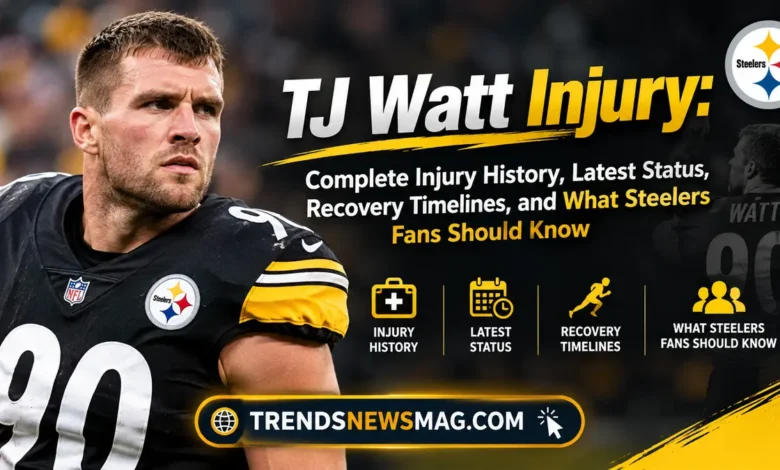
When a player as important as T.J. Watt appears on an injury report, the story immediately becomes bigger than one defensive player missing practice. Watt has been one of the defining pass rushers of his generation, and his availability can materially affect how the Pittsburgh Steelers structure their defense, generate pressure, and protect leads.


That is why searches surrounding TJ Watt Injury tend to spike whenever the Steelers report a physical issue, even when the underlying problem is relatively minor. Injury designations can also be misunderstood. Being listed as limited in practice does not automatically mean a player will miss a game, while being absent from practice can have very different implications depending on the type and severity of the injury.
A useful way to understand Watt’s health is to look beyond a single headline. His injury history includes knee, rib, shoulder, and ankle-related concerns, along with the normal wear associated with playing an unusually demanding position. The distinction between a confirmed diagnosis, a practice limitation, a game-time decision, and a precautionary absence is especially important.
This guide examines the documented history around Watt’s injuries, explains how those injuries can affect an elite edge rusher, and shows how fans can interpret future updates without jumping to conclusions.
Why TJ Watt Injury Updates Matter So Much to Pittsburgh
The Steelers’ defense has been built around creating pressure without constantly having to manufacture it through complicated blitz packages. Watt is central to that approach. When he can win one-on-one against an offensive tackle, Pittsburgh can send fewer extra rushers and keep more defenders in coverage.
That makes his health strategically significant. A replacement linebacker or edge defender does not simply have to reproduce Watt’s sack total. The replacement also has to occupy blockers, set the edge against the run, collapse the pocket, force quarterbacks off their spot, and influence protection schemes. Even when Watt does not record a sack, opposing offenses frequently account for him before the snap.
Watt’s production provides useful context. He has been a multiple-time All-Pro selection and won the NFL Defensive Player of the Year award for the 2021 season after tying the single-season NFL sack record with 22.5 sacks. Those achievements explain why an injury involving him receives disproportionate attention.
There is also a psychological component for opponents. A dominant edge rusher changes offensive play-calling. Quarterbacks may release the ball faster, running backs may stay in protection, and tackles may receive additional help. Consequently, the effect of Watt’s absence can be larger than what appears in the box score.
TJ Watt Injury History and the Major Health Concerns
Watt’s professional career has included several notable injury episodes, although it is important to distinguish between injuries that ended a season, injuries that caused missed games, and smaller ailments that affected practice participation.
One of the most significant setbacks came in 2017, his rookie season, when Watt suffered a groin injury that caused him to miss Pittsburgh’s regular-season finale. The problem did not define his career, but it illustrates an important point about edge rushers: groin and lower-body issues can affect the explosive lateral movement required to turn the corner around an offensive tackle.
In 2020, Watt dealt with a knee issue during the season. He continued to play through the problem, reinforcing the broader pattern of availability that became associated with his early career. Playing through an injury does not mean the condition was insignificant; it simply means the medical and performance teams determined that participation remained possible.
The most consequential episode occurred during the 2022 season, when Watt suffered a torn pectoral muscle against the Cincinnati Bengals in Week 1. The injury required surgery and kept him out for a substantial portion of the season. He ultimately returned later that year, but the recovery illustrated how different soft-tissue and muscle injuries can be from routine weekly soreness.
A pectoral injury is particularly relevant for a pass rusher because the upper body is involved in nearly every aspect of the position. Edge defenders use their hands to strike offensive linemen, separate from blocks, convert speed to power, and finish tackles. A repaired muscle therefore needs to withstand repeated high-force movements rather than simply tolerate normal daily activity.
Watt has also experienced ankle-related concerns and other lower-body issues at different points in his career. These deserve careful interpretation because an ankle problem can range from relatively manageable soreness to a significant ligament injury. The phrase “ankle injury” alone does not provide enough information to predict a player’s availability.
A Timeline of Notable TJ Watt Injury Issues
Looking at the broader timeline helps separate isolated setbacks from recurring patterns. The table below focuses on major, publicly documented injury episodes rather than every routine practice designation.
| Season | Injury or issue | General impact | Why it mattered |
|---|---|---|---|
| 2017 | Groin injury | Missed late-season action | Lower-body explosiveness is crucial for edge rushing |
| 2020 | Knee issue | Played through the problem | Demonstrated ability to remain productive while limited |
| 2021 | Various minor concerns | Generally remained highly available | Produced one of the most dominant defensive seasons in NFL history |
| 2022 | Torn pectoral muscle | Missed substantial time | Required surgery and interrupted his season |
| 2023 | Lower-body/ankle-related concerns | Managed during the season | Highlighted the physical demands of his position |
| 2024 | Ankle-related injury concerns | Monitored around game availability | Demonstrated why practice participation matters when evaluating status |
This timeline should not be interpreted as evidence that Watt has a single chronic injury. Professional football players frequently accumulate unrelated injuries over several seasons, particularly at positions involving constant collisions and explosive movements.
The more useful question is whether an injury has affected his mobility, strength, burst, or ability to finish plays. Those performance variables tell us more than the simple existence of an injury designation.
How a TJ Watt Injury Can Affect His Pass-Rushing Performance
For an elite edge defender, health is closely connected to biomechanics. Watt’s signature rushes often begin with explosive acceleration, but the final stage depends on ankle flexion, hip rotation, core stability, shoulder strength, and hand usage.
Consider a speed rush around the outside shoulder of an offensive tackle. Watt needs to explode from his stance, bend his body while maintaining balance, plant his outside foot, and then redirect toward the quarterback. A relatively small restriction in ankle or hip mobility can make that maneuver less efficient.
The same applies to his inside counter. Once an offensive tackle begins preparing for the outside rush, Watt can cross the tackle’s face or use a counter move. That requires quick deceleration and redirection. Lower-body discomfort can therefore affect not only raw speed but also the timing of his counters.
Upper-body injuries present a different problem. A pass rusher can have excellent foot speed and still struggle to finish if he cannot consistently use his hands to control the blocker. This was particularly relevant when considering his 2022 pectoral injury and recovery.
One practical way to assess the effect of an injury is to watch snap-to-snap movement rather than focusing exclusively on sacks. A player who records zero sacks may still be generating pressure, forcing quarterbacks to move, or attracting double teams. Conversely, a sack total alone cannot prove that a player is completely healthy.
What Happened With Watt’s 2022 Pectoral Injury
The 2022 pectoral injury remains one of the most important entries in Watt’s medical history because of its severity and timing. He suffered the injury during Pittsburgh’s Week 1 game against Cincinnati and subsequently underwent surgery.
The Steelers had to manage the situation carefully because pectoral injuries can require a substantial rehabilitation period. For an ordinary daily activity, strength recovery might be measured very differently from the requirements of an NFL defensive lineman or linebacker. Watt needed enough strength and confidence to repeatedly engage offensive linemen at full speed.
His eventual return demonstrated why rehabilitation timelines should be treated as ranges rather than guarantees. Medical recovery is not simply a countdown from surgery to a predetermined date. Strength, range of motion, healing, conditioning, contact tolerance, and confidence all matter.
The episode also illustrates why early reports about a player’s timetable can change. Initial estimates are often based on typical recovery patterns, while the actual return depends on the individual’s progress. A player may be medically cleared but still require careful management of workload.
For fans following TJ Watt Injury news, the key lesson is straightforward: the type of injury is only the beginning of the story. Surgery, rehabilitation, practice participation, contact work, and eventual game workload each provide different information.
How Ankle Problems Can Affect an Elite Edge Rusher
Ankle injuries deserve special attention in Watt’s case because his position depends heavily on lower-body leverage. Edge rushers must repeatedly plant, cut, accelerate, stop, and bend while absorbing contact from much larger offensive linemen.
A mild ankle sprain may permit a player to practice and play with manageable limitations. A more serious ligament injury can produce a completely different recovery timeline. Swelling, stability, pain tolerance, and the player’s ability to generate force through the affected foot all influence the decision.
There is also a difference between being available and being unrestricted. A player can suit up while having his snap count monitored. Coaches may reduce certain packages, avoid unnecessary special-teams work, or adjust practice repetitions.
That distinction is important when interpreting TJ Watt Injury reports. A player listed as questionable is not necessarily expected to miss the game, and a player listed as probable in older reporting terminology was never a guarantee of full health. Official game-status designations should be considered alongside practice participation and the team’s comments.
How to Read a Steelers Injury Report Correctly
NFL injury reports are designed to communicate participation status, but they are not complete medical charts. The terms “limited,” “full,” and “did not participate” describe practice involvement rather than providing a detailed diagnosis.
A player who does not participate in a Wednesday practice may have a completely different outlook from a player who misses Friday’s practice. Teams frequently manage veteran players, especially during long seasons, and practice schedules can be influenced by game preparation.
The progression matters. If Watt moves from no practice to limited participation and then full participation, that sequence provides more information than any isolated designation.
Game status is another important layer. If a player is officially listed as questionable, the designation means there is uncertainty regarding availability; it does not mean the player is definitely out. Teams can make final decisions close to kickoff.
The best approach is therefore to compare official Steelers communications with NFL reporting and reputable beat reporters. For broader player statistics and career information, Pro Football Reference is also a useful reference point.
What Watt’s Injury History Says About Durability
It would be misleading to describe a long NFL career as either “injury-free” or “injury-prone” based on a handful of headline events. Football is a collision sport, and players at Watt’s position experience repeated stress to the ankles, knees, hips, shoulders, hands, and upper body.
The more informative measure is availability over time and the severity of individual injuries. Watt played through various issues during his career and remained one of Pittsburgh’s most productive defensive players.
His 2021 campaign is a useful example. Despite dealing with injuries during the season, he finished with 22.5 sacks, tying Michael Strahan’s then-standing single-season record. The achievement demonstrated that the presence of an injury designation does not necessarily prevent elite production.
At the same time, the 2022 pectoral injury showed that some injuries cannot simply be managed on a week-to-week basis. The distinction between an injury that can be played through and one requiring surgery is enormous.
For that reason, discussions about TJ Watt Injury should avoid treating every missed practice as evidence of a long-term problem. Context is critical.
Why the Steelers Have So Much at Stake When Watt Is Limited
Pittsburgh can compensate for the temporary absence of an individual defender by redistributing snaps, changing pressure concepts, and asking other pass rushers to take on larger roles. But replacing Watt’s complete impact is considerably harder.
His presence influences protection schemes before the snap. Offensive coordinators may leave a running back in protection or use a tight end to chip him. That means another Steelers defender can potentially receive a more favorable matchup elsewhere.
Watt’s impact also extends to run defense. Although he is primarily celebrated for his pass rushing, setting the edge is a fundamental responsibility for an outside linebacker. A player recovering from an ankle or lower-body problem may therefore face challenges in both rushing the passer and maintaining leverage against the run.
This is why statistics such as pressures, quarterback hits, sacks, tackles for loss, forced fumbles, and snap percentage should be viewed together. No single number captures the entire defensive impact.
A healthy Watt also gives Pittsburgh flexibility. The Steelers can rush four defenders and keep more players in coverage, or they can create exotic pressure packages knowing that Watt remains a major threat. When he is unavailable, those strategic options can narrow.
How Long Does a TJ Watt Injury Usually Take to Heal?
There is no universal recovery period because the term “injury” covers a huge range of conditions. A minor ankle sprain, a significant ligament injury, a muscle strain, and a surgically repaired tendon or muscle can have completely different timelines.
For example, a mild soft-tissue problem may improve within days or weeks, while a major surgical injury can require months of rehabilitation. The player’s position also matters because returning to general athletic activity is not the same as returning to NFL-level contact.
Watt’s 2022 pectoral injury is a particularly useful example. His recovery required surgery, rehabilitation, and a gradual return to football activities. The process involved more than simply waiting for pain to disappear.
When evaluating a new TJ Watt Injury, fans should therefore pay attention to the medical description and subsequent practice progression rather than relying on a generic timeline found online.
Another important factor is reinjury risk. Medical staffs may gradually increase workload after a player returns, even when the player is officially active. A snap count that increases over several games can be a deliberate part of the rehabilitation strategy.
How Fantasy Football Players Should Interpret Watt’s Injury Status
For fantasy football managers, Watt’s health matters primarily because defensive scoring formats can reward sacks, tackles, forced fumbles, and turnovers. However, defensive player statistics vary significantly by league settings.
An injury can reduce opportunity before it reduces production. If Watt is limited to fewer snaps, he may have fewer chances to generate pressures and sacks. On the other hand, an opponent that heavily focuses protection on him can create opportunities for other Pittsburgh defenders.
Fantasy managers should also avoid assuming that a player’s previous injury automatically predicts future performance. Different injuries affect different physical attributes, and rehabilitation can restore performance over time.
The most useful approach is to confirm the official game status shortly before kickoff and then examine expected workload. In leagues where defensive players are individually rostered, replacement options should be evaluated according to matchup, snap expectation, and role rather than simply choosing the next player listed on Pittsburgh’s depth chart.
The Difference Between Injury News and Injury Speculation
Modern sports coverage moves extremely quickly. A player can trend on social media within minutes of leaving practice, even when the team has released no diagnosis.
That creates an important distinction between confirmed information and speculation. An official team announcement, NFL injury report, or direct quote from a coach or player carries a different evidentiary weight from an anonymous social-media post.
This matters especially for TJ Watt Injury searches because Watt is a high-profile player. A photograph showing him wearing tape or walking differently may prompt extensive discussion, but an image alone cannot establish a diagnosis.
Similarly, a reporter saying that Watt “looked limited” at practice is useful observational information, but it does not necessarily reveal why he was limited. The most responsible reporting separates observation from medical interpretation.
For readers, the best habit is to ask three questions: What has actually been confirmed? Who confirmed it? What changed from the previous report? Those questions can eliminate much of the confusion surrounding weekly NFL injury news.
What Fans Should Watch in Future Watt Injury Updates
The most meaningful future updates will generally involve practice participation, official game status, workload, and performance. Those four pieces of information can reveal much more than a headline alone.
Practice participation shows whether the player is progressing toward normal football activity. Game status indicates whether the team expects him to be available. Workload reveals whether he is being managed after returning. Performance can then show whether the injury is affecting his explosiveness or technique.
For example, if Watt progresses through a full practice week and plays his normal number of snaps, that provides considerably more evidence of functional recovery than a vague report saying he “feels better.”
Conversely, a player can be listed as active but have a noticeably reduced role. That does not necessarily indicate a setback; coaches and medical staffs sometimes deliberately control workload.
The broader context should always include the opponent and game situation. A player returning from an injury may receive fewer snaps in a blowout, while a close game can require a heavier workload. Snap counts should therefore be interpreted alongside circumstances.
Where to Find Reliable Information About Watt’s Health
The Steelers’ official website and NFL communications are appropriate starting points for confirmed team information. League injury reports provide standardized participation information, while reputable beat reporters can add context from practices and press conferences.
NFL coverage can be found through the official NFL website, while broader biographical information is available through Wikipedia’s T. J. Watt page. These sources serve different purposes, so they should not be treated as interchangeable medical authorities.
Medical details deserve particular caution. Unless a diagnosis has been officially announced or reported by a reputable journalist citing a credible source, readers should avoid treating social-media speculation as fact.
For serious injury questions, the relevant medical professionals are the appropriate authority. Sports articles can explain mechanisms, recovery concepts, and publicly reported timelines, but they cannot replace an individualized medical assessment.
What T.J. Watt’s Career Reveals About Playing Through Injury
One of the most interesting aspects of Watt’s career is the relationship between availability and performance. Elite athletes often compete with conditions that would prevent ordinary physical activity, but that does not mean the injury is irrelevant.
Playing through an injury can require technical adjustments. A pass rusher might rely more heavily on one move, avoid certain movements, or modify how aggressively he bends around the corner. The player may still produce, but the underlying physical demands can be different.
This is another reason sack totals alone can be deceptive. Suppose an edge rusher records two sacks while playing through an ankle problem. Those sacks demonstrate that the player was productive, but they do not prove that the ankle had no effect on his movement.
Watt’s career is also a reminder that recovery is not always linear. A player can improve rapidly, experience soreness after increased workload, and then return to full participation without that temporary setback representing a serious complication.
That nuance is essential whenever TJ Watt Injury becomes a major NFL storyline.
The Bigger Picture for Pittsburgh’s Defensive Future
Watt’s importance to Pittsburgh extends beyond any single season. The Steelers have traditionally valued defensive pressure, physicality, and the ability to create disruption without compromising coverage.
An elite edge rusher makes that philosophy easier to execute. When Watt is healthy, opposing offenses must devote significant attention to him. That can influence protection calls, personnel groupings, quarterback timing, and the opportunities available to other defenders.
His absence does not automatically determine a game’s outcome. Football is too interconnected for one player to dictate an entire result. But his availability changes the strategic environment in which the defense operates.
For Pittsburgh, the ideal scenario after any significant injury is not simply getting Watt back onto the field. It is getting him back at a workload and movement level that allows the coaching staff to use the full defensive playbook.
That distinction between “active” and “fully functional” is one of the most useful concepts for understanding NFL injury reporting.
Conclusion: Understanding TJ Watt Injury News Without the Noise
The most important lesson from the history of TJ Watt Injury reports is that context matters more than headlines. Watt has dealt with several injuries during his NFL career, including the serious pectoral injury that interrupted his 2022 season, as well as lower-body and other issues that have affected practice participation at various points.
Yet an injury designation by itself cannot tell the whole story. The type of injury, practice progression, official game status, snap count, and on-field movement all provide different pieces of information.
For fans, fantasy managers, and NFL analysts, the smartest way to follow Watt’s health is to prioritize verified reports and watch how the situation develops. A limited practice does not automatically mean a missed game, just as being active does not necessarily mean a player is operating at 100 percent.
Watt’s value to Pittsburgh comes from more than sacks. His presence changes protection schemes, creates opportunities for teammates, supports the run defense, and gives the Steelers greater flexibility with their coverage and pressure packages. That is why every significant health update receives so much attention.
For authoritative background and career information, readers can consult the NFL’s official player profile for T.J. Watt and Pro Football Reference, while current game-week status should be confirmed through official Steelers and NFL injury reporting.
Is TJ Watt currently injured?
The answer depends on the specific date and the latest official injury report. NFL player status can change rapidly during a game week, so a historical article should not be treated as a real-time medical update. For the latest TJ Watt Injury information, readers should check the current Pittsburgh Steelers and NFL reports before relying on older coverage.
What was T.J. Watt’s most serious NFL injury?
Watt’s torn pectoral muscle in Week 1 of the 2022 season was one of the most significant injuries of his career. The injury required surgery and caused him to miss a substantial portion of the season. His eventual return required rehabilitation and a gradual progression back to NFL competition.
How long was T.J. Watt out with his pectoral injury?
Watt missed several weeks following the 2022 pectoral injury and returned later in the regular season. The precise recovery timeline is a useful example of why major injuries should not be reduced to a simple calendar estimate. Surgical recovery, rehabilitation, strength restoration, football conditioning, and medical clearance all influence when a player can safely return.
Has T.J. Watt had ankle injuries?
Ankle-related concerns have appeared during Watt’s career, including periods when his practice participation or game preparation was affected. An ankle problem can vary considerably in severity, so the term alone does not establish whether a player will miss a game or experience a long-term absence.
Does an injury affect Watt’s sack production?
It can. Sack production depends heavily on acceleration, flexibility, balance, hand strength, leverage, and the ability to change direction. A lower-body injury may affect cornering and acceleration, while an upper-body injury can affect hand fighting and finishing strength. However, sack totals alone cannot establish whether an injury is limiting a player.
Why does T.J. Watt’s availability matter so much to the Steelers?
Watt is a central component of Pittsburgh’s pass rush and defensive structure. His ability to pressure quarterbacks with a relatively small number of rushers allows the Steelers to devote more defenders to coverage and other responsibilities. When he is unavailable or limited, the team may need to redistribute pass-rush responsibilities or alter its defensive approach.
Where can fans verify the latest TJ Watt Injury report?
The best places to verify current status are official Pittsburgh Steelers and NFL communications, followed by established NFL reporters who cite team or league sources. Practice participation and official game-status designations are more reliable than social-media speculation. For career statistics and historical information, Pro Football Reference and the NFL’s official player profile are useful supplementary resources.
Trending Today: Why Technology Cannot Replace Humans Roartechmental: The Human Qualities Machines Still Cannot Replicate