Tommy Jacobs Gaming Eyexcon: What This Trending Gaming Term Actually Means (And Why Sources Disagree)

If you’ve spent any time scrolling through gaming blogs or tech roundups lately, you’ve probably noticed a name popping up with increasing frequency: Tommy Jacobs Gaming Eyexcon. It shows up in headlines promising “the future of esports,” in guides claiming to explain a revolutionary eye-tracking device, and in convention recaps describing a community-driven gaming expo. The problem is that these descriptions don’t agree with each other. One article will tell you Tommy Jacobs Gaming Eyexcon is a piece of hardware that tracks your eye movements at 240Hz. Another will tell you it’s an annual convention built around accessibility and indie developer support. A third will describe it as a vague “performance enhancement concept” that doesn’t map to any specific product at all.
That kind of inconsistency is unusual for anything genuinely established in the gaming industry. When a real hardware brand or a real convention exists, you can typically find a consistent origin story, a company registration, retailer listings, press coverage from established gaming outlets, or at minimum a working website with verifiable details. With Tommy Jacobs Gaming Eyexcon, none of that lines up cleanly. So before diving into the different versions of the story circulating online, it’s worth being upfront: this article treats Tommy Jacobs Gaming Eyexcon as exactly what the evidence suggests it currently is — a fast-spreading online term with multiple competing, unverified narratives attached to it, rather than a single confirmed product, person, or event. That distinction matters, and it’s the lens through which everything below should be read.
The Conflicting Stories Behind Tommy Jacobs Gaming Eyexcon
The first thing that becomes obvious when you research Tommy Jacobs Gaming Eyexcon across multiple sources is that there isn’t one story — there are at least three, and they don’t fit together. The first narrative frames Tommy Jacobs as a grassroots community organizer whose journey began with childhood fascination for game mechanics, who ran small local meetups and tournaments, and who eventually built those experiences into a full-scale convention called Eyexcon. In this version, Tommy Jacobs Gaming Eyexcon is an event with workshops, indie developer demo zones, accessibility initiatives, and career mentorship tracks. It reads like a fairly standard “passionate fan builds a convention” origin story, the kind that’s been told about dozens of real gaming expos over the years.
The second narrative is entirely different. Here, Tommy Jacobs is described as a hardware inventor with roughly fifteen years of experience in esports coaching and UX design, who built Eyexcon as a literal piece of optical tracking hardware. This version claims the device uses a 240Hz refresh rate to translate eye movements into in-game actions in under five milliseconds, that it plugs into PlayStation, Xbox, and Nintendo systems without extra drivers, and that it includes a feature called “VisionSync” which monitors blink rates and adjusts screen brightness. Some versions of this story even mix in promotional language for an apparently unrelated brand, suggesting these articles may have been assembled by stitching together unrelated marketing copy rather than reporting on a real product. A third narrative is vaguer still, describing Tommy Jacobs Gaming Eyexcon as a general “framework” for improving game responsiveness and visual smoothness, without naming any specific hardware, software, or event at all. When three supposedly factual descriptions of the same name contradict each other this significantly, the most reasonable conclusion is that none of them reflects a verified reality, and that what you’re actually looking at is a term that gained traction online before anyone agreed on what it was supposed to describe.
Why Eye-Tracking Technology Is a Believable Hook for This Term
Even though the specific claims about Tommy Jacobs Gaming Eyexcon don’t check out, it’s worth understanding why eye-tracking made for such a convincing premise in the first place. Eye-tracking technology is real, it has existed in gaming and accessibility contexts for years, and it genuinely does offer interesting possibilities for how people interact with screens. Companies like Tobii have shipped consumer eye-tracking peripherals for PC gaming since the 2010s, allowing players to look toward a point on screen and have the camera aim follow their gaze, supplementing rather than replacing a mouse or controller. These devices use infrared sensors to map where your pupils are pointed, and they’ve found real use cases in flight simulators, strategy games, and accessibility setups for players with limited mobility.
That established, legitimate technology is precisely what makes a fabricated story like Tommy Jacobs Gaming Eyexcon plausible-sounding to a casual reader. The vocabulary used across these articles — gaze prediction, saccadic movement, low-latency tracking, biometric input — is borrowed almost directly from real eye-tracking research and existing consumer products. A reader who has heard of Tobii or who knows that the PlayStation and Xbox accessibility settings already support some gaze-based features will find claims about Tommy Jacobs Gaming Eyexcon easier to accept, because they sound like a natural next step rather than something invented from scratch. This is a pattern worth recognizing generally: content built around a fabricated brand often borrows real, verifiable technical language to create a sense of legitimacy, even when the specific product or person being described can’t be traced to any primary source. Genuine reaction-time statistics, like the oft-cited figure that professional first-person shooter players average reaction times in the low 200-millisecond range, get folded into the narrative to make hardware claims feel grounded in real research, even when the hardware itself has no verifiable existence.
What a Search for Verifiable Information Actually Turns Up
When you try to verify Tommy Jacobs Gaming Eyexcon through the channels that would normally confirm a real hardware brand or convention, the trail goes cold fast. There’s no listing on major gaming hardware retailers. There’s no press coverage from outlets that typically cover new gaming peripherals first, the kind of publications that get hands-on review units before a product launches. There’s no event listing on convention-tracking sites that catalog gaming expos by date and location. There’s no business registration, trademark filing, or social media presence with verified followers and a consistent posting history that would normally accompany a hardware company or annual convention with “global recognition,” as some of the more enthusiastic articles claim.
What you do find is a cluster of blog posts, most published within a tight window in early-to-mid 2026, all describing Tommy Jacobs Gaming Eyexcon using overlapping but inconsistent language. Several of these posts reuse nearly identical sentences and phrases — descriptions of childhood fascination with “the underlying mechanics of games,” references to “groundwork” laid through local meetups, and the same three-pillar structure of reducing participation barriers, practical learning, and creator upskilling. This kind of repetition across supposedly independent sources, combined with the complete absence of primary verification, is one of the more reliable signals that a term originated as content designed to rank in search results rather than to report on something that actually exists. It doesn’t necessarily mean malicious intent on anyone’s part, but it does mean readers should treat any specific factual claim attached to Tommy Jacobs Gaming Eyexcon with real skepticism until an independent, verifiable source confirms it.
How This Compares to Legitimate Gaming Conventions and Hardware Launches
It helps to look at what a real gaming convention launch or hardware release actually looks like, so the gap becomes obvious. Take PAX, EVO, or Gamescom as reference points for conventions. Each has a documented founding history, registered organizing entity, ticketing infrastructure, year-over-year attendance figures reported by independent outlets, and a physical venue that can be verified through public records. Hardware launches follow a similarly traceable pattern: a company files for trademarks, sends review units to established outlets like IGN, The Verge, or Polygon ahead of launch, lists the product through retailers with SKUs and warranty information, and typically has founders with a documented professional history on platforms like LinkedIn or in prior industry coverage.
| Verification Signal | Real Gaming Convention (e.g., PAX) | Real Hardware Brand (e.g., Tobii Gaming) | Tommy Jacobs Gaming Eyexcon |
|---|---|---|---|
| Registered business entity | Yes, publicly documented | Yes, publicly documented | Not found |
| Independent press coverage | Extensive, multi-outlet | Extensive, multi-outlet | None found in major gaming press |
| Consistent founder biography | Consistent across sources | Consistent across sources | Changes between sources |
| Retailer or ticketing listings | Verifiable | Verifiable | None found |
| Social media with verified history | Active, longstanding | Active, longstanding | Not found |
| Core product/event description | Consistent | Consistent | Contradicts itself across articles |
This table isn’t meant to suggest every legitimate gaming product or event needs to pass every single one of these checks before it’s worth taking seriously — plenty of small, genuinely real indie projects start without major press coverage. But when none of these signals are present, and the descriptions of what the thing even is keep changing depending on which article you read, that combination is a meaningfully different situation than an under-the-radar but real project. As one longtime gaming journalist put it when discussing how to evaluate unfamiliar gaming brands, “if you can’t find the company behind a product anywhere except blog posts that all sound the same, that’s not an obscure gem — that’s a red flag.” That kind of instinct applies directly here.
The Role of SEO Content Farming in Spreading Unverified Terms
Understanding why something like Tommy Jacobs Gaming Eyexcon spreads requires understanding a little about how search-driven content economics work. When a search term starts generating curiosity, even a small amount, it creates an opportunity for websites to publish content that ranks for that term and captures the resulting traffic. If the term is genuinely novel or has limited existing coverage, there’s relatively little competition to outrank, which makes it especially attractive to publish about quickly, even before there’s a clear, verified definition for what the term actually refers to. This creates a strange feedback loop: the less verified something is, the more loosely different sites are free to describe it, and the more those descriptions diverge from each other.
This isn’t a new phenomenon, and gaming culture has seen versions of it before — rumored game features, fake leaks, and “insider” hardware speculation have circulated through gaming forums for decades. What’s different now is the speed and volume at which this kind of content can appear across many websites in a short window, often using strikingly similar sentence structures and the same handful of statistics, like reaction-time figures or refresh-rate numbers, recycled from article to article. For an average reader, this can make an unverified term feel more credible simply because so many results show up when you search for it. Volume of search results is not the same as evidence, though, and that distinction is worth keeping in mind anytime a name surfaces across many gaming blogs simultaneously without a single primary, verifiable source behind it. Readers researching Tommy Jacobs Gaming Eyexcon specifically should notice that the volume of articles about it is not matched by any independent confirmation of who Tommy Jacobs is, what company (if any) makes the supposed hardware, or what organization runs the supposed convention.
What Real Eye-Tracking and Accessibility Gaming Tools Actually Offer
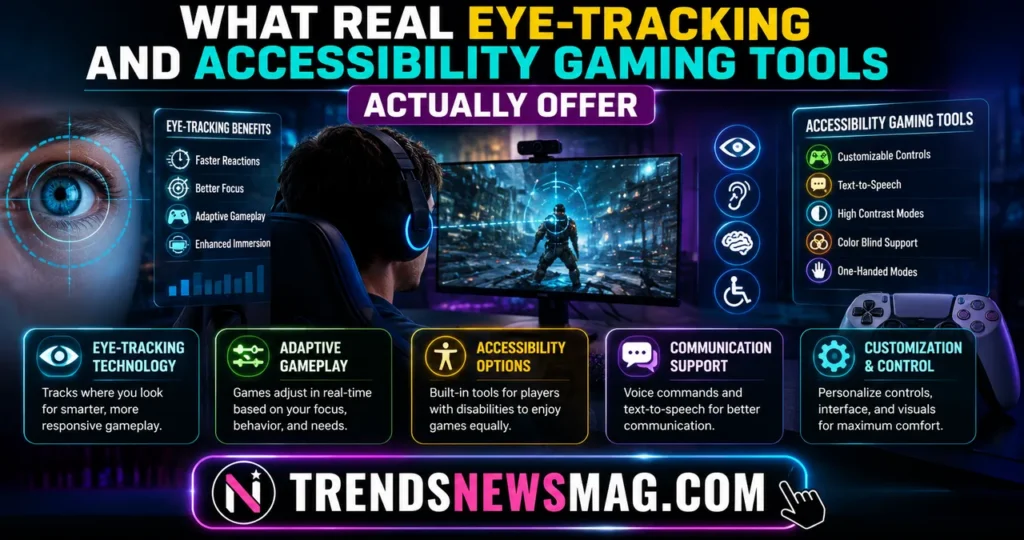
Since the eye-tracking angle is central to several versions of the Tommy Jacobs Gaming Eyexcon story, it’s worth spending real time on what legitimate eye-tracking gaming technology actually does, since that context is genuinely useful regardless of where this particular term came from. Eye-tracking input for games generally falls into a few practical categories. The first is aim-assist and camera control, where your gaze direction nudges where the camera or crosshair points, layered on top of traditional controller or mouse input rather than replacing it entirely. The second is foveated rendering, a technique used in some VR headsets where the system renders the area you’re directly looking at in higher detail than your peripheral vision, saving processing power without a noticeable quality loss. The third is accessibility-focused gaze control, which allows players with limited hand mobility to navigate menus, aim, or even type using eye movement alone.
These real applications share a few common traits that any claimed eye-tracking product should be able to demonstrate. They require calibration specific to an individual’s eyes, since pupil position and head geometry vary significantly between people. They depend on consistent lighting conditions, since infrared tracking can be thrown off by glare or extreme brightness. And critically, none of the mainstream, verified consumer eye-tracking products on the market today have eliminated the need for any physical input device entirely in competitive gaming contexts, despite some marketing language suggesting otherwise. Claims describing Tommy Jacobs Gaming Eyexcon as something that replaces controllers entirely with pure gaze input, while achieving sub-five-millisecond response times, go considerably further than what publicly demonstrated, peer-reviewed, or independently reviewed eye-tracking technology has achieved as of today. That doesn’t make rapid future progress impossible, but it does mean those specific numbers shouldn’t be taken as an established fact about an existing product.
How to Evaluate Unfamiliar Gaming Brands and Convention Names Going Forward
Given how often new gaming hardware, conventions, and personalities genuinely do emerge, it’s useful to walk away from this with a practical framework rather than just suspicion about one specific term. The first thing worth checking is whether the name appears in coverage from outlets with an established editorial reputation in gaming, places where independent reporters and reviewers have a track record of testing hardware or attending events before writing about them. A genuinely new but small indie convention might not have massive press coverage, but it should still have a verifiable venue, ticketing page, or social presence with a real history rather than a brand-new account.
The second thing worth checking is whether the founding story stays consistent. Real people and real companies have one biography, not three different ones depending on which website you land on. If one source says someone has fifteen years in esports coaching and another describes the same person as a convention organizer with no hardware background at all, that’s not a quirky discrepancy — it’s a sign the underlying story isn’t anchored to a verified person. Third, look for primary sources: an actual company website with a working “about” page, a LinkedIn profile with a consistent employment history, retailer listings with reviews from verified purchasers, or social media accounts with engagement history that predates the surge of blog coverage. The absence of all of these, as is currently the case with Tommy Jacobs Gaming Eyexcon, is meaningfully different from a small project simply being under the radar. None of this means every unfamiliar gaming term is fabricated. It means unfamiliar terms deserve the same basic verification habits you’d apply to any other claim before treating it as established fact, and that habit serves readers well whether the next trending name turns out to be completely legitimate or, like this one currently appears to be, unverifiable.
Conclusion
Tommy Jacobs Gaming Eyexcon is a useful case study in how quickly an unverified name can spread across gaming content without ever being pinned down to a single, consistent, confirmed reality. Depending on which article you read, it’s described as a community convention, a piece of biometric hardware, or a vague performance-enhancement framework, and these descriptions actively contradict one another rather than simply offering different angles on the same confirmed thing. No independent press coverage, retailer listing, business registration, or verifiable social presence currently supports any of these versions. The eye-tracking technology referenced throughout these articles is real and genuinely interesting, with legitimate applications in accessibility, VR rendering efficiency, and supplementary aim control, but the specific claims made about Tommy Jacobs Gaming Eyexcon go well beyond what’s been independently demonstrated by any verified product on the market. The most useful takeaway isn’t really about this one term specifically. It’s the broader habit of checking for primary sources, consistent biographical details, and independent verification before treating any fast-spreading gaming name as established fact, whether that’s Tommy Jacobs Gaming Eyexcon or whatever name follows the same pattern next.
FAQs
What is Tommy Jacobs Gaming Eyexcon actually supposed to be?
Depending on the source, Tommy Jacobs Gaming Eyexcon is described as a community-driven gaming convention, a piece of eye-tracking hardware that replaces controller input, or a vague concept related to improving gaming performance and visuals. These descriptions contradict each other in meaningful ways, and none of them are backed by independent press coverage, retailer listings, or verifiable business records, so it’s best understood currently as an unverified term rather than a confirmed product or event.
Is there a real person named Tommy Jacobs behind this?
There’s no independently verifiable biography for a Tommy Jacobs connected to gaming hardware or convention organizing that matches the claims circulating online. Different articles describe entirely different professional backgrounds for him, ranging from a grassroots convention organizer to a fifteen-year esports hardware veteran, and these versions don’t reconcile with each other, which suggests the name hasn’t been tied to a single, confirmed individual through any primary source.
Does eye-tracking gaming hardware like this actually exist?
Real eye-tracking gaming hardware does exist, and companies like Tobii have sold consumer eye-tracking peripherals for years, primarily used for camera and aim assistance alongside traditional controls, plus accessibility applications for players with limited mobility. However, the specific capabilities attributed to Tommy Jacobs Gaming Eyexcon, including fully replacing controllers and achieving extremely low latency gaze-to-action translation, go beyond what’s been independently confirmed in any publicly available, reviewed product.
Why are there so many articles about Tommy Jacobs Gaming Eyexcon if it’s unverified?
When a search term starts generating curiosity, it becomes attractive for websites to publish quickly in order to capture search traffic, especially when there’s limited existing competing content to outrank. This can create a situation where many articles appear about a term in a short window, often reusing similar language and statistics, without any of them being anchored to a verified primary source, which is a pattern that fits what’s currently visible across coverage of Tommy Jacobs Gaming Eyexcon.
How can I tell if a gaming convention or hardware brand is legitimate?
Check for independent press coverage from established gaming outlets, a consistent founding story that doesn’t change between sources, verifiable retailer listings or ticketing pages, and a social media or business presence with a real history rather than one that appeared suddenly alongside a burst of blog coverage. If a name like Tommy Jacobs Gaming Eyexcon shows up across many articles but none of them agree on basic facts and none point to a primary, verifiable source, that’s a strong signal to treat the claims with caution rather than assuming legitimacy just because the term is widely discussed.
Should I be worried about scams related to Tommy Jacobs Gaming Eyexcon?
If you encounter anything asking for payment, personal information, or pre-orders tied to Tommy Jacobs Gaming Eyexcon, treat it with significant caution given the complete lack of verifiable business records, retailer presence, or independent confirmation behind the name. Legitimate hardware pre-orders and convention ticket sales are traceable through established payment processors and verifiable company information, so the absence of that kind of verifiable infrastructure here is a meaningful reason for caution rather than something to dismiss.
Trending Today: [Alexander Savin The Flying Elephant]